12/ People have told me before that inflation is what happens when the “economy is overheated” (too much spending/consumption) so increasing interest rates are a way to “cool down the economy”. But that makes zero sense for Norway right now.
13/ I don’t see any sign of the Norwegian economy being “overheated”. What I see is the opposite tbh. People seem to be struggling financially much more than I’ve seen in decades.
14/ What is a problem is that the NOK to USD/Euro exchange rate weak. So imports are more expensive. But to “fix” that the central bank has raised the interest rate. Which means people who were already struggling with higher prices now also get hit with higher interest rates.
15/ And young people and families are being hit the hardest because they are either renters (and rents are increasing because of the interest rates and the cooling of construction because of the higher import costs and higher intrest rates) or early homeowners with big mortgages.
16/ Meanwhile the politicians are on TV saying “Well Actually The Economy Is Going Great”. But the only sectors that seem to be doing great are those who are exporting (being paid in foreign currency) and that’s because they are raking in on the NOK being weak, and that’s not “the economy” that’s just gambling.
17/ So basically, I don’t see that the interest rate is the appropriate tool for strengthening the NOK. Except to put on a show for people who think Milton Friedman is a person who had anything reasonable to say.
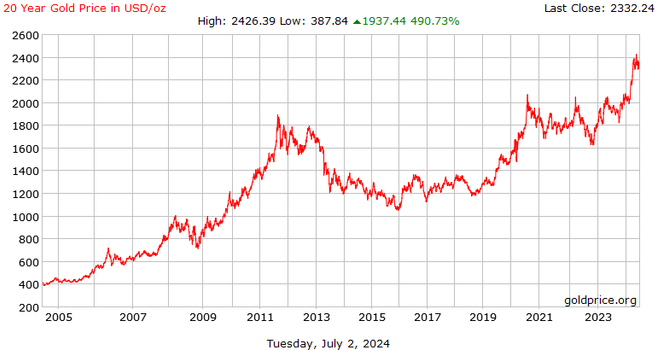
18/ In my opinion the most logical thing is that the NOK is down for the same reason gold is way up: people are scared. Russia invaded Ukraine, Israel is pushing for a regional war in the Middle East and… let’s be honest here: the US might elect a fascist dictator in a few months.
Basically NOBODY will make the decision to buy NOK no matter what the interest rate is. They are putting their money where they think it’s safe and that isn’t a tiny economy by the polar circle.
19/ I’m starting to conclude that this is yet another Friedman-model fuckup.
20/ To be honest, I’m not even sure that MMT would work for a tiny economy based mostly on imports of household goods and selling bottled up carbon emissions to the world.
21/ I am getting increasingly disillusioned with economics as an explanation model for anything other than a bunch of powerful people who like to hear themselves talk.
22/ And people are so keen on simple explanations they are willing to close their eyes to reality.
23/ One thing that is very Norwegian, and relevant here, we are a high-trust society. On every level. But for this particular matter: we trust our government much more than most other populations. And if they say the interest rate has to go up, we say: OK.
But what if they’re just wrong?
24/ but I think the currency lens is probably the right one, but not MMT (or maybe I’ll change my mind when I’m further in). From the little I have read we (the Norwegian government) are both the biggest buyers AND the biggest sellers of our own currency: we sell massive amounts of NOK to the oil companies, because they need it to pay tax, but now we have a lot of NOK that are mostly going into our sovereign wealth fund, which invests (mostly/exclusively?) outside of the country (I think this decision was specifically to not “heat up” the economy with too much money). But to invest abroad the sovereign wealth fund needs to sell a lot of NOK.
25/ so maybe we CAN influence the NOK, but not through interest rates, but rather by… reducing foreign investments by the sovereign wealth fund instead. Funnily enough this idea is based on the most basic economic theory: supply and demand.
26/ And all indicators are showing that it’s not working. The price of the NOK isn’t really being affected by the interest rate. It is being affected by What Everyone Else Is Doing. This weakness of the NOK doesn’t seem to have much to do with Norway at all. We’re just a too esoteric (and small) currency for a global market whose risk appetite is low.
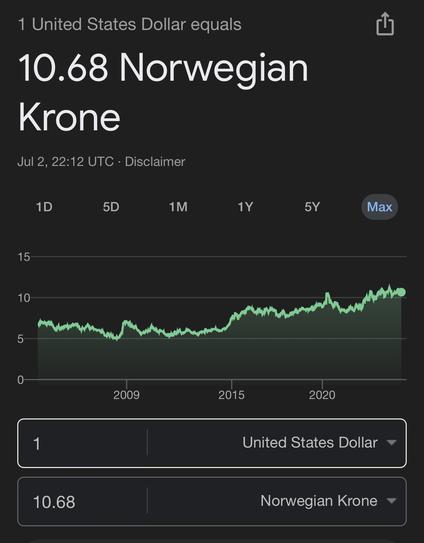
27/ Looking at the NOK vs USD and Euro and the gold price in dollars. When people are all in on gold they’re not buying the currency of “the capital of Sweden” (old joke about nobody knowing we exist)
28/ I love how much she uses the words “believe” and “faith” - gets across how religion-like it is.
29/ It’s clear to me now why they are using the interest rate. It is the only tool they have. They have one single knob, one single variable, so they have to use it even if they know that it won’t work against the problem they’re facing. Because it was never meant to solve the problem they’re facing.
More generally, I don’t know that importing a Friedman model from the US, which has a massive economy and The Most Popular currency, makes any sense for us.
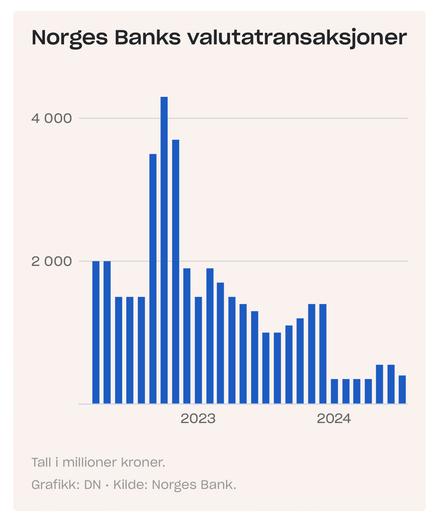
30/ Maybe they have been trying to do exactly what I’m saying here? Reducing the amount of NOK they are unloading onto the market.
https://www.dn.no/makrookonomi/norges-bank/makrookonomi/norges-bank-oker-kronesalget-til-550-mill-kroner-per-dag-i-mai/2-1-1635409
Norges Bank øker kronesalget til 550 mill. kroner per dag i mai
Etter fire måneder på rad med uendret kronesalg, økes beløpet i mai.
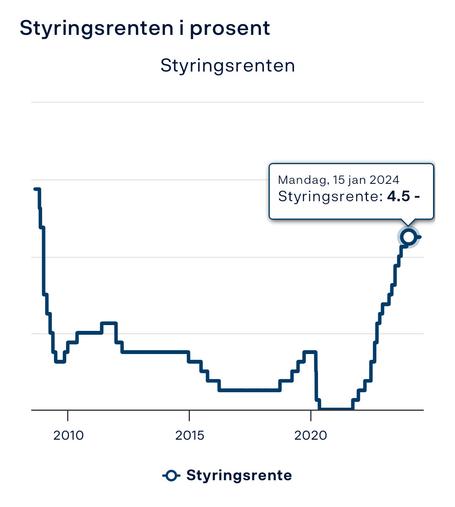
31/ Seems to correlate? This is the central banks “governing interest rate”
32/ Lol, looking at all these graphs together… it doesn’t seem to matter either. So maybe the problem is rather that there is no market for NOK right now. Only what we force into existence by making oil companies pay us in NOK for taxes.
33/ Which, to be fair, is fully in line with MMT: taxes’ primary purpose is to create demand for your own currency, not to fund anything.
34/ But then I don’t think there is any good reason for increasing interest rates. It is clearly not having any effect outside of making folks that were already struggling with increased food prices even more financially insecure.
35/ it’s funny how Norwegian newspapers and even the central bank are not even pretending this has anything to do with us. You want to know what numbers the Norwegian central bank is looking at to figure out if they can lower the Norwegian interest rate?
The unemployment rate in the United States of America.
https://e24.no/internasjonal-oekonomi/i/Xj6olo/viktige-jobbtall-kan-skyve-paa-rentehaapet-fed-har-tatt-feil-foer
https://www.nrk.no/ytring/det-haster-overhodet-ikke-med-rentekutt-1.16778904
https://www.norges-bank.no/contentassets/d0bfbe13692a4dc28d569698605e2c8d/ppr-2-24.pdf?v=20062024135632

Viktige jobbtall kan skyve på rentehåpet: – Fed har tatt feil før
Amerikanske jobbtall kan skyve på forventningene om rentekutt i USA, men det er prisveksten som bekymrer Storebrand-forvalter Olav Chen.
36/ Turns out that the pre-Friedman King of Economy, John Maynard Keynes, agreed with me (according to the book), or the quote is about the opposite (about lowering the interest rate to make people take out loans)… but it turns out to be kind of the same for the NOK 🤪
“You can’t push on a string”
Turns out that perhaps the quote is misattributed 😅
https://en.wikipedia.org/wiki/Pushing_on_a_string
My point being: you can try to make your currency attractive, but you can’t make people buy it.
And I posit that the NOK is weak because the planet is fucked and everybody knows it.
Pushing on a string - Wikipedia

How George Soros Broke the Bank of England
38/ Apparently one of the things you can do in our situation is to increase salaries. Because the currency thing is making goods a lot more expensive an increase in salaries could make that gap smaller. And we did that. Sort of. The government blessed a really good deal between the employers and the unions.
39/ However, here we meet another weird dynamic: in Norwegian union “culture” they negotiate first with the export industry. Because the thinking goes that they are more sensitive because they are exposed to currency fluctuations. But remember they are raking it in on the currency exchange. So now that deal is pretty great for workers. But… the rest of the Norwegian economy is not great and they get hit with yet another blow: first imports got way more expensive, then the interest rates shot up (absolutely doing its job of cooling our not-hot economy) and now salaries shoot up.
40/ And one sector is particularly vulnerable: construction. Because:
1. Materials (imported) are much more expensive
2. Interest rates are way up, so a lot of projects are halted due to financing
3. They are dominated by highly unionized workers and their salaries just went up (because the unions didn’t negotiate with them, they negotiated with the swimming in money export sector)
So all sorts of companies associated with construction are going bankrupt.
41/ Which means, as
@intargapoints out, housing prices are not going down as we expected.
https://hachyderm.io/@intarga/112719682482183505@[email protected]
I find the interest rate situation in Norway extra annoying, because even with it not working to bring down inflation, the one silver lining it should have had was to cool the housing market. Instead, house prices are still going up because we completely stopped building 🙄🙄🙄
42/ The interest rate hikes are making a hard situation worse by “cooling” the wrong economy. We are getting a higher interest rate because America has lower unemployment (I am really happy for y’all though).
43/ And that gets us the whole “what is inflation?”. Because if it is that it is harder to make ends meet because everything is more expensive. Then they are actually creating MORE inflation.
Yeah, we are exposed to the exchange rate, but now we are killing the economy that’s supposed to compensate, while driving actual living costs even further through the roof.
44/ Housing is also a weird market in general, because once you’re in, you buy and sell in the same market. So that market becomes sort of disconnected from everything else. Because demand is constant and supply is pretty constrained: the people selling their homes and newly built stuff.
But with no construction the supply is even more constrained, and the people buying are mostly the people selling, so it becomes a strange closed loop system.
45/ However, if you are a renter you are also getting hit, again by different effects. The current left coalition (and previous iterations) have wanted to make it less lucrative to be a landlord. So margins have shrunk due to higher taxes etc. But a lot of this has been funded through loans, and so those margins are getting squeezed further. So landlords are either selling off their properties, which are often in the cities, or raising rents. But the housing market is undersupplied so it just absorbs these properties.
So now we have fewer rental properties, which would drive up prices on its own (according to economic theory 😅), but the remaining market is also increasing rent to compensate for higher interest rates.
So even if you rent you are getting hit by the interest rate. And actually it’s worse there, because rents will for sure not go down in the same way mortgages will if/when they reduce the interest rate.
46/ Or in kubernetes analogy (because of Cybercyn and the book The Unaccountability Machine): some stuff in our system (the Norwegian housing market) are auto-scaling in some cloud, some are manually scaled (by buying and adding new servers in our on prem data center) and once the peak in consumption is over, some things might scale down quickly, but some are stuck now with a lot of expensive hardware taking up space in our server racks.
Mortgages are in AWS and rents are on-prem in my very confusing analogy.
47/ I don’t know what the answer is, my earlier idea of constraining the supply of NOK… it looks like they did that, and it had apparently about as much effect as the interest rate (not much if any).
Maybe without these two things it would’ve spiraled out of control… but I don’t think so, because this wasn’t caused by our economy.
So maybe the best thing would’ve been to just accept it? Yeah, the NOK is weak, because the world is rough, increase salaries some and just sit tight? Maybe even stimulate internal growth to compensate?
48/ And maybe the bottom dropped out from under the NOK, but the whole oil tax thing will keep it from dying. Because there will always be buyers, because they have no other choice.
49/ is it possible that they are so afraid of “inflation” they are actually creating “inflation”? (Where each “inflation” is a different flavor of inflation)
50/ I told you, inflation is much harder to grok than I thought, because it’s much less well-defined than they say it is. It seems economists don’t actually know what it is, they just know some of its shapes. Unfortunately, the current Norwegian shape is not the stereotypical one. And the Norwegian central bank only has one hammer and it was made for the stereotypical case.
51/ Ok, I’m still on the inflation chapter (but getting towards the end, I promise), and I think I get at least one of the major changes MMT wants to do: To manage the economy through fiscal policy: spending more/less and increasing/lowering taxes, instead of through monetary policy: raising/lowering interest rates.
@Patricia This is I guess also the cause of the political battle between MMT and classical economists. If you use fiscal policy as a lever, the consequences of that will be born almost entirely by those who own capital/land and as it happens they have an entire profession of people ('economists'), to prevent that from happening.
I mostly just love how MMT drives traditional economists up the wall.
 Patricia Aas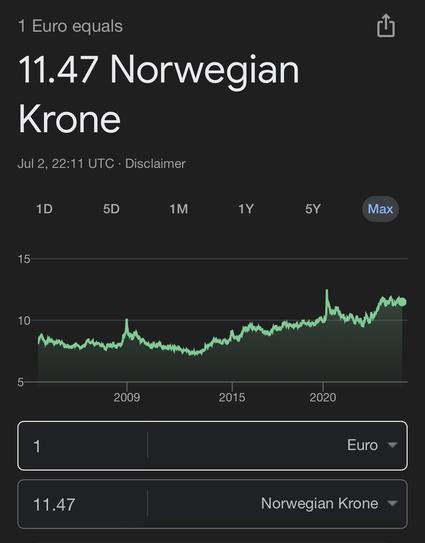
 Alper Çuğun-Gscheidel