Hot take: if you can choose between an #ebike and a car, of course take the bike.

However if your choice is between a regular bike and an e-bike the former is much more environmentally friendly.

In short, biking become less and less environmentally friendly the more regular bikes get replaced with e-bikes and e-scooters.

#climatechange #environment #biking

@WhyNotZoidberg Agree 100%. But it's worse than that...
E-bikes are not only more expensive and not only have a larger environmental footprint, but they also have very much shorter lifespans.
The result of the rise of e-bikes in the Netherlands is that total sales of bicycles (inc e-bikes) has dropped by more than half. What's more, because e-bikes become unmaintainable after a few short years, they do nothing to add to the the long-tail of second/third/fourth hand bikes which have always made up the majority of daily use machines so all the old bikes in the future will have to come from the small number of non-assisted bikes still being sold.
In the past, the average bicycle lasted for abut 14 years before it was scrapped. The much lower sales of non assisted bikes now require that of those machines lasts on average over 40 years before it is scrapped. This is not realistic , especially as non-assisted bikes have also become less maintainable over time.
A high cycling modal share cannot be maintained with a smaller pool of usable bicycles.
http://www.aviewfromthecyclepath.com/2022/03/the-challenge-of-declining-bicycle.html
The challenge of declining bicycle sales in the world's leading cycling nation

A few days ago I quote tweeted this graph from Datagraver on twitter with a comment that "Sadly, cycling is dying in the Netherlands." The ...

@hembrow @WhyNotZoidberg "ebikes don't last as long as traditional bikes but their existence causes the total number of bikes sold to decline" seems very strange to me. Logically, one would expect an increase in total sales, not a decrease.
@prestontumber You might like to hope so, but it's not what we're experiencing. The source of the stat is at the shared link above.
I think that what's happened is that people who buy new bikes now spend more money per bike, but it's not enough to buy as many bikes as before. So the total number of sales is collapsing.
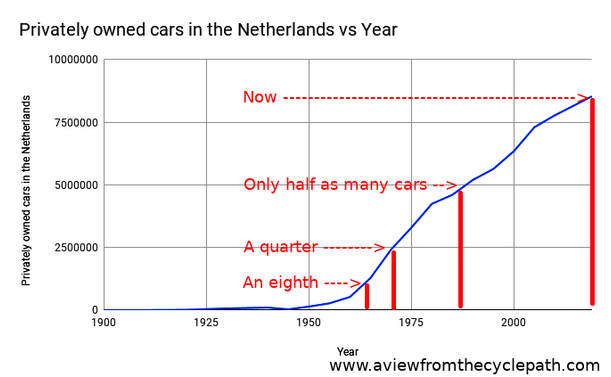
While the future of cycling is not particularly safe in our country, car ownership and use are still unfortunately growing at a ludicrous pace. We've now had decades of right wing governments who have made car ownership and use more attractive. The last time there was a real political push for cycling was decades ago (1970s/early 80s).
http://www.aviewfromthecyclepath.com/search/label/dutchcarownership
@WhyNotZoidberg
A view from the cycle path

Why is it that people cycle more in the Netherlands than in any other country ? The answer is in the infrastructure. Long established blog with content up to the present day detailing how the infrastructure of the Netherlands makes cycling so pleasant that almost everyone cycles in this country and a higher proportion of cycle journeys are made here than anywhere else

@hembrow @WhyNotZoidberg I feel like blaming ebikes for that seems like a bit of a stretch, then? Especially as the prices for all bikes are high. One reason I bought my ebike was precisely that - if I was going to buy a cargo bike anyways, I might as well get electric assist.

If car ownership is increasing, that's the issue, and the ebike stuff is likely to be a symptom and not a cause. I do also wonder about public transport cuts, which are themselves something RW governments like to do.

@prestontumber You can feel that way if you want, but e-bikes are at least a large part of what is destroying cycling in my country and I'm not happy about it.

Public transport has little, to nothing at all, to do with any of this. Dutch people don't use public transport very much at all.
About 2% of all journeys in this country are by train, and about another 2% are by bus/tram and subway combined. That's not changed in years.
http://www.aviewfromthecyclepath.com/2015/05/how-much-do-dutch-really-cycle-how-is.html
@WhyNotZoidberg

How much do the Dutch really cycle ? How is it is measured ? Which are really the top ten cycling cities of the world ?

Lists are popular on the internet. As a result, there are often attempts to make lists which rank such things as cycling cities. Such lists ...

@hembrow @WhyNotZoidberg

...literally nothing you have posted supports that, especially if regular bikes are getting more expensive as well. You can do "old man yells at cloud" all you like, but it's not actually objective.

Disregard public transport all you like - inadequacies in transit are a reason people may choose autonomous modes of transport, and cars are one such mode. You can say "that hasn't changed in years" - has the population? Has the housing market? Has the median age?

@hembrow @WhyNotZoidberg All of these things can impact mode share. The idea that it is the fault of people who've electrified their bakfietsen that the total share of people riding has fallen is facially absurd.

@prestontumber Not only have you completely missed the point, but you've also begun an ad-hominum argument. Is that objective in your world ?

You clearly have no idea about how the Dutch bicycle market works.

To maintain our fleet of 23 million bicycles in 2000 with sales of 1.5 m bikes per year in 2000 required that each bicycle would last around 14 years. A bicycle would typically be on its third or fourth owner by the time it was beyond economic serviceable age and end up scrapped.

With sales of proper bicycles plummeting in large part because of people who buy new bikes buying e-bikes instead, and because e-bikes go to landfill after five years because they can't be repaired, we now need each new real bicycle to last 60 years in order to maintain the fleet size. That's impossible.

This effect will take a few years to make itself obvious, but without enough bicycles we won't be able to cycle as much as now.

If you can magically come up with a method whereby a fleet of 23 million bikes can be sustained from annual sales of 350000 new bikes without requiring them to last >60 years on average please let me know.

Please read the blog post. I already explained all of this, *and* also answered many of the typical responses that people come up with:
http://www.aviewfromthecyclepath.com/2022/03/the-challenge-of-declining-bicycle.html
@WhyNotZoidberg


The challenge of declining bicycle sales in the world's leading cycling nation

A few days ago I quote tweeted this graph from Datagraver on twitter with a comment that "Sadly, cycling is dying in the Netherlands." The ...

@hembrow @WhyNotZoidberg You're the one who started the incivility, not I. You don't get to go on arrogantly about "feelings" when my statements were clearly just a courtesy to avoid pointing out that you were making the fairly elementary logical fallacy of confusing correlation with causation.

I have heard your argument, I just find it perplexing you want to pretend that bicycle sales exist in a vacuum, even in a country as bike-friendly as NL.

@hembrow @WhyNotZoidberg I certainly never claimed to know anything about bicycle economics in NL, but you may want to work on demonstrating your argument better.
@hembrow @WhyNotZoidberg Upon further reading, your blog post is interesting, and I think presents your argument better. I am curious as to what you'd recommend to fix this, other than "don't buy ebikes", which I suspect is a non-starter.

@prestontumber I wish I had a solution but unfortunately, I don't.

"Don't buy ebikes" is indeed a non-starter. They've been pushed incredibly heavily by bicycle manufacturers and the idea of not being required to do much actual pedaling has clearly been made very attractive to "bicycle" customers. Consumerism is in. Repairability and sustainability are not. E-bikes lean on an open door with today's consumers.

I think what we're watching now is very close to a repeat of what happened a hundred years ago when many established bicycle manufacturers switched first to manufacturing motorbikes and then started making cars. Just like early motorbikes, early e-bikes also looked like bicycles. But newer e-bikes are becoming steadily less bicycle like, heavier, bulkier, much less efficient and no longer really rideable without the motor. It's the same profit chasing as a century ago combined with the same selling ease to the customer as before.

Sadly, "don't vote for right-wing politicians who make driving more attractive" is also a non-starter. My country recently voted for our most right wing government since the 1940s occupation. We already have a remarkable number of financial disincentives for cycling and they're not going to fix any of that.

We're in a bad place.
@WhyNotZoidberg

@hembrow @WhyNotZoidberg On another level, e-bikes are simply antithetical. The point of a bike is that it HAS to be efficient on human power. E-bikes sacrifice an already typically suboptimal function for form. Heavy, bad speed control, now fatbikes which no one in their right mind would ride without the motor. Pedals are mostly a fashion accessory.
@hembrow @WhyNotZoidberg Riders behave like motorists with that binary between stop and go, not feeling the energy it takes. They ARE motorists. Transport efficiency is lost. The minimum of exercise is lost. They cannot remove even more pressure from the standard for cycle infrastructure which must support flow and momentum.

@jonathanavt Absolutely agree.

The documented negative effect of e-bikes on the fitness of teenagers is especially sad to see.
https://nos.nl/artikel/2497778-rivm-maakt-zich-zorgen-nederlanders-zijn-flink-minder-gaan-bewegen

Human powered bicycles have to be built to be efficient or they're not usable. Even the better E-bikes are horrible to ride without assistance, and the ridiculous designs (e.g. fatbikes) are basically impossible to ride.

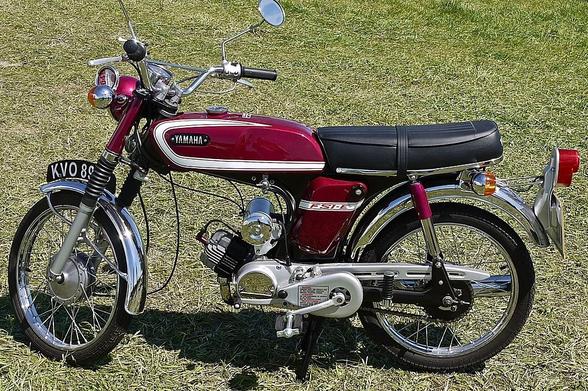
Fatbikes remind me of the Yamaha FS1E of the 1970s. These were really popular with teenagers in the UK because they were unrestricted in speed (if built before a certain year) but because they had pedals they were licensed in a really liberal way. You couldn't actually pedal then anywhere, though. Those pedals existed only to get around the law.
I understand they were also available in NL under similar conditions (but I didn't live here then).
https://en.wikipedia.org/wiki/Yamaha_FS1#/media/File:Sweet_16_Fizzy.Yamaha_FS1E._-_Flickr_-_mick_-_Lumix.jpg
@WhyNotZoidberg

RIVM maakt zich zorgen: Nederlanders zijn flink minder gaan bewegen

Jongeren zitten steeds minder minuten per week op de fiets. Een mogelijke verklaring is de opkomst van de e-bike.

@hembrow @WhyNotZoidberg Of course e-bikes can help some people who wouldn’t otherwise be able to ride. But I’ve lost faith in that as a primary narrative. I bring it up at times. The reaction is always that it’s better than a car (without substantiating modal shift) or that they have to go ~10 km. It doesn’t take much fitness to go 20 km a day. That’s just complacency, never experiencing how a few hours of exercise can change you. Motorized transport is too alluring to know what it’s about.
@hembrow @WhyNotZoidberg Not to mention that more efficient bikes exist. Again not considered because the form is weird or there is no hype around them. You can go faster than many motorized bikes with minimal effort.

@jonathanavt Indeed. 20 km just isn't that much to ride in a day if you keep a reasonable level of fitness. Actually, it's only slightly more than you need to ride each day (without assistance) in order to keep your body at a reasonable level of fitness:

https://www.aviewfromthecyclepath.com/2017/12/cyclings-recommended-minimum-daily.html

But as we already discussed, people aren't too concerned about fitness these days.

Fifteen years ago things were very different and e-bikes were IMO quite a positive thing. For instance, I remember working on adapting an e-trike for a young girl who'd been thrown from a horse (the danger of horses being a whole other subject). She could no longer balance or pedal well and providing her with an e-bike meant she could still join in with friends on the way to and from school or for after school events. One of our kids had a friend who used an e-bike because she had a breathing problem, so that allowed her to join in with everyone else. But now it's just everyone, all the time.

I sometimes wonder if e-bike usage, and perhaps also increased driving, to some extent now compensates for long-covid (over a million Dutch people suffer from this).
@WhyNotZoidberg

Cycling's Recommended Minimum Daily Allowance. Do you ride your bike enough to maintain good health ?

Do you ride your bike enough to maintain good health ? I suspect that many people actually do not. A surprising amount of cycling is require...

@jonathanavt @hembrow talking about full powered e-bikes and scooters owned by people who could easily use a bike or e padec yes, they are only another consumer toy.