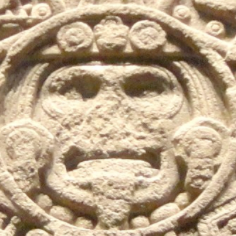
The winter #solstice is today at 20:51 UTC (21:51 summer time). At that moment, the angle between Earth's axis of rotation and the plane of its orbit around the sun will be greatest, resulting in the least amount of sunlight reaching the southern hemisphere, and thus the shortest day and longest night of the year.

Yes, winter, not summer solstice. Don't assume everybody lives in your hemisphere.

1/11

For the #Quechua (AKA #Inca or #Inka) people, the winter solstice was the time of #IntiRaymi, traditionally the biggest celebration of the year. It was the darkest time of year, which meant that it was about to get brighter, sunnier, and warmer. This was all tied to the rebirth of #Inti, the god of the sun, and lasted for nine days before the Spanish banned it.

2/11

But because St. John's Eve falls just a few days after Inti Raymi, a whole lot of Inti Raymi celebrations were transferred to that day. Since 1944 AD, Inti Raymi was revived by indigenous people of #Peru, and today is an official holiday celebrated on 24 June.

3/11

But, of course, the #Quechua are far from the only people to attach significance to the winter solstice. Germanic peoples had #Jule; just as Inti Raymi traditions transferred to St. John's Eve, so too most of Jule was attached to #Christmas when the early Germanic peoples converted to Christianity.

The Romans had #Saturnalia, but that fell a few days before the solstice. There was also #SolInvictus, but that was mostly a #pagan attempt to coöpt Christmas.

4/11

Likewise, traditional #Cherokee timekeeping describes things has happening "n winters ago", suggesting the winter solstice was probably important there, too.

And, of course, the #Celts of #Ireland built #Newgrange specifically so that the sun shines in the central passage only at noon on the solstice.

5/11

In #China, New Year's Day falls in spring, but the exact date is determined by when the new moon falls in relation to #Dongzhi, the winter solstice festival.

The #RigVeda also implies that the winter solstice marked New Year's Day in the #IndusValley civilisation, but is unfortunately too vague to say much with certainty.

I am now going to talk in a somewhat more abstract and philosophical way about time, drawing on #Jyotisha

6/11

The #SūryaSiddhānta describes the time from the spring equinox to the autumn equinox as daytime for the gods and nighttime for the demons; the other half of the year is day for the demons and night for the gods. Perhaps this just means that demons like darkness, or it might mean that Indians thought summer on top of the world corresponded to winter underneath, there demons live.

7/11

The Surya Siddhanta also describes the (sidereal) year as being a (civil) day of the gods. I suspect that a wise guru at some point said that "A year to a human is but a day to a god" and people proceeded to take that incredibly literally.

But it's interesting to look at this view of time and draw analogies between the start of the year and the start of the day.

8/11

If a year to a human is a day to a god, then the winter solstice is the gods' midnight. The spring equinox is the gods' sunrise, as it's when light and dark are equal, and light is about to overcome the dark. The autumn equinox thus corresponds to sunset of the gods, when light and dark are again equal, and the year transitions into darkness. The summer solstice is noon for the gods.

19/11

As such, #calendars which tie the beginning of the year to the spring equinox remind one of beginning the day at sunrise, as is standard in #Iran, #India, #Tibet, #SoutheastAsia, and sub-saharan Africa.

Beginning the year at the autumn equinox corresponds to beginning the day at sunset, as was common in #Mesopotamia, #Greece, and the #Celtic realms.

10/11

A year which begins with the winter solstice corresponds to a day which begins at midnight, as was long the case in China.

If the year starts on the summer solstice, it corresponds to a day which begins at noon, which is something only modern astronomers do, because it's a bit silly unless you're nocturnal.

Thank you for reading and happy #solstice.

11/11

@Infrapink thank you for this interesting thread! I have a lifelong calendar time brain glitch (ADHD + anxiety + PTSD) but I like the cultural history very much.

@mtechman
So glad you liked it!

Calendars are something of an obsession of mine. A few years ago, I had some COVID-related downtime, and started writing a calendar converter to teach myself programming. That sent me down a whole bunch of rabbit holes into local cultural practices and some history you wouldn't normally think to wonder about.