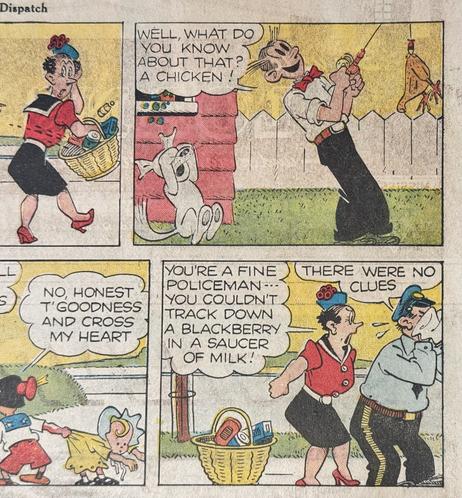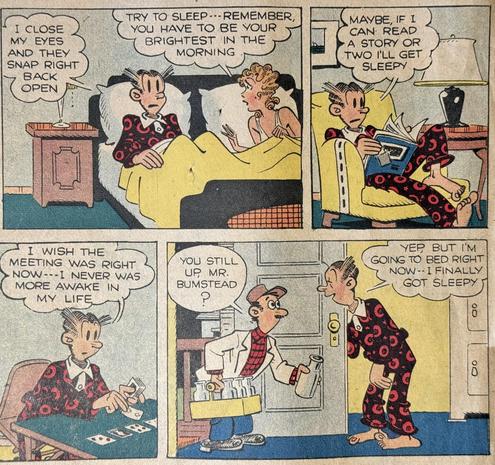
On September 5, 1946, the St. Louis Post-Dispatch switched the printing of its color comics from relief letterpress to rotogravure. Rotogravure was mostly limited to fancy sections, including fashion, color photography, and advertising. The paper seems to be the only one in United States that ever chose to use the very expensive rotogravure process for comics. In these panels, you can see and compare relief versus rotogravure.

The comics with Dagwood and the chicken are printed by relief letterpress (photos 1 and 3). The comics with Dagwood in his pajamas are printed by rotogravure (photos 2 and 4). Compare and contrast!

Rotogravure is an incised or intaglio process. This contrast with letterpress, which is a relief or raised process. Rotogravure relies on wells of ink, which vary in depths to simulate gradations of color.
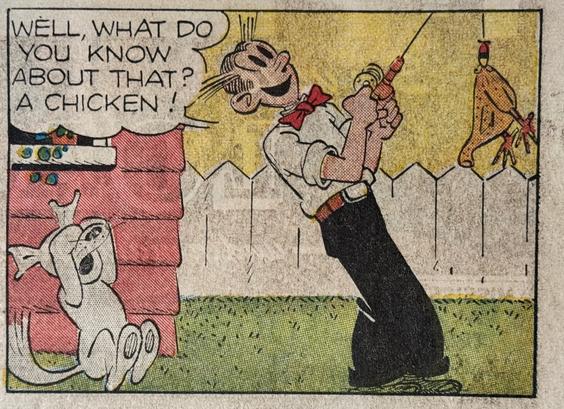
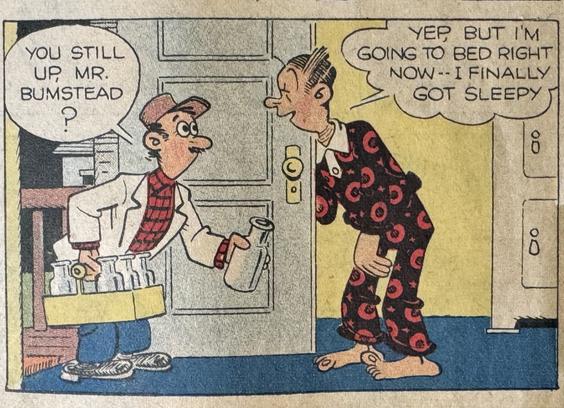
The ink is translucent, becoming darker when it’s drawn from more deeply etched wells. The paper is pressed onto the incised roller and it’s transferred out of the wells onto the paper. With letterpress, it’s a direct contact method, with the ink transferred by pressing directly onto raised type or line art or photos.
If you like this sort of thing, consider preordering my book, How Comics Were Made! https://howcomicsweremade.ink/order
Participate :: How Comics Were Made: a Visual History of Printing Cartoons by Glenn Fleishman

@glennf The gravure looks great - the detail being held in the pyjama pattern (the centre circles) is remarkable.
@glennf Contemporary photographer’s now use polymer plates to produce photogravure prints. Polymer plates does away with the acid etching https://www.routledge.com/Polymer-Photogravure-A-Step-by-Step-Manual-Highlighting-Artists-and-Their-Creative-Practice/Harmon/p/book/9780815366041
Polymer Photogravure: A Step-by-Step Manual, Highlighting Artists and Their Creative Practice

Polymer Photogravure: A Step-by-Step Manual Highlighting Artists and Their Creative Practice is a three-part book on the non-toxic process of making ink-on-paper intaglio prints from continuous-tone photographs using water-etched photopolymer plates. Author Clay Harmon provides clear and easy to understand instructions that will enable anyone to successfully make a photogravure print. By quantifying the sensitometric behavior of polymer plates, Harmon has developed a methodical approach which

Routledge & CRC Press
@pinhman Super cool. Same for letterpress: you can get zinc or magnesium plates, but photopolymer works great for digital to analog typesetting.
@glennf I believe photographer like Harmon worked to adapt polymer plates for a photogravure work flow.
Copper Plate Photogravure: Demystifying the Process

Copper Plate Photogravure describes in comprehensive detail the technique of traditional copper plate photogravure as would be practiced by visual artists using normally available facilities and materials. Attention is paid to step-by-step guidance through the many stages of the process. A detailed manual of technique, Copper Plate Photogravure also offers the history of the medium and reference to past alternative methods of practice.Copper Plate Photogravure: Demystifying the Process is part o

Routledge & CRC Press

@glennf

Having read the St. Louis Post-Dispatch all of my life, I took this printing technology for granted.

The paper is now #Enshittified these days wrt to print tech. Even not too long ago, the back page of comics would be color during the week. Now, only color comics on Sunday edition. Other days, just B+W. Comic strips dropped. What is left has been so shrunken that I need cheaters to read the text.

Joseph Pulitzer would be rolling in his grave.

https://historicmissourians.shsmo.org/joseph-pulitzer/

Joseph Pulitzer - SHSMO Historic Missourians

SHSMO Historic Missourians
@SpaceLifeForm They were an early daily colorer! For a long while, starting in the 1910s, only a paper or a few colored their dailies. It took until the 1980s that it became more routine and then by the late 80s, fairly normal. Weird to see time flow backwards.