
We're living in the #enshittocene, in which the forces of enshittification are turning everything from our cars to our streaming services to our dishwashers into thoroughly enshittifified piles of shit. Call it the Great Enshittening:

https://pluralistic.net/2023/11/09/lead-me-not-into-temptation/#chamberlain

--

If you'd like an essay-formatted version of this thread to read or share, here's a link to it on pluralistic.net, my surveillance-free, ad-free, tracker-free blog:

https://pluralistic.net/2024/01/13/solidarity-forever/#tech-unions

1/
Pluralistic: The enshittification of garage-door openers reveals a vast and deadly rot (09 Nov 2023) – Pluralistic: Daily links from Cory Doctorow

How did we arrive at this juncture? Is it the end of the #ZeroRateInterestPolicy? Was it that the companies that formerly made useful things that we valued underwent a change in leadership that drove them to make things worse? Is Mercury in retrograde?

None of the above. There have been many junctures in which investors demanded higher returns from firms but were not able to force them to dramatically worsen their products.

2/

Moreover, the leaders now presiding over the rapid unscheduled disassembly of once-useful products are the same people who oversaw their golden age. As to Mercury? Well, I'm a Cancer, and as everyone knows, Cancers don't believe in astrology.

The Great Enshittening isn't precipitated by a change in how greedy and callous corporate leaders are. Rather, the change is in what those greedy, callous corporate leaders can *get away with*.

3/

Capitalists hate capitalism. For a corporate executive, the fact that you have to make good things, please your customers, pay your workers, and beat the competition are all bugs, not features. The best business is one in which people simply pay you money without your having to do anything or worry that someday they'll stop. #UBI for the investor class, in other words.

4/

Douglas @Rushkoff calls this "going meta." Don't sell things, provide a platform where people sell things. Don't provide a platform, invest in the platform. Don't invest in the platform, buy options on the platform. Don't buy options, buy derivatives of options.

A more precise analysis comes from economist #YanisVaroufakis, who calls this #technofeudalism. Varoufakis draws our attention to the distinction between #profits and #rents.

5/

Profit is income a capitalist receives from mobilizing workers to do productive things, then skimming off the surplus created by their labor.

By contrast, rent is income a feudalist derives from owning something that a capitalist or a worker needs to be productive. The entrepreneur who opens a coffee shop earns profits by creaming off the surplus value created by the baristas. The rentier who owns the building the coffee shop rents gets money simply for owning the building.

6/

The coffee shop owner can never rest. At any moment, another coffee shop can open down the street and lure away their customers and their baristas. When that happens, the coffee shop goes bust and the owner is ruined. But not the landlord! After the coffee shop goes bust, the landlord's asset is *more* valuable - an empty storefront just down the street from the hottest coffee shop in town.

7/

Capitalists hate capitalism. Faced with a choice of retaining their workers by paying them a fair wage and treating them well, or by saddling them with noncompetes that make it impossible to work for anyone else in the same field, and obligations to repay tens of thousands of dollars for "training" if they quit, bosses will take the latter every time. Go meta, baby.

8/

Some for competition. Faced with the choice of competing to win the most customers with the best products, or merging so that customers have nowhere else to go, even the bitterest of rivals find it remarkably easy to intermarry until our corporations landscape is so interbred the dominant firms all have Habsburg jaws. Think: Facebook-Instagram. Disney-Fox. Microsoft-Activision:

https://locusmag.com/2021/07/cory-doctorow-tech-monopolies-and-the-insufficient-necessity-of-interoperability/

9/

Cory Doctorow: Tech Monopolies and the Insufficient Necessity of Interoperability

I care about monopolies for exactly one reason: self-determination. I don’t care about competition as an end unto itself, or fetishize “choice” for its own sake. What I care about…

Locus Online

Enshittification has complex underlying dynamics and a reliable procession of stages, but the effect is quite straightforward: things are enshittified when they become worse for the people who use them and the suppliers who makes them, but nevertheless, the users keep using and the suppliers keep supplying.

There are four forces that stand in the way of enshittification, and as each of these forces grows weaker, enshittification proliferates.

10/

The first and most important of these constraints is #competition. Capitalists claim to love competition because it keeps firms sharp: they must constantly find ways to improve products and cut costs or be swept away by a superior alternative. There's a degree of truth here, but that's not the whole story.

For one thing, competition can "improve" things that we would rather see abolished.

11/

Critics of the #GDPR, the EU's landmark privacy law, often point to the devastation that enforcing privacy law had on the European #AdTech industry, driving small firms out of business. But these firms were the most egregious privacy offenders, because they had the least to lose, lacking the dominant position of US-based Big Tech surveillance companies.

12/

Having the least to lose, they were the most reckless with their privacy invasions - but they were also the least equipped to pay expensive enablers from giant corporate law firms to hold off European enforcers, and so they were obliterated. The resulting lack of competition is fine, as far as privacy goes: we don't want competition in the field of "who is most efficient at violating our human rights":

https://www.eff.org/deeplinks/2021/04/fighting-floc-and-fighting-monopoly-are-fully-compatible

13/

Fighting FLoC and Fighting Monopoly Are Fully Compatible

Are tech giants really damned if they do and damned if they don’t (protect our privacy)?That’s a damned good question that’s been occasioned by Google’s announcement that they’re killing the invasive, tracking third-party cookie (yay!) and replacing it with FLoC, an alternative tracking scheme that...

Electronic Frontier Foundation

But there's another benefit to competition: disorganization. A sector with hundreds of medium-sized, competing companies is a squabbling mob, incapable of agreeing on the site for an annual meeting. An industry dominated by a handful of firms is a *cartel*, handily capable of presenting a unified front to policy makers, and their commercial coziness provides them with vast war-chests they can use to suborn governments and capture their regulators:

https://pluralistic.net/2022/06/05/regulatory-capture/

14/

Regulatory Capture – Pluralistic: Daily links from Cory Doctorow

Competition is the first constraint. When there's competition, corporate managers fear that you will respond to enshittification by defecting to a rival, costing them money. They don't care about your satisfaction, but they *do* care about your money, and competition hitches their ability to satisfy you to their ability to get paid by you.

15/

Competition has been circling the drain for 40 years, as the "consumer welfare" theory of antitrust, hatched by Reagan's court sorcerers at the University of Chicago School of Economics, took hold. This theory insists that monopolies are evidence of "efficiency" - if everyone shops at one store, that's evidence that it's the best store, not evidence that they're cheating.

16/

For 40 years, we've allowed companies to violate antitrust law by merging with major competitors, acquiring fledgling rivals, and using investor cash to sell below cost so that no one else can enter the market. This has produced the inbred industrial hulks of today, with five or fewer firms dominating everything from eyeglasses to banking, sea freight to professional wrestling:

https://www.openmarketsinstitute.org/learn/monopoly-by-the-numbers

17/

Monopoly by the Numbers — Open Markets Institute

The Open Markets Institute uses journalism to promote greater awareness of the political and economic dangers of monopolization.

Open Markets Institute

The endless and continuous weakening of competition has emboldened corporate enshittifiers, who operate on the logic of Lily Tomlin in her role as an AT&T spokeswoman: "We don't care. We don't have to. We're the phone company":

https://vimeo.com/355556831

But the drawdown of competition has also enabled regulatory capture, by converting cutthroat adversaries to kissing cousins.

18/

SNL 9/18/76 - Lily Tomlin - We’re the Phone Company, We Don’t Care!

As relevant today as it ever was, just replace "phone company" with Google, Microsoft, Amazon, Facebook, any number of other companies who don't care!

Vimeo

These companies have convinced their regulators not to enforce privacy, consumer protection or labor laws, provided that the gross violations of these laws are accomplished via apps.

This is where #TechExceptionalism is warranted: while the bosses that run these companies aren't any nobler - or more wicked - than the Robber Barons of yore, they *are* equipped with a digital back-end for their businesses that let them change the rules of the game from moment to moment.

19/

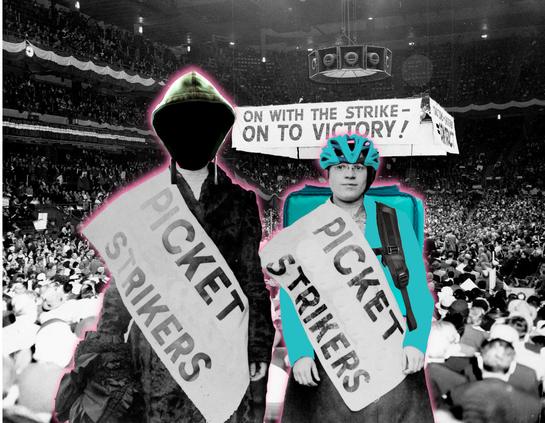
Think of labor law: as #VeenaDubal writes, gig-work companies practice #AlgorithmicWageDiscrimination, turning your paycheck into a slot machine that pays out more when you are more selective about which jobs you take, and which then docks your pay by tiny increments as you become less discriminating about answering the app's call:

https://pluralistic.net/2023/04/12/algorithmic-wage-discrimination/#fishers-of-men

20/

Pluralistic: Gig apps trap reverse centaurs in wage-stealing Skinner boxes (12 Apr 2023) – Pluralistic: Daily links from Cory Doctorow

This is a plain violation of labor law, but the fiction that gig workers are contractors, combined with the opacity and speed of the wage discrimination back-end, lets the companies get away with it.

21/

@pluralistic Great riff on the principles of the word of the year. I think there is one more important countervailing force to add to the four you describe: customers leaving, not just to the competition but just saying "No". While we may be stuck for the essentials of life, large swathes of these markets nobody really needs in the first place, much of it just entertainment in some form or other. I think we the consumers can send the message clearly in the more optional markets and it will reverberate out from there. It does take collective action, but in many cases single digit percentages may be plenty to move the needle loud and clear. All we need to do is stop holding our noses and sticking with them.

@pluralistic Being one of Chamberlain's many enshittification victims, I bought a "ratgdo" (Rage Against The Garage Door Opener), a small $30 circuit that hooks to a Chamberlain-brand garage door opener and lets me control it locally with #HomeAssistant. I then disconnected my opener from the official MyQ site and deleted their app.

It's a small victory, but I savored it.

Just bought two ratgdos myself (had to wait a bit because they were backordered), and am looking forward to hooking them up and ditching the Chamberlain app! (Thanks for boosting, Cory!) @targetdrone @pluralistic