 Yogthos
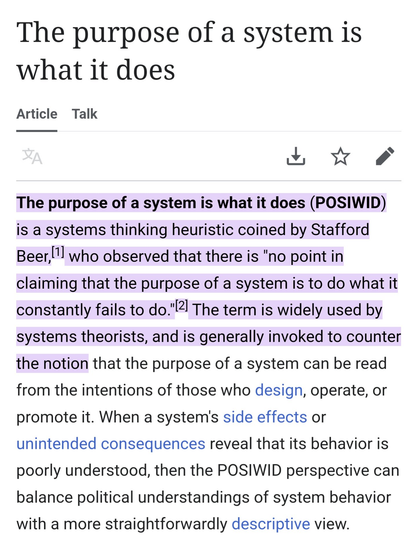
People love to talk about what the intentions are. However, when a system constantly produces a different outcome than the one it is "intended" for then it's perfectly reasonable to assume the actual intention is the outcome it continues to produce.
@flyingsaceur @malkavon @yogthos
as I've said many times...
incompetence and stupidity are the plausible denial of malice and complicity
It's equally reasonable to assume that there are conflicting interests, each with their own intentions and with different amounts of power to influence the system.
@yogthos thank you for sharing this concept.
This applies PERFECTLY to the COP process, which „should“ address climate change but has failed again and again to do so over 30 years.
#COP #COP28 #cop29 #ClimateChange #ClimateCrisis #climateemergency
@escarpment @kechpaja @yogthos Doing a thing once as an experiment that turns out badly can be good intentions gone awry.
Repeatedly doing a thing that turns out badly is a clear indication that the real intention is to turn out badly, regardless of whatever stated reasoning was supplied.
@yogthos This principle denies the possibility of things not going according to plan.
I'm working on a web game. My purpose of the game is to let players move around. I accidentally flip a != with an == and oopsie no players can move. Is the purpose of the game to be a game where no one can move?
@yogthos I have provided multiple examples that clearly illustrate why this principle is bunk. You have doubled down in your defense of it, while providing no supporting examples for it, except vague allusions to "people responding to systemic pressures." I hope I have at least put the idea in your head that this principle needs scrutiny. We should aim to debunk first, and accept whatever survives all our debunking efforts.
That Wikipedia page lacks a "criticisms" or "controversy" section.
@escarpment because the point there is that it's necessary to recognize what the system actually does and separate that from whatever intent is being espoused.
Acknowledging that the system is broken instead of talking about the intent of the system is the whole point of the principle. That's the prerequisite to making change.
The Escarpment system is not about understanding.
@yogthos @RD4Anarchy @[email protected]
Escarpment, if I recall correctly, once said that if faced with starvation they’d murder a child and force-feed the corpse to their own child, to keep their own child alive.
This is the game theory one as well, right?
Oh yeah, yikes!
@yogthos That's your first clue that it's an empty statement- "makes perfect sense the first time you read it", without any scrutiny or examination of counter arguments.
There is a persistent problem of what I would call pseudo-philosophy. "Property is theft." "We all die alone." And this principle. They resonate with people because they seem satisfyingly profound, when they are really just linguistic perplexities that confuse and bewilder rather than clarifying or informing.
@yogthos If "it makes perfect sense" despite that meaning being in gross defiance of the generally agreed upon meanings of the words that constitute the principle, it's not a principle but a Rorschach test where you can impose whatever meaning you like.
Sure, the words themselves "the purpose of the system is what it does" are false, because we all agree that purpose and actual implementation are separate ideas. So here's what it *actually* means (insert your favored "interpretation").
@escarpment the words "the purpose of the system is what it does" are not false, you just intentionally choose to interpret them in a nonsensical way, which is why what you're doing here amounts to sophistry.
Human language is fundamentally subject to personal interpretation. That's just how language works.
@escarpment the point there is that you have to acknowledge the way the system is ACTUALLY functioning and the outcomes it's producing, and to separate that from whatever intent there was.
Only then can you begin to change the system in a positive way. I don't know how much more clearly I can spell this out for you.
@yogthos So the point is to acknowledge how a system is functioning and how it varies from its intent. That too is an uncontroversial principle.
"One ought to monitor and evaluate a system against its intended purposes to determine how well it is functioning to meet those purposes."
That too is different than "the purpose of a system is what it does", which is false.
 Aaron Pettman
 malkavon (he/him)
 AN/CRM-114
 joriki
 IPmonger
 Eric Lawton
 pgcd
pgcd _noelamac_
 Simon Zerafa
 Maxi 12x 💉
 Jorkin MahJongus
 kechpaja
 TBMcQueen
 Tom Magnanimous
 Escarpment
 Urzl
Urzl RD
RD HeavenlyPossum
 Corvid Crone
 Word of Mouth