
People love to talk about what the intentions are. However, when a system constantly produces a different outcome than the one it is "intended" for then it's perfectly reasonable to assume the actual intention is the outcome it continues to produce.
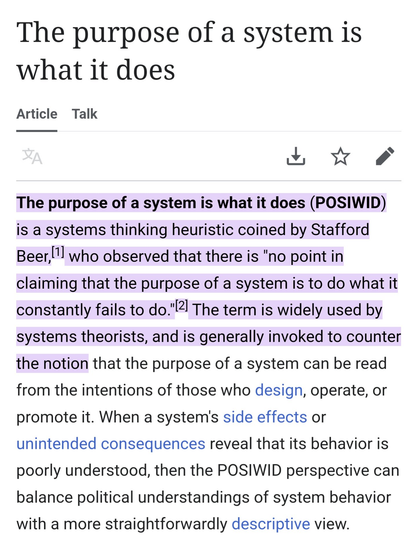
@yogthos I characterize this idea as false. It stretches the basic meanings of words. Simply producing one example of a system whose purpose is not what it does disproves this statement. Take a car that drove for 100,000 miles then crashed into a ditch. The purpose of the car was to transport passengers and cargo, and it did so effectively for 100,000 miles. Now it sits in a ditch. Sitting in a ditch is not its intended purpose.
@escarpment that example is just sophistry
@yogthos This "principle" is just sophistry. Someone stated it confidently enough that people take it as true and interesting.
@yogthos "Purpose" is a word that means people's intentions. This "principle" amounts to "people's intentions are not people's intentions". Or "people's intentions are something other than their intentions." Or "people have secret intentions."
@escarpment people act according to systemic pressures they're exposed to

@yogthos This principle denies the possibility of things not going according to plan.

I'm working on a web game. My purpose of the game is to let players move around. I accidentally flip a != with an == and oopsie no players can move. Is the purpose of the game to be a game where no one can move?

@escarpment you're conflating goals with the implementation here. A proper analogy would be to have a game mechanics where players can't move and excuse this by saying that your intent was for players to be able to move instead of addressing the problem
@yogthos In that analogy, you are simply accusing the creator of the game with having intended to have the game fail and then making an excuse for why it failed. This is like the conspiracy theory of all conspiracy theories, that every mistake is actually intentional. Version 3.1 of my chess engine comes out and actually no moves are possible. And you accuse me of *intentionally* making it that way and just making excuses.
@escarpment again, this is not what the principle states. What it says is that if your goal is to have the player move, and the current mechanics don't allow the player to move then you need to change the mechanics.
@yogthos The principle is not "if a system is broken, fix it." That doesn't get a Wikipedia page and an acronym. It's "the purpose of a system is what it does."
@yogthos that's a principle I can get behind and I'm sure no one disputes. If a system defies its intended purpose, fix it.
@yogthos If that was the principle in question, why didn't you just say that? "If a system is broken, you need to change it."

@escarpment because the point there is that it's necessary to recognize what the system actually does and separate that from whatever intent is being espoused.

Acknowledging that the system is broken instead of talking about the intent of the system is the whole point of the principle. That's the prerequisite to making change.

@yogthos But if you have no idea what the intent is, how do you fix it? Presumably you fix it to align *more* with its purpose, further indicating that intent and what-it-does are different entities and the purpose of a system is *not* what it does.
@escarpment the premise of the principle, once again, is that you DO know what the intent is and that the system is not serving that intent, but you're EXCUSING that by stating the intent.
@yogthos Why does the principle need so much help to make any sense? A principle such as "if a system has one intent and you know it, but it's not serving that intent, and you make an excuse for it by claiming another intent" is not very interesting or controversial. The principle explicitly states in English: "the purpose of a system is what it does." Those are the only words in the principle. I dispute those words and claim they form a false statement.
@escarpment I don't know why it's so hard for you personally to understand this principle, it made perfect sense to me the first time I read it 🤷‍♂️

@yogthos That's your first clue that it's an empty statement- "makes perfect sense the first time you read it", without any scrutiny or examination of counter arguments.

There is a persistent problem of what I would call pseudo-philosophy. "Property is theft." "We all die alone." And this principle. They resonate with people because they seem satisfyingly profound, when they are really just linguistic perplexities that confuse and bewilder rather than clarifying or informing.

@yogthos If "it makes perfect sense" despite that meaning being in gross defiance of the generally agreed upon meanings of the words that constitute the principle, it's not a principle but a Rorschach test where you can impose whatever meaning you like.

Sure, the words themselves "the purpose of the system is what it does" are false, because we all agree that purpose and actual implementation are separate ideas. So here's what it *actually* means (insert your favored "interpretation").

@escarpment the words "the purpose of the system is what it does" are not false, you just intentionally choose to interpret them in a nonsensical way, which is why what you're doing here amounts to sophistry.

Human language is fundamentally subject to personal interpretation. That's just how language works.

@yogthos I'm interpreting them literally because I see no reason not to interpret them that way. All our discussions have presupposed that purpose and what-it-does are separate and distinct entities. All your clarifications have made markedly different arguments (which I haven't disputed) than the one made by the phrase "the purpose of a system is what it does."
@yogthos My counter argument is simple: "The purpose of a system is not what it does. The purpose is the intent and hope of the designers of the system. What-it-does is the result or outcome of the design process, and is subject to change as the designers iterate on their design of the system to match its intended purpose."
@escarpment and as I've explained earlier this definition conflates intent with the implementation. I've also explained the problem with conflating these two things in this very thread.
@yogthos No, it does not conflate the two. It says they are distinct. Intent is "purpose". Implementation is "what it does." Separate. Not the same. I don't think you would look at me funny if I compared the two. "This system's implementation meets its intended purpose." Is that statement meaningless because implementation and purpose are the same?
@escarpment no, all our discussion is predicated on your conflating the intent with the implementation of the system which is the actual purpose of it.
@escarpment you're extrapolating a lot based on your personal difficulty or understanding a particular concept here