Trump just filed his opening brief in the immunity appeal in DC circuit court of appeal.

https://storage.courtlistener.com/recap/gov.uscourts.cadc.40415/gov.uscourts.cadc.40415.1208582803.0_3.pdf

It's late but I just had to start reading (morbid curiosity)

Paragraph #1: He tells the court that if he can be indicted there will be no end to it. Presidents will be indicted for decades! It will be a parade of horribles!

(Assumption: This is a purely political.)

#2 is the doozy.
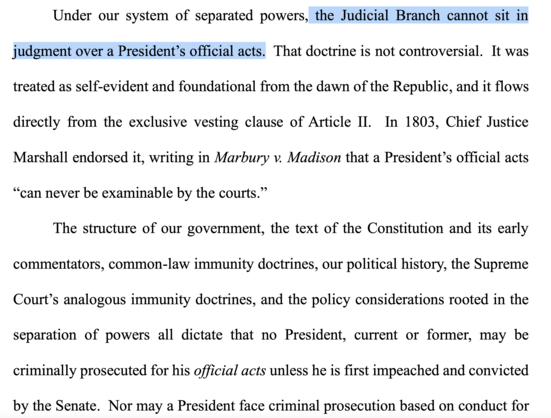
Basically, Dear Court: You have no power to sit in judgment of MEEEE.

It's laughably absurd.
1/

Can you imagine addressing a court of law with: "you have no power over me."

("Oh yeah?" the justices will think. "Watch.")

His idea of "separation of powers" is wacky.

The branches serve as checks against each other so no one branch becomes too powerful.

Aside: It's hard to imagine the Supreme Court bothering to take this at all. I don't know why so many people think it is a given that they will.

The Colorado case is different. There are good reasons for them to hear that one.

2/

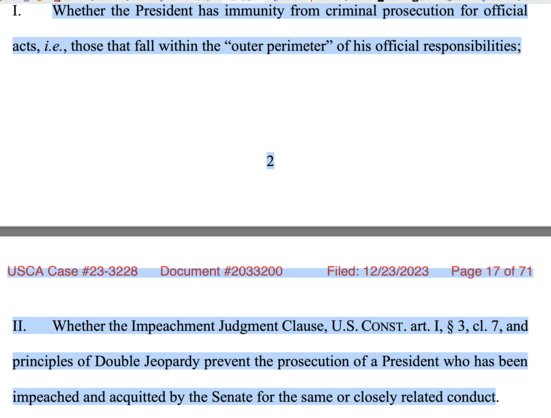
At least the brief is clearly written. The two issues are (1) absolute criminal immunity for official acts (2) double jeopardy applies.

The problem are obvious.

Problem with #1:

Absolute criminal immunity isn't a thing. It doesn't exist. Moreover, what he did was no way part of his "official" duties (among other things presidents have nothing to do with elections, particularly when they are a candidate.)

3/

Problem with #2:

Double jeopardy (from the 5th Amendment, I attached the text) says you cannot twice be put in jeopardy of criminal punishment.

The only jeopardy he faced in the Senate trial was whether he would be removed from office.

Moreover, the impeachment clause actually says that after being tried in the Senate you can be criminally charged. (I attached that as well.)

It's all right there in the Constitution.

4/

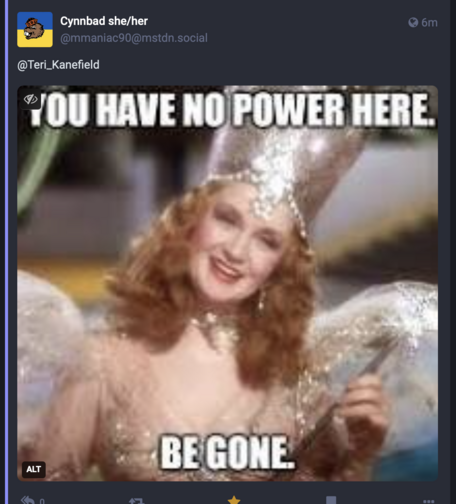
Perfect line, from @mmaniac90

What was going through my head was the line in Singing in the Rain when Lina Lamont says, "Do you think I'm dumb or something?" (and everyone is thinking, yeah, we do!)

Here you go: https://www.youtube.com/watch?v=gE3C8gGPMNI

Next, Trump spends a few pages mischarcterizing the evidence.

("Mischaracterizing the evidence" generally annoys justices. It's not a good idea to annoy the judge.)

5/

Am I dumb or something Lina Lamont Fandub

YouTube

Apparently Trump found a quotation from Chief Marshall. He gives the quotation like this:

As Chief Justice Marshall wrote in Marbury v. Madison, the President’s official acts “can never be examinable by the courts.”

Me: "Really? Marshall said that?"

So I pulled up a copy of Marbury v. Madison and started doing word searches.

Of course Marshall didn't say that.

Here's the case. You can see for yourself:
https://supreme.justia.com/cases/federal/us/5/137/

6/

Marbury v. Madison, 5 U.S. 137 (1803)

Marbury v. Madison: Congress does not have the power to pass laws that override the Constitution, such as by expanding the scope of the Supreme Court’s original jurisdiction.

Justia Law
@Teri_Kanefield Who wrote that brief? Aren't there rules that hold lawyers accountable for making stuff up and filing it with the court? I remember reading a news account recently about an attorney who got in trouble with the court for filing something written by AI that included fictitious cases

@azemon "mischaracterizing the evidence" happens often.

Courts get annoyed but it isn't sanctionable.

I will revise because the way I wrote it was misleading.

@azemon @Teri_Kanefield
Technically, the line is in the brief (if you cut out the context, and, more importantly, who it is speaking about). It's literally saying that if the President orders someone to do something within normal bounds, that officer should not be liable (and by implication, the president would be).

I am absolutely not a legal scholar, but then it kind of seems to go on to say explicitly that this doesn't hold in cases like this.

It's kind of impressive.

@Oggie @azemon

Amazing, right?

@Teri_Kanefield @azemon
I mean, if I wanted to point to an explicit refutation of the argument, drawing someone's eye to this particular part of the argument would be a simple and great way to do it?

It's really a solid refutation of the concepts that seem to be what is going on here.

It's like citing 'Under no circumstances can he be held liable' as 'he be held liable'. Just well done.

@Oggie @Teri_Kanefield @azemon can judges and other lawyers really be manipulated like that? In my opinion (I am a computer scientist and not a legal professional), research, studying sources and critical thinking should actually be basic tools for them?
@AUROnline @Oggie @azemon No, it won't work.
@Teri_Kanefield @AUROnline @Oggie @azemon Not just because 'research, studying sources and critical thinking' are basic tools and taught in legal education, but even more because legal proceedings are invariably adversarial. You learn to play the game or you don't have a career.