 Codey McCodeface
 Alice McFlurry
The mechanic is always trying to upsell me on tire rotations and I’m like nice try but that's literally what those things do.
 Biggles 20X6!
@Alice no no, it's like shift rotations, they swap the tires out when they're too tired, he's probably got like bunks full of alert and awake tires ready and raring to go after they've had a good long nap, and they're probably bouncing off the walls and irritating him.
 R.L. Dane

 🍵
🍵 
Yeah, because the front tires wear faster than the rear (IIRC).
I mean, I don't know if the price they quoted you is a good deal, because literally all they have to do is jack up your car, remove all four tires, swap the fronts with the backs, tighten down the lugnuts and put the car down again. It's like a five minute job with the right tools.
 Bryan Wright
@Alice
You want the tires to rotate? That's gonna cost extra.
You want the tires to rotate? That's gonna cost extra.
 paul
paulRound round, go around
I go around
Yeah
(go around round round, I go around)
I go around
(go around round round, I go around)
My kinda town
(go around round round, I go around)
I'm a real cool head
(go around round round, I go around)
I'm makin' real good bread
I'm gotin' bugged driving up and down the same old strip
I gotta find a new place where the mechanics are hip
 The cat who walks thru walls
@amiserabilist @Alice Encore! Encore! Let's have "Do It Again" now!
 mnemonicoverload
@Alice
LOL! I was chatting with my dad recently and his mechanic refuses to rotate his tires because they're apparently wearing perfectly even. Fluke 100% pristine alignment. "Don't touch them, don't even look at them funny." 😂
LOL! I was chatting with my dad recently and his mechanic refuses to rotate his tires because they're apparently wearing perfectly even. Fluke 100% pristine alignment. "Don't touch them, don't even look at them funny." 😂
 RealGene ☣️
@mnemonicoverload @Alice
I saw a Jeep parked the other day with four balding and rotting tires, with a spare on the back that still had sprues and was so glossy from Tire Shine I could practically see myself.
Rotate your spare also!
 0x575446, Fifth Columnist
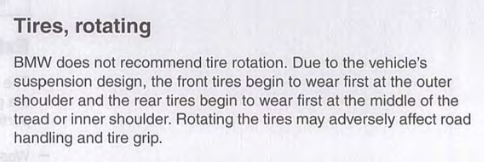
@mnemonicoverload @Alice This is what the Bentley's says about mine:
 glasspshr
@0x575446 @mnemonicoverload @Alice
yep. Also, do they still try to sell rubes on inflating your tires with nitrogen for an extra fee? That was a good one at least as far as a few years ago.
Funny, I never had a tire fail from oxidizing from the inside first…
@0x575446 @Alice @glasspusher I've had wheels leak due to rust pitting of the inner surface of the (steel) rim where it mates with the tire before. Obviously it's highly dependent on your local conditions though and not an issue at all with alloy wheels.
I certainly wouldn't let that rare occurrence convince me to put anything but regular air in my tires though and afik that's not really what they were promoting with the whole "nitrogen" thing anyway. My understanding was the point of it was supposed to be maintaining the same tire pressure regardless if the tires were cold or hot, as if it's somehow a huge burden to check your tire pressures when the seasons change. lol
@mnemonicoverload @0x575446 @Alice
really? Last I checked (so to speak) nitrogen expanded and contracted with temperature same as most other gases. Perhaps they were selling it as being bone dry? I could see how a bit of water vapor could affect things, but isn't that why air compressors have a knock out valve for removing condensed water in the first place?
yeah rilly check your tire pressure a few times a year, it's just common sense
@0x575446 @Alice @glasspusher I think the idea is nitrogen is more temperature stable so it expands / compresses LESS within the normal temperature changes experienced by your tires. I still can't imagine it ever being worth the additional cost and hassle though.
if that's their argument, it's lousy. Air is 78% nitrogen as it is, 21% oxygen, which expands/contracts pretty much the same way.
A friend of mine who got suckered into it, they pushed it as avoiding oxidation/dry rot
I understand that it's morally reprehensible to let a sucker keep their money, but I will carve out an exception for folks who rip people off on their car work
 Indyzign 🏳️⚧️ 🏴
@glasspusher @mnemonicoverload @0x575446 30+ years in the automotive industry, inc sportscars, IndyCar, and F1 - the nitrogen fills are purely about pressure stability with differing temps.
Great for a race car, but road cars don’t need that, not even if you’re Lewis Hamilton/Max Verstappen/Fernando Alonso etc etc
Great for a race car, but road cars don’t need that, not even if you’re Lewis Hamilton/Max Verstappen/Fernando Alonso etc etc
@JamieR @mnemonicoverload @0x575446
Hi Jamie, thanks. I'm a chemist here and familiar with the gas laws and fugacity and PV = nRT and so on. Other than knocking out the water vapor, which would leave you with nitrogen, oxygen and a bit of argon, I don’t see a reason why pure nitrogen would give you more pressure stability than just bone dry air. Perhaps it's easier and cheaper to use nitrogen from a tank, which is bone dry, than to dry out air.
Any additional insight you have into this would be welcome. Thanks!
@glasspusher @mnemonicoverload @0x575446 so I’m no chemist, just a spanner monkey really, but the nitrogen used in tyre inflation is oxygen-free and all moisture removed, which is why it’s more stable.
There’s a really good article here https://www.continental-tyres.co.uk/b2c/tyre-knowledge/nitrogen-in-tyres/
There’s a really good article here https://www.continental-tyres.co.uk/b2c/tyre-knowledge/nitrogen-in-tyres/
@JamieR @mnemonicoverload @0x575446
Hi Jamie,
Thanks. The article was OK, (it had one thing wrong, nitrogen can “support moisture”). At least they said nitrogen wasn't necessary to the average joe.
*but*
if race cars are using it I’m sure it has a benefit. Likely it's the easiest/cheapest way to get dry gas into the tires to avoid any pressure variations from water vapor going in.
Being race car tires are going to get a lot hotter a lot quicker than the average punter's, having dry gas inflating them is a Good Thing
@glasspusher @mnemonicoverload @0x575446 yes, it’s ideal for stabilising pressures in race cars - a couple of psi can make a huge difference in the way the tyre reacts/responds, and behaves, especially at high speed (150+ mph).
Of course, you can set the car up cold with probably something like a 99% accuracy rate, but that doesn’t help when temps drop (safety car period/yellow flags for example). It’s all about the tenths/hundredths of a second
 RacerX
Will It Go Round In Circles
 Sparrow 🎄🎁
 Max Leibman has moved!
@Alice The guy at the garage said my transmission needed work. I told him no thanks, I’m cis.