 Luke Peltier
 nixCraft 🐧
They said by 2020, there won't be any IPv4 left, but the reality is..
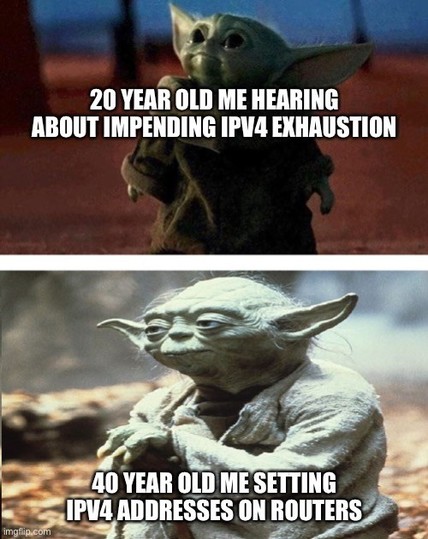
@nixCraft I was on the NANOG mailing list last decade and it was a perennial discussion.
v6 booster: "v4 is obsolete! 96 more bits, no magic!"
Corp network admin: "How do I use DHCP to set default gateway and NTP server and DNS servers and...?"
v6 booster: "That's old thinking! You need to embrace the v6 way!"
Corp network admin: <sets another branch office up with RFC1918 addressing>
v6 booster: "v4 is obsolete! 96 more bits, no magic!"
Rinse, repeat....
@eptesicurse @nixCraft
#IPv6 must be a complete new technology, Google Cloud began supporting IPv6 addressing for VM instances ... last year, 2022.
(Just found out, last time I looked it was only available with extra simulated network stuff as extra layer).
When I first heard about IPv4 and its modern successor IPv6 in a lecture about 25 years ago, I thought: How deep will I have to learn the old IPv4 stuff, in practice IPv6 will soon be used everywhere...
I was young and naive 😉
@atocci @nixCraft we _have_ run out of unallocated IPv4 space, there is now just trading existing allocated space and reclaiming/consolidating devices behind NAT to ensure there are enough IPs for servers.
Market forces push for centralized servers and dumb clients, aka "the cloud", reducing the kind of communication relationships that can be had with normal IP service, making it impossible for any device to talk to any other device without a middleman extracting value somehow.
Maybe the point of ipv6 was to reach around firewalls and leak.
@nixCraft I think it’s a simpler reason they’re not in use, at least at home/office. They are way too long and are hexadecimal so depending on the individual hard to memorize.
2001:0db8:85a3:0000:0000:8a2e:0370:7334
Way to long
 LONG LIVE HERRSCHER OF SENTIENCE!
 Sterling
 BlackSquirrelz 👾
 Øystein Viggen
 Clemens aka data
 Seth 🎙️
 Feacher? I hardly know 'er
 Daniel
 Luigi Rosa
 Technodad
 Oliver Vettra-Morrigan
 Thinkaholic is 🐸 antifa
 Zalasur 🐸🇺🇦
 savaran
 Thomas Schäfer
 train
train Florian 'floe' Echtler
 🄯 CarlOS
 Julie's old account
 Hella (old account)
 Magnus Ahltorp
 Toshiro N.
 Xavier Ashe
 Dean Baguette
 ethersniffer
 atocci
 Raven667
 manchicken moved!
 Yuuka
Yuuka L29Ah
L29Ah B Larson
 Fabrizio T.