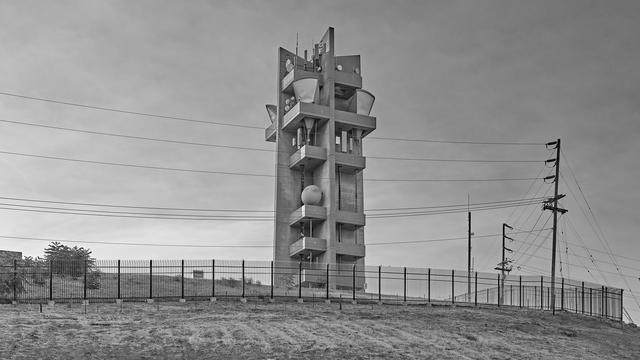
AT&T Long Lines Oak Hill Tower, San Jose, CA 2021.

This unusual Brutalist tower was part of the former AT&T terrestrial microwave network that once carried the bulk of US long distance telephone traffic. The (long since disconnected) horn antennas are too big and heavy to remove.

Too many pixels at https://www.flickr.com/photos/mattblaze/51261791084
#photography

AT&T Long Lines Oak Hill Tower

Flickr
The Long Lines terrestrial microwave network eventually succumbed to changing engineering economics. Putting up microwave links, at scale, was cheaper in the mid 20th century than buying the real estate easements for cable trenches across the entire US. But eventually, the demand for high speed data exceeded the bandwidth available over the (relatively low frequency) microwave links. And a fiber optic cable has enormous bandwidth, making cable links the only viable way to increase capacity.
Ironically, microwave relays have recently been making a comeback in certain niche applications such as high-frequency trading, where the lower latency of radio compared with fiber is an advantage.

Technical note on the photo: Captured with Rodenstock 50mm/4.0 HR Digaron-W lens (@ f/4.5) on a Cambo WRS-1600 camera, about 15mm of vertical shift, Phase One IQ4 -150 digital back (@ ISO 50). dual exposure mode (which preserves a couple stops of additional highlight detail).

I shot this in landscape rather than portrait to preserve context.

@mattblaze It's been a lot longer than "recently" - it's been going on for more than a decade.
@karlauerbach that’s pretty recent, over the history of these technologies.
@mattblaze Funny thing, high-frequency traders are also trying to use high frequency radio, as in shortwave, for long distance low latency links (I'm sure you know that….)

@mattblaze Amusingly, the HFT crowd are even breathing life back into ye olde shortwave radio!

Nothing can beat it in terms of latency between say London and New York ... provided you don't care much about bandwidth, that is.

@mattblaze There's also a proposal before the FCC to allow them to do same on HF at up to 20 kW. https://www.arrl.org/news/commercial-interests-petition-fcc-for-high-power-allocation-on-shortwave-spectrum
Commercial Interests Petition FCC for High Power Allocation on Shortwave Spectrum

The ad hoc group “Shortwave Modernization Coalition” petitioned the Federal Communications Commission (FCC) to allow data communications on multiple bands within the HF 2 – 25 MHz range with up to 20 KW, including in bands immediately adjacent to spectrum allocated to the Amateur Radio Service.

@drb @mattblaze

This penny chasing crowd should sod off this magic narrowband spectrum & take all those pesky OTH radars with them to QRM hell!

Shortwave Trading | Part I | The West Chicago Tower Mystery

Since 2014 this blog has extensively covered the wireless networks built by high-frequency trading (HFT) firms or network providers to reduce latencies between the different exchanges around the wo…

Sniper In Mahwah & friends
@en4rab @mattblaze here in Seattle one of the HF trading Yagis (or log periodic?) is either on or very near a former Long Lines site.
@mattblaze I think I heard that this in turn means HFT can depend on the weather (since microwaves don't like rain). Not quite sure how bad rain fade really is.
@sgf @mattblaze When I first started at MIT in 1994, in what were still the early days of the commercialization of the Internet, we were still connected to NEARnet (one of the NSF-funded regional academic networks) by microwave, although I think by then it had been relegated to a backup role as metropolitan fiber was still getting built out. We would still occasionally get rain fades talking to institutions that were still microwave-only.
@sgf The high-speed connectivity at MIT (a whole 45 Mbit/s connection to NSFnet, never mind that it was shared with 40 other universities) was a revelation having come from UVM where we had a fractional T-1 (128 kbit/s committed, but burstable) to NEARnet. Now I have a thousand times that to my home.
@wollman A less dramatic story: I started uni in the UK in '97, and one of the big attractions was getting Ethernet to your room when everyone else had dial-up (amazing for Quake!). By the end of my PhD, cheap residential DSL wasn't quite there, but it was very close. Things moved quickly!

@mattblaze ... I hate everything about this fact I just learned. 😉

(More seriously, that is technologically fascinating. I just wish the incentive was something more holistically valuable to humanity than "high-profit cheating of the information asymmetry system artificially baked into our trade mechanisms").

@mattblaze

This website has tons of maps, photos, and info about the old network.

https://long-lines.com/

I used to work with a few old Long Lines guys and have been in a few sites that still had lots of MW gear still in them. A few years ago AT&T sold off the sites in my state. One of the ones I work near was converted in to some sort of bunker home.

They carried more then just phone. "Network" TV news and shows used it. Military and computer networks too.

Long Lines Map and Information - Home

@mattblaze "lower latency of radio compared with fiber is an advantage."
Really? Wow. That surprises me.

@spocko @mattblaze
Light moves through glass at ~ ⅔c.
Then, due to how light propagates through fiber, the effective length of the fiber can be 1.5 times the actual length.

So microwaves through the air really can be faster…

@RealGene @mattblaze Fascinating.
@spocko @RealGene yeah, and in practice, there are additional factors that favor radio if you care about latency. Say you need a link from NJ across the Hudson to Wall Street. You can’t just string a fiber in a straight line between the two endpoints. You have to lease circuits in existing cableways. So fiber will be running over maybe 5x the physical distance of a single straight microwave link. And then that multiplies by the .65 velocity factor penalty.
@mattblaze Rights of way along rail lines were why MCI bought Western Union in 1990. Needed a place to run those cables to replace the old analog microwave multiplexers.
@mattblaze As a fan of all things Brutalist, I love this.
@mattblaze I would have believed that the tower was from a Terry Gilliam film.
@mattblaze This is a delightfully unique picture, thanks for sharing it Matt!

@mattblaze That's a very cool piece of archeological, technological, and just general history!

I strongly recommend that anyone following along here follow the supplied Flickr link—both for the better image quality and for the impressively thorough writeup about this artifact.

@mattblaze I remember finding these interesting infrastructure to look at when I was a kid. (Well, I still do, for that matter, though a lot of them did in fact go away)

@mattblaze love me a bit of brutalism.

Wonderful photo thank you.

@mattblaze A lot of Baltic and Eastern European countries build their new gsm telco infrastructure in a similar way around 2000. It were easier and cheaper than fibre. I met their people at countless Nokia trainings courses. For some reason those courses were always in the middle of the Finish winter but I guess that’s why vodka and saunas were invented.

@johnrohde @mattblaze

Who wants to waste a Finnish summer in a Nokia training course?

@mattblaze there are still towers with those horn antennas along Highway 11 in Northern Ontario. Waiting....
@mattblaze … leave it alone …
@shyduroff It doesn't mind if I photograph it.
@mattblaze @shyduroff All that old gear just ran and ran and ran without complaint. It was Long Lines, not Long Whines.

@mattblaze This thing was the view from my backyard for the four years I spent in high school. Today it‘s surrounded by a bunch of housing and commercial, but in the early 90s it was just an empty hill.

https://felt.com/map/Untitled-Map-ZPGxGoNqRh2F2IUeC0gouB?loc=37.283208,-121.850105,15.21z&share=1

Untitled Map – Felt

The best way to make maps on the internet.

@mattblaze OH that's what those are!! There's one in Vancouver with those big horn antennas, I've always wondered what it was (thought it was art 🤣)

@mattblaze It occurs to me that I know very little about this tech.

The microwaves were basically direct-beam transmission to other stations?

@mark right. They acted as repeaters/relays, getting trunk circuits back and forth to the next tower over the hill/curvature of the Earth. Some, like this one, also had switching offices that relayed calls to and between the long distance network and the wire line telephone network.

@mark @mattblaze fun fact: amateur radio can also still use microwaves. https://www.arrl.org/microwave

The circuits are kinda funky because the wavelengths are so short.

Microwave

The American Radio Relay League (ARRL) is the national association for amateur radio, connecting hams around the U.S. with news, information and resources.

@mattblaze Love the look of those sector shaped long range telco microwave antennas.

@nblr @mattblaze

The top floor seems to be still lit. A bunch of small dishies, probably 4G links.

@harkank @nblr yes, it’s currently operated by American Tower, which leases antenna space to land mobile and cellular companies.

@mattblaze @nblr

These tiny telco dishies had spread for a while here in .at like mushrooms in fall. Now they are slowly diminuishing as telco operators are rearranging their networks in the aera of what they call "edge computing" in 5G.
Wireless daisy chains are becoming a thing of the past.

@mattblaze

"The (long since disconnected) horn antennas are too big and heavy to remove."

Are there no meth heads in San Jose?

@mattblaze
It looks like same antenna tech. The tower has multiple units.
Discovery of background radiation in the universe.

https://en.wikipedia.org/wiki/Discovery_of_cosmic_microwave_background_radiation

Discovery of cosmic microwave background radiation - Wikipedia

@Csosorchid Yep, same design (unsurprisingly).
@mattblaze Here's a time lapse of the horn removal from the Sacramento AT&T building back in 2012. It was quite an effort.
@mattblaze The last time you posted this was the first time I looked at your Flickr, and then lost an evening to looking up the AT&T terrestrial microwave network.
@mattblaze we’ve got these at the old AT&T Building next to Whole Foods in Hillcrest, San Diego