 JA Westenberg
A thousand pop-sci anthropology hacks and TERFs just felt a disturbance in the force 🫡
@Daojoan can't remember who put it this way (might have been David Graeber in "Debt"), but it really rings true:
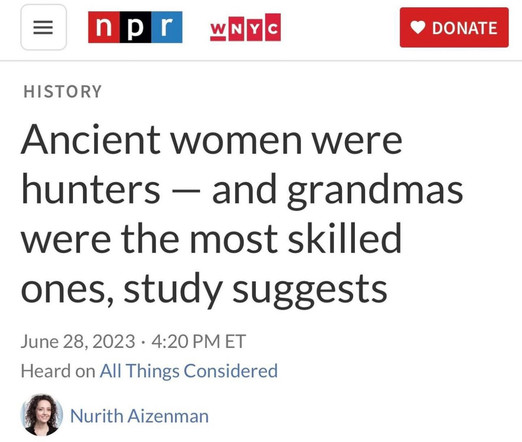
Of course women were equal members of the pre-agriculture tribes! Survival was difficult, and any tribe that attempted to side-line a full *half* of their members from active participation in hunts etc would simply die off.
@forteller @flyhigh @hazelnot @rysiek @Daojoan @srslywrong
Funny, I expected you to recommend "Everyday Anarchism" since he references to Graeber in almost every episode and the title, and right now does a series on Debt.
I totally love both shows!
@titia @Daojoan
The average lifespan of humans in prehistoric times was roughly 35. No medicine, no awareness of disease, bathing & cleanliness were as rare as clean drinking water.
As recently as 100 years ago, the average lifespan was just 65 (which is why "Social Security" & "Retirement" were set to 65.)
Just 250 years ago, "blood letting" was the "cure" for most diseases. That "Red & Blue" stripped barber poll we all know used to indicate the local barber was also a "physician".
@MugsysRapSheet @titia @Daojoan
Average life expectancy was low, average being the key word.
But this is a skewed perspective because the number was low due to high child mortality.
During the middle ages for instance those who survived childhood/birth had a decent chance of living well into their 60s.
They also had clean drinking water, bathing, cleanliness & were aware of disease.
Blood letting is still a thing.
Okay, das würde natürlich eine Menge erklären...😉🙁
Die Art der "nackten Affen" wäre dann durch und durch kriegerisch veranlagt.
Übrigens: Das halte ich für unwahrscheinlich; denn dann hätte wir uns schon längts ausgerottet. Wir können eben auch anders; wenn wir wollen.
@Daojoan just in case I was able to track down the original paper, https://journals.plos.org/plosone/article?id=10.1371/journal.pone.0287101
through Dr. Wall-Scheffler's site at https://wallscheffler.wordpress.com/

The sexual division of labor among human foraging populations has typically been recognized as involving males as hunters and females as gatherers. Recent archeological research has questioned this paradigm with evidence that females hunted (and went to war) throughout the Homo sapiens lineage, though many of these authors assert the pattern of women hunting may only have occurred in the past. The current project gleans data from across the ethnographic literature to investigate the prevalence of women hunting in foraging societies in more recent times. Evidence from the past one hundred years supports archaeological finds from the Holocene that women from a broad range of cultures intentionally hunt for subsistence. These results aim to shift the male-hunter female-gatherer paradigm to account for the significant role females have in hunting, thus dramatically shifting stereotypes of labor, as well as mobility.
 Michał "rysiek" Woźniak · 🇺🇦
 auser
auser Tallbitch
 hazelnot
 Esslar2
 Børge
Børge Ruby
Ruby flo
flo GailV37
 jonny (good kind)
 Amy 🇹🇭🏳️⚧️
 Dave T-W
 Trump & Epstein: Biz partners.
 Titia Schuurman
 Lewis
Lewis Fake History Hunter
 MarjorieR
 cwicseolfor (has moved!)
 Femme Malheureuse
 DadsForSensibleCurfews
 chuls
chuls MistherFrenchFries
 Oregon Wine Woman
 Wolfgang Feist
 Anomielia the #DREADpirate
 John Christian Lønningdal
 Vectorheart
 Badscrew
 Rain Dog
 Rezvan Hosain
 Xenofact (he/him)
 Sci-Fi Girl
 dr jamesbicycle