 Carl T. Bergstrom
1. “Imagine we land a space probe on one of Jupiters’ moons, take up a sample of material, and find it is full of organic molecules. How can we tell whether those molecules are just randomly assembled goo or the outcome of some evolutionary process taking place on the planet?”
2. This is the question at the core of the now infamous Assembly Theory paper published last week in Nature and thoroughly panned on social media.
https://www.nature.com/articles/s41586-023-06600-9
My view? There is actually some very cool science here — it’s just extremely well hidden. This thread is my attempt to explain.

3. Let's get a few things out of the way first.
a) The main text of the paper is terribly written. Terribly.
b) It’s obvious why people understand it and were skeptical to say the least.
c) Nature failed both the authors and its readers by publishing it in its present form.
4. I have two potential COIs, one of which matters and one of which people might claim matters.
The one that matters is that I've collaborated with author Michael Lachmann for nearly 30 years, and we are close friends. This matters because if I didn't know Michael so well, I probably wouldn't have taken the time to figure this paper out.
5. The one that people might claim matters is that I’m currently funded by the Templeton World Charity Foundation.
I would disagree, because they’re an entirely separate organization from the Templeton foundation that funded some of the Assembly Theory research, they don’t care what I say, and I wouldn’t pander to them even if they did.
But I want to be upfront about it.
6. With that out of the way, what does the paper do? The heart of the paper is a simple and elegant exercise in discrete mathematics. Imagine a world of arbitrary objects that can be assembled, combinatorially, to produce additional objects.
7. You begin with a set of elemental objects that require no assembly at all, and you have a set of assembly rules for when two objects can be joined. This then gives you a set of objects that can be created in a single step.
Below, an illustration.
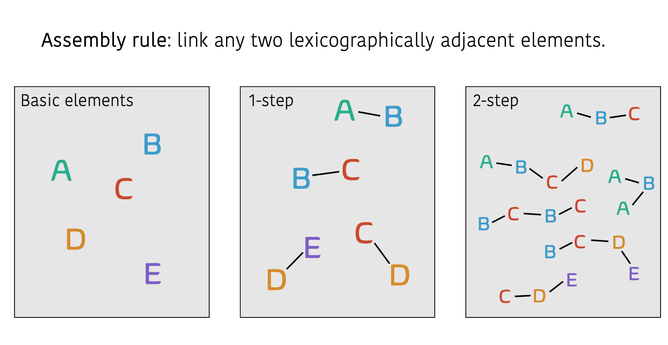
8. Within this framework, we can take any object and calculate the minimum number of unique assembly steps that would have been required to produce it given our set of basic elements and our assembly rules.
9. This gives the ASSEMBLY INDEX of an object.
Example below: The object at left has assembly index of four: 1) join C-D, 2) join two C-D pairs, 3) join two C-D quadromers at an interior D, 4) join two of the resulting octomers.
The one at right has assembly index of five: every link is a unique step.
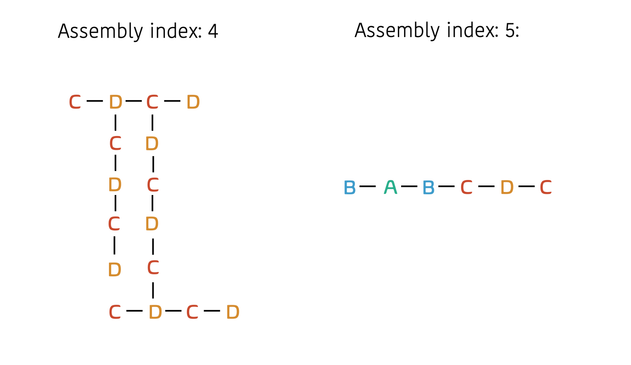
10. (This previous example highlights an interesting relation between modularity / compositionally and the emergence of elaborate form. The structure at left is maximally modular and thus has low assembly index despite large size; the structure at right is minimally modular and so has the reverse.)
11. In a system such as this, one can work out the mathematics of how the universe of possible objects increases with increasing assembly index. In general, it blows up super-exponentially. The Nature paper does this, though most of the details are hidden in the supplementary material.
12. But what happens if not all assembly rules are equally like to be applied, not all objects are equally likely to be incorporated into downstream objects, or not all objects are equally likely to survive?
One can treat that mathematically as well, and the space of observed objects can collapse.
13. Moreover, with strong enough biases in how assembly proceeds, the objects that are produced in high multiplicity of “copy number”. This can occur even for objects that have high assembly index.
Notice that thus far we are still talking about a simple model in discrete mathematics.
14. If we see a world with a high diversity of objects with low assembly index, it suggests that objects are merely randomly assembling and/or disassembling with no particular preference among assembly rules nor much propensity for some forms to survive better than others.
15. If instead we see a world with a low diversity of objects with high assembly index, we then need some explanation for why we these objects instead of the many others that could exist. This explanation might involve biases in assembly — think catalysis — or in survival — think selection.
16. Here’s an example. Suppose we observe world 1 at left. The objects are low assembly index, low copy number. Much of the possibility space at observed assembly indices is filled out.
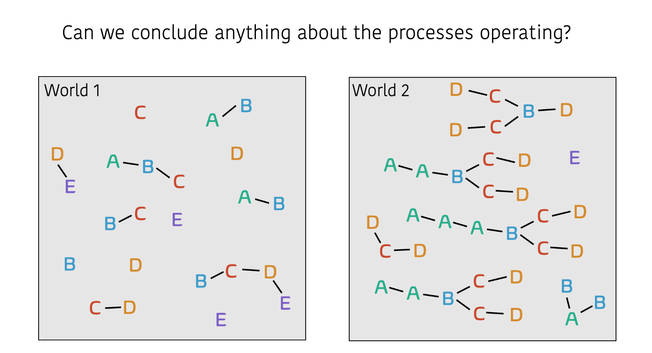
17. Suppose instead we observe world 2 at right. The objects are high assembly index, high copy number. There’s clearly something special about that AA-B-CC-DD structure; it’s either really easy to form, or really stable once formed, or both.
18. Moreover these mechanisms creating preferences for some objects over others are making it possible to create and explore more of the object space for high assembly index objects, instead of getting bogged down in the already massive space of low assembly index possibilities.
19. And this brings us to the money figure from the Nature paper, reproduced below. At the left of the figure we see a world like world 1 above. At right, a world like world 2.
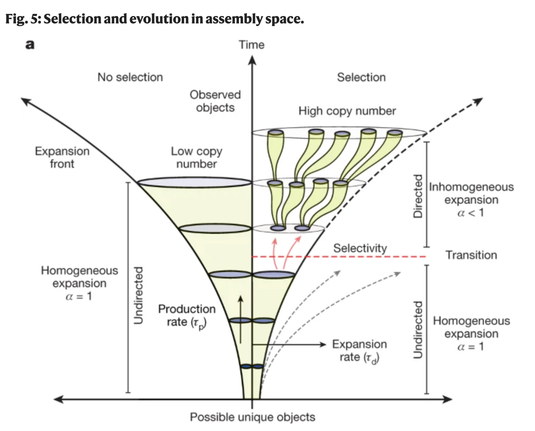
20. At least at the metaphorical level, life on earth, of course, is like the world at right. Highly complex molecules, organisms, etc., at high assembly numbers, tightly clustered in possibility space. This paper helps us solidify what is special about the biological complexity we observe here.
21. Returning at long last to the question at the start of the thread, how do we know if our organic soup from a Jovian moon is the product of some evolutionary process:
If the discrete math model from the paper’s supplementary material can be ported to real-world chemical environments using e.g. mass spectroscopy, we basically know how to build an evolution-detector that we could put on a space probe.
22. But what I find even cooler is that this paper gives me a new way to think about how the complexity and compositionality of structures in the universe relates to the processes that led them to come into existence and persist long enough to be observed. At it’s core, that is assembly theory.
 katch wreck
@ct_bergstrom one problem with this is that it treats molecules as classical objects, i.e. based on independent point masses, which violates Heisenberg's assumption that the true system state is a higher-dimensional function dependent on all of the variables coupled together, simultaneously, and which is in principle unobservable. even the concept of a "particle" is just an approximation of this high dimensional function in the form of a factorization. it's unlikely that biology is so simple
@katchwreck Remember, this is a model in discrete mathematics, not a model of physics.
@ct_bergstrom right, but they are chemists claiming that it explains evolution
 TJ Radcliffe
In highly dispersive environments all that is ~irrelevant. It's extremely unlikely that the ur-space of the universal wavefunction is a significant factor in biology, even at the molecular level, beyond some very, very special cases.
@tjradcliffe @ct_bergstrom i'm sorry, but this is a totally biased and unfounded assumption! case in point: the Cry/MagR complex. there's *no way* this could have evolved using ball-and-stick approximations