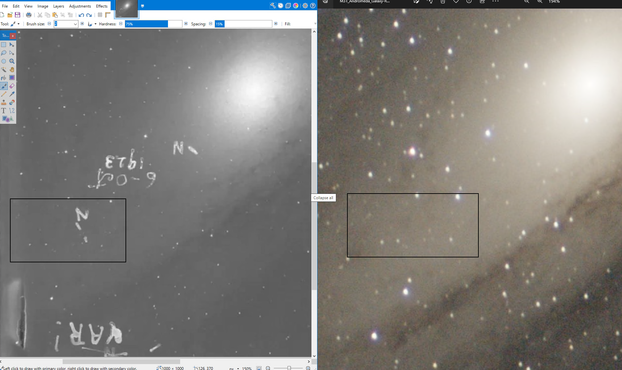
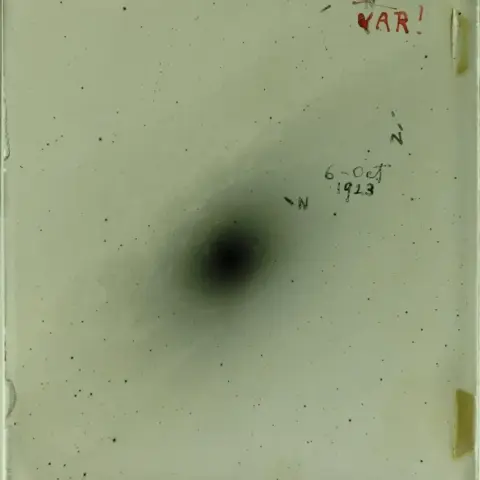
It's the 100th Anniversary of the "VAR!" plate, when humanity first had physical proof to understand the scale of the Universe. Happy VARDay, everyone!
#Astronomy #Astrodon #HistoryOfScience #Science #Telescopes #MtWilson #VARDay
@thomasconnor Does that star have a name? Can it be seen with midrange amateur equipment, like 5-8" telescopes? What is its period? Might make for a fun #AmateurAstronomy project. #AAVSO

@hendric It's "V1" -- and we've gone back to look at it, since. Hubble used the 100 inch Hooker telescope, albeit with a photographic plate instead of modern CCDs. My wholly off-the-cuff guess would be you'd need something a little bigger than that, all the same.

But there have been follow on projects: https://hubblesite.org/contents/news-releases/2011/news-2011-15.html

@thomasconnor Looks like I just barely missed it in my 80mm f/5 with 30 minutes the last time I did an Andromeda picture a few years ago. https://hendric.smugmug.com/Hobbies/Astronomy/20201221-Dark-Skies-at-Bastrop/
I'm sure it's well within the mid-range of #AmateurAstronomy if a schmuck like me almost got it. I've since upgraded to a much better telescope and mount. I'll give it a try soon and see what I can get!
20201221 Dark Skies at Bastrop - hendric

Pictures taken under dark skies in Bastrop, TX

@hendric You might have also caught it in a faint period. Either, way, clear skies and good luck! It's wild what modern amateur scopes can do!
@thomasconnor Great point! I did find an article from a few years ago discussing capturing it with a 350mm high end telescope. I think my 90mm F/6 should be able to capture it though. It has much better focus and is apochromatic vs my ST80 F/5 "colors lol" old scope.
@thomasconnor I dunno, the zoom image on this is just baffling to me, it doesn't look like the right FoV at all. I didn't find any contact info for the author to ask for clarification on which star is V1. https://www.astronomy.com/science/the-star-that-changed-the-cosmos-m31-v1/ #astrodon #AmateurAstronomy
The star that changed the cosmos: M31-V1

An astroimager follows in Edwin Hubble’s footsteps to prove the utter vastness of our universe using a single star.

Astronomy Magazine