I am feverish in bed post-vaccine, please tell me a cool fact about something
@ian OK, I’ll chime in:

Most writing systems either evolve over generations, or are created by expert linguists.

But Cherokee’s was invented by one person, Sequoyah, who not only was not a linguist, but never went to school and never learned to read or write.

He saw English-language books, and despite not speaking English, understood the general principle, and thought, ā€œI can do that for my language!ā€

He spent 12 years developing his writing system, and it is still the standard today.
@ian
In _Languages of the World_, Kenneth Katzner remarks that the creation of a writing system that suits its language so well by someone with no linguistic training at all ā€œmust surely rank as one of the most impressive intellectual feats achieved by a single person.ā€

More:
https://en.wikipedia.org/wiki/Cherokee_syllabary

https://en.wikipedia.org/wiki/Sequoyah#Creation

Cherokee syllabary - Wikipedia

@inthehands @ian I think an awesome thing about this is that he basically tried some of the major historical approaches, discarded them as impractical and kept trying.
@inthehands @ian oh, that reminds me of the history of hangul
Hangul - Wikipedia

@inthehands @ian Very cool. I'd often wondered about the unusual glyphs, and "saw a book, didn't know the letters, invented their own" is impressive.
@inthehands @ian I’ve designed several fonts that include the Syllabary. Let me tell you, kerning is a big challenge. There are very many overhangs to take into account.
@ossobuffo @ian Ha, wow, I can only imagine what that undertaking involves! Though kerning Cherokee is probably home base kind of stuff for a mind that can handle notating in Lilypond. 😜

@inthehands @ian It's not even the only script designed by an illiterate person who had seen written language, Pahawh Hmong was designed by Shong Lue Yang in the 1900s for Hmong and is still used in addition to Latin

It's quite interesting seeing how Cherokee has characters that look like Latin and Pahawh has characters that look like Thai

@inthehands @ian

Second fun fact: precisely because he never learned how to read beforehand, and also because the phonetics of his language are syllable-focused like Japanese, Sequoyah lifted several
#Cherokee / #Tsalagi glyphs directly from the Latin alphabet, but in such a way that their phonetics do not match their Latin counterparts. That can be expected, but to not have a single match after dozens of instances, out of casuality, is statistically impressive. For instance:

- įŽ  makes an "a" sound, while įŽ“ sounds like "le"
- įŽ” makes an "e" sound, while į’ sounds like "sv", where the "v" sounds like the "a" in "about"
- įŽ¢ makes an "i" sound
- įŽ¤ is so close, but it makes an "u" sound, and į« sounds like "wi"
- įŽ„ sounds like "v" (see above)
- įŽ© sounds like "gi", while įŽ½ sounds like "mu"
- įŽŖ sounds like "go", while įŽÆ sounds like "hi"
- įŽ« sounds like "gu"
- įŽ¬ sounds like "gv", while į‹ sounds like "quv"
- įŽ± sounds like "hu" despite of looking like the Cyrillic "g"
- įŽ³ sounds like "la", while į” sounds like "ta"
- įŽ¶ sounds like "lo"
- įŽ· sounds like "lu"
- įŽ» sounds like "mi", while į² sounds like "yo"
- į† sounds like "qua"
- įŽ sounds like "se"
- į™ sounds like "do"
- įš sounds like "du"
- įž sounds like "tle"
- įŸ sounds like "tli", while į£ sounds like "tsa" and įØ like "tsv", and į© like "wa" and į³ like "yu" (confused yet?)
- į¢ sounds like "tlv", while įŽ® sounds like "he"
- į¤ sounds like "tse"
- į¦ sounds like "tso"
- į® sounds like "wv", while į° sounds like "ye" and į“ sounds like "yv"

@csolisr

When I learned the syllabary several years it felt like I had to unlearn the association of those glyphs with Latin lookalikes!
It's also interesting that Sequoyah's original syllabary was very squiggly and quite unlike the Latin alphabet—'twasn't 'til the problem of printing presented itself that he made the simplified, blockier script we know and love today, tweaked thereafter by Elias Boudinot and Samuel Worcester.

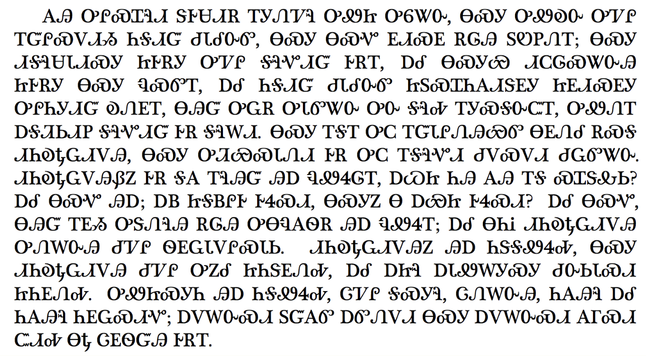
@inthehands @ian I looked at the image first and thought ā€œwhat a weird font, I can’t read any of thatā€. Before realizing its not English

I guess that matches the background of looking at english books without knowing the language though!

@cinebox @ian
I believe he also took inspiration from Greek and Hebrew scripts. And he just kinda…vibed with the letters, and chose the sound-symbol pairings that made sense to him. I love the boldness of that. Dude just had an internal compass and followed it through the whole damned wilderness until he had a writing system.
@inthehands It's such an awesome thing, thanks for pointing it out. Much more than just an interesting fact!
@inthehands @ian rumored to be one of my mom’s ancestors.
Could be …he did father a lot of children in his wandering
Inherited this from her when she died
@MishaVanMollusq @ian Oh, cool! There certainly are worse things to have in one’s family history!
@inthehands @ian unconfirmed .
If not a genetic ancestor then defintely one of spirit
@MishaVanMollusq @ian
Well, a beautiful thing about family lore is that the telling is at least half of what matters, and things don’t need to meet academic standards of rigorous historical verification to become a part of the family fabric.
@inthehands @ian this came up when she was doing the family genealogies, and the clue was from a local member of AIM
@MishaVanMollusq @ian Well see already your family history is badass
@inthehands @ian Pirates and Methodist Circuit riders on pop’s side .
He’s not Cherokee by a long shot

@inthehands @ian

And the tree is named after him, not the other way around.

@eestileib @ian How the trees got their name is apparently an open question, but the botanist in question naming them in honor of the person is a leading theory. This much at least we know for certain: the person was named before the tree.
@inthehands @ian I get astonished by what Sequoya achieved. I can only express admiration every time for his efforts and the gift of the Cherokee writing system
@inthehands @ian And it suited the language so well that Cherokee went from "no written form" to "most people who speak the language are literate" in a decade or so.

@inthehands @ian The Korean writing system was also created all at once, although it was a decision to switch from Chinese characters to a native system. https://en.m.wikipedia.org/wiki/Origin_of_Hangul

It was ā€œcreatedā€ by King Sejong the Great, but I am somewhat skeptical that he did so truly alone—it’s easy for the boss to take credit for the team’s work, as it were. (I’m not trying to imply anything about Cherokee here, Sequoyah probably didn’t have a court of professional scholars on hand.)

Origin of Hangul - Wikipedia

@standev @inthehands @ian The coolest bit about Hangul, though, is that the shape of the letters are a cue to how to make the sound. So they’re not just arbitrary shapes. I don’t know of another script system that tries to represent the biology side too.

https://takelessons.com/blog/learn-hangul-korean-alphabet-for-beginners-z11

https://en.m.wikipedia.org/wiki/Hangul#Letter_design

@inthehands @ian Very distinctive and IMO beautiful glyphs