Evidence of America’s — and the world’s — climate migrations are mounting.

In this thread, I’ll collect all the papers, news items and anecdotes I find on the subject. Feel free to contribute by using this tag:

#climatemigration

It’s starting with insurers. When homes are destroyed and homeowners lose everything, with no recourse, market forces herd people away from the zones of greatest vulnerability:

https://www.washingtonpost.com/business/2023/09/03/natural-disaster-climate-insurance/

#climate #climatechange #adaptation #climateimpacts

🧵
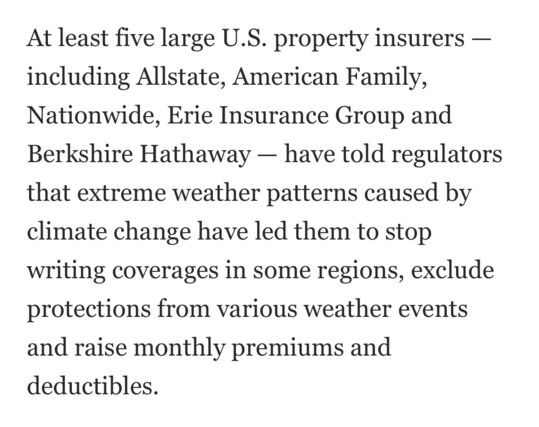
Home insurers cut natural disasters from policies as climate risks grow

Major insurers say they will cut out damage caused by hurricanes, wind and hail from policies underwriting property along coastlines and in wildfire country.

The Washington Post

Tech workers who fled to Austin during the pandemic are being repelled — Austin is #3 in the country for outmigration now — by a summer that has smashed all records for heat, with well over a month of days above 100 degrees.

This is a profoundly different weather than Austin had 20 or 30 years ago.

🧵 #climatemigration #climatechange

https://www.businessinsider.com/tech-workers-moved-to-austin-regrets-2023-8

Some tech workers who moved to Austin are having regrets

Drawn by the promise of an emerging tech hub, some tech workers who flocked to Austin found a middling tech scene, subpar culture, and scorching heat.

Insider

In areas most vulnerable to climate change-enhanced disasters, like Florida, the cost of home insurance has gone up so much that it’s now affecting how much lenders will give — potentially pushing many out of the home ownership market altogether.

Others are risking having no insurance at all, gambling on complete financial ruin should their home be damaged or destroyed.

🧵 #climatemigration #climateimpacts #climatechange

https://www.wsj.com/personal-finance/americans-are-bailing-on-their-home-insurance-e3395515

Americans Are Bailing on Their Home Insurance 

Some homeowners who are skipping coverage say they can no longer afford rising premiums

WSJ

One thing I've discovered in my own reporting is how many incipient threats are just waiting in the wings, for a single bad season, a single black swan event to make entire towns uninhabitable.

People who don't live out west don't know this, but entire towns have burned to the ground, forcing everyone to leave.

A prime example: Grizzly Flats, California.

1,200 residents. Most of their homes burned to the ground in 2021

#climatechange #climatemigration

https://www.wsj.com/articles/they-moved-to-rural-california-for-affordable-homes-then-the-caldor-fire-destroyed-the-town-11636207202

They Moved to Rural California for Affordable Homes. Then the Caldor Fire Destroyed the Town.

Growing populations of towns in ‘wildland-urban interface’ is a key reason for rising wildfire threat in the West, researchers say

WSJ

“We can say now that people are dying from climate change, and that’s a different kind of statement than we would have made before”

"By 2050, the number of people suffering from a month of inescapable [extreme] heat could further grow to a staggering 1.3 billion."

https://www.washingtonpost.com/climate-environment/interactive/2023/pakistan-extreme-heat-health-impacts-death/

via @therockyfiles

#climatechange #climateimpacts #climatemigration

Pakistan bears the brunt of global extreme heat illness and mortality

Climate-fueled disease — tied to heat, pathogens and toxins — is an emerging, lethal threat that countries are ill-prepared to confront. The Post visited ground zero for this new era, Pakistan, to see what the future holds.

The Washington Post

@mimsical

Can it really count as a "black swan event"? I'm thinking of how climate change makes suchlike fires increasingly likely to happen.

In the old times, it would have been one. But that was a different world. Today's probabilities include a lot more fires.

:-(

@unchartedworlds @mimsical

Honestly, it wasn't rare for such things to happen in the 19th century. You just don't know about them because that was the past, and those communities were far more isolated than they are now.

Then in the 20th century, organizations such as the US Forest Service dedicated themselves to making fires rare, and town-destroying fires nonexistent. Unfortunately, as the threat receded into the past, funding for such efforts dried up ; and there's a legacy of poorly-thought-out practices which left more available fuel for destructive fires. It can be nearly impossible to do a "controlled burn" in California, for instance, owing to a variety of conflicts among regulatory agencies.

@tsukkitsune

Oh interesting, thanks for the info. I have read other stuff about the "controlled burn" & other management rhythms being abandoned & that wisdom lost, & that being a factor.

@mimsical

@unchartedworlds @mimsical Some places black swans are really common. Things are changing. Can't make any assumptions based on previous weather/climate
Climate-proof Duluth? Why the city is attracting 'climate migrants'

Two years ago, a Harvard professor identified Duluth as a potential destination for future “climate migrants” — people who leave their homes due to rising sea levels or climate-related extreme weather. While initially met with some skepticism from locals, some people have already moved to Duluth because of climate change. And more are looking to come.

MPR News
@bryanhansel yes! great story, good addition to this thread
@bryanhansel @mimsical I haven't been to Duluth in ages and now I want to see what the southern transplants have done to the place.
@brianvastag @mimsical it's pretty much the same except the medical industry has exploded in size.
@mimsical They're not even Black Swan events anymore unless you aren't paying attention to the science. A significant rise in major catastrophes like out-of-control wildfires, flooding after heavy rain, deadly heatwaves, etc. is to be expected.
@mimsical And if you live in any coastal area, you might want to get away from there. If you own any property in a coastal area, it will probably become entirely worthless in the future, so if you can find some idiot who will buy it, make sure they deserve it and aren't just some poor deluded sucker. Sea level rise is the whitest of white swans now, it happens in plain sight.
@mimsical companies like kin insurance specialize in going into insurance markets others won't. Their claim is that their automated data pipelines and lack of brick and mortar agent costs (alongside charging the appropriate premium) allows them to take on these risks. Time will tell if that will be the case.

@grumpasaurus @mimsical

More likely it's a marketing scam being ignored by Republican regulators and GOP oversight boards.

They will accept high price premiums from home owners who are grateful to get any insurance at all. Home owners get desperate because many mortgage lenders will close loans when there's no property insurance.

Then the insurer will declare bankruptcy just like insurers did after Katrina.

There's been huge consolidation of insurance into the hands of #KochNetwork donors.

@Npars01 @mimsical it's always interesting when such high unit economics still pursues such a big funding round
https://www.businesswire.com/news/home/20230322005218/en/Kin-upsizes-its-Series-D-round-to-109M
Kin upsizes its Series D round to $109M

Kin, the direct-to-consumer home insurance company built for every new normal®, today announced that it conducted a third close, an incremental $15 mi

@grumpasaurus @mimsical

Markets should heed Dan Arielly's books, especially "Predictably Irrational"

https://en.m.wikipedia.org/wiki/Dan_Ariely

Dan Ariely - Wikipedia

What Your Insurer Is Trying to Tell You About Climate Change

Insurers are trying to send a message. The government is trying to suppress it.

The Atlantic
@obrien_kat ah, saw this one, haven't read it yet - ty for sharing
@mimsical Thanks for reporting on this. I think that insurance is one of the most powerful, yet often overlooked, mechanisms for shaping societal behavior and choices in response to change. See self-driving cars

@marcelsalathe @mimsical

Insurance and risk management services only work as a corrective in a free market.

Instead, the oil industry has been buying up insurers and consolidating the property insurance industry for over a decade.

They plan on declaring bankruptcy in the event of disaster. Or getting a government bailout.

Reminder, the same overconsolidation is happening in the life insurance industry too. They plan on not paying settlements in mass death events too.

@Npars01 @marcelsalathe @mimsical homes and lives worthless in the eyes of Capitalism.....

@mimsical Sounds like there is 3 groups of homeowners in Florida.

1 is the uninsured who risk complete ruin if disaster hits.

2 is those insured with Florida which seems not to have enough reserves to cover a big disaster. If disaster hits they will likely only get a fraction of what they need (also risk of complete ruin).

3 is those insured with private insurance. If a big disaster happens, these companies will fight claims to avoid bankruptcy.

Thus risk of complete ruin for all groups

@michaelwong
Long term it doesn't even matter much what insurance you have, when you eventually sell the price will be rock bottom.

People currently holding properties at risk should hurry out before everyone else does and the market crashes.

@mimsical

@notsoloud @mimsical

I fully agree but also say do a lot of research into the new place you move.

@mimsical @briannawu So…am I supposed to feel sympathy for these people that bought in areas that are clearly going to get wiped out on a regular basis?

I believe in insurance, just like I believe in unionism. We protect each other. But if you’re going to choose risky behavior that is solely for your benefit, you should pay for the risk. Not me.

@mimsical Medical bankruptcy and natural disaster bankruptcy. It must be very exciting living in the US.
@mimsical Rates for commercial property insurance *elsewhere* in the US ( personal experience in MKE, WI ) are also going up because of climate change related claims impact on the re-insurance market for US property insurers.
@mimsical Compare California, where State Farm simply refuses to sell home insurance entirely https://calmatters.org/housing/2023/05/state-farm-california-insurance/
State Farm won't sell new home insurance in California. Can the state shore up the market?

Deadly wildfires and expensive construction costs are driving State Farm out of California's home insurance market.

CalMatters
@mimsical
No one wants to admit home prices will fall to more reasonable levels? Ordinary homes should be 5 figures, not 6. That will make insurance costs more affordable as well.
@mimsical
Its not just home owners that need home insurance. Home Contents insurance is needed by anyone who has somewhere to live be they a tenant or home owner.
@mimsical But FL is too fascist to beef up building codes to match the challenges climate will hurl at its residential infrastructure. And building and the ownership of buildings is already hurting because of inflation. Insurers eventually bring about improvements in codes but I see that effect mostly in fire and electric codes.