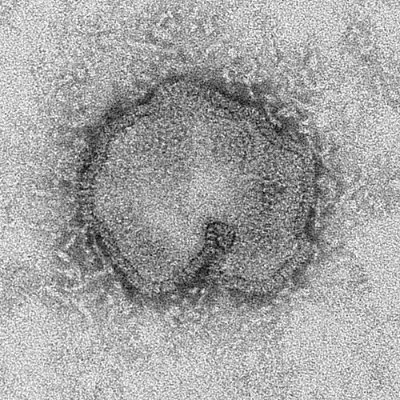
1/9
Some people feel that SARS-CoV-2 infection of the brain is "rare". (e.g. <10% of cases)

But can we really say that #SARSCoV2 infection of the nervous system is rare? ๐Ÿค”

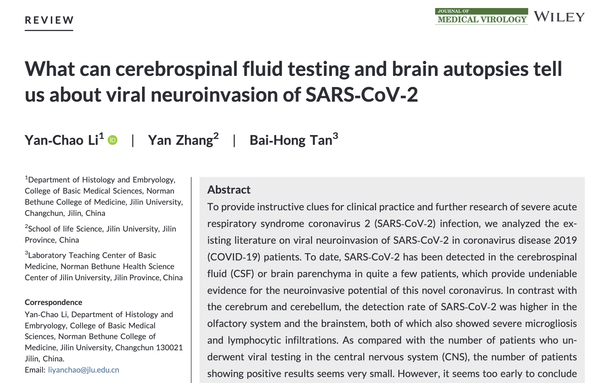
That's a question posed by neuroscientist Yan-Chao Li of Jilin University in his literature review and meta-analysis:

"What can CSF testing & brain autopsies tell us about viral neuroinvasion of SARS-CoV-2?"
https://doi.org/10.1002/jmv.26943

๐Ÿ‘‡ Thread below ๐Ÿ‘‡

#virus #virology @virology #InfectiousDisease #coronavirus #covid
@pyrrhus @virology How often might persistent brain infection- not shown by nasal swab- be the cause of #longcovid ?

@trueinfections @pyrrhus @virology

It contributes to be sure, but Covid is tricky, just because someone is asymptomatic doesn't mean they're not infected--what is true during acute Covid is also true during chronic manifestations of the disease.

@trueinfections

Great question. Unfortunately, we don't yet have a great answer.

It's challenging to detect the virus in the brain at autopsy. It's even more challenging to detect the virus in the brain in a living individual.

Therefore, new technology will likely be needed in order to answer your question appropriately...

@pyrrhus Could imaging find it? Would there be viremia from a brain infection? Could testing the blood reveal that?

@trueinfections

Unfortunately, true imaging is not yet available.

And most neurotropic viruses are not detectable in the blood after the first few days post infection.

This is why polio was always diagnosed based solely on symptoms, because there simply was no poliovirus to test for in either the blood or the CSF. But doctors who took the time to carefully observe patients could usually recognize the particular set of neurological symptoms that typically come with a poliovirus infection.

@pyrrhus Considering the many dimensions of #COVID19 , I wonder if it really is different from most other #infectiousdiseses . Or is it that thereโ€™s a before for comparison?