I have so many questions about what just happened with Voyager 2. But let's review:

On August 20, 1977, Voyager 2 was launched from Earth.

In December 1977, it entered the asteroid belt.

In June 1978, its main radio receiver failed. Since then it's been using the backup receiver!

On July 9, 1979, it flew past many of Jupiter's moons, made its closest approach to Jupiter, and took tons of beautiful pictures.

On August 26, 1981 it shot past Saturn and took tons of beautiful pictures.

On August 25, 1989 it shot past Neptune and took tons of beautiful pictures.

On November 5, 2018 it crossed the heliopause and entered interstellar space, 120 times farther from the Sun than we are.

On July 18, 2023, it overtook Pioneer 10 and became the second farthest man-made object from the Sun.

3 days later, some idiot sent a command that pointed its high gain antenna 2 degrees away from Earth. HOW EXACTLY DID THIS HAPPEN?

On August 4, 2023, NASA used its most high-powered transmitter to successfully command Voyager 2 to reorient towards Earth, resuming communications. HOW WAS THAT POSSIBLE?

Voyager 2 is now 133 AU away. How can you "shout" across such a distance and attract the attention of someone who is not looking in your direction? That's very far. It takes light about 18 hours to travel that far.


@johncarlosbaez As far as I heard, Voyager was programmed to "right itself" in case it found that it wasn't pointed in the general direction of the Earth, which it would check by taking pictures of reference stars. Don't quote me on that, though.

EDIT: Corrections given in replies!

@dragfyre @johncarlosbaez That would have happened, eventually, but that's not what actually happened. AFAIK, the antena does not have a single high sensitivity direction (think of diffraction patterns), so even if it's pointing in the wrong direction it's possible to target one of the lower "secondary sensitivity peaks" if you beam loud enough. But bear in mind that IANAVI (I'm not a Voyager engineer)

@RGBes
@dragfyre @johncarlosbaez

That's correct. As with all antennas, Voyager's high gain antenna has an antenna pattern with a main high gain lobe, but also has sidelobes. In other words, it will pick up signals from other directions, but they have to be stronger.

The farther off axis, generally speaking, the lower the gain and the stronger the signal has to be, but it's not an even decline.

In this case, fortunately, NASA was able to send a signal of sufficient strength that Voyager picked it up anyway.

@johncarlosbaez @RGBes @Jwilliams @dragfyre About that error in commands: there is an investigation in progress and we will learn what happened. I spent most of my career at JPL. I pushed for automation of the operations consoles in the Deep Space Network. In addition to controlling the antennas and ground data systems, these consoles are used to send routine commands to spacecraft. (continued)
@johncarlosbaez @RGBes @Jwilliams @dragfyre I did not succeed in persuading NASA to upgrade the ops consoles. Why? International prestige and labor politics. DSN stations are located worldwide, with the largest 60 meter antenna dishes in the US, Spain, and Australia. Other than in the US, the operator console jobs are considered very high tech and important to national prestige. (continued)
@johncarlosbaez @RGBes @Jwilliams @dragfyre The jobs are also staffed by union members under contract. Any proposed change to the consoles that would even appear to automate them is rejected immediately. My hypothesis about the mid command: operator error. Why? In my day, consoles used a command line. Everything was typed manually. Typos are not frequent, but they occur. 🤷‍♂️

@johncarlosbaez So I take it Voyager 1 is furthest from earth. After reading this I has more reading to do…

Thanks for the info  

@mxtthxw - Voyager 1 is the farthest from Earth, and moving faster too!

But for a few months each year, the distance between Earth and the Voyagers decreases.

@johncarlosbaez I can’t find the reference any more, but I read in a news story that the erroneous command was an earlier, correct command resent by mistake — i.e. some set of past instructions that were useful at the time they were first sent, but were accidentally sent again rather than a suitably updated version.

@gregeganSF - Very interesting! I find it annoying, though not shocking, that all the official NASA communications that I've seen about this so far are quiet about the details of what happened. E.g.:

"A series of planned commands sent to NASA’s Voyager 2 spacecraft July 21 inadvertently caused the antenna to point 2 degrees away from Earth. As a result, Voyager 2 is currently unable to receive commands or transmit data back to Earth."

https://www.jpl.nasa.gov/news/nasa-mission-update-voyager-2-communications-pause

NASA Mission Update: Voyager 2 Communications Pause

Once the spacecraft’s antenna is realigned with Earth, communications should resume.

NASA Jet Propulsion Laboratory (JPL)
@johncarlosbaez @gregeganSF they probably got #inches and #cm muddled up again
@johncarlosbaez @dominic @gregeganSF I always think of Hubble when I’m measuring anything. Measure twice and cut once.
@seb321 @johncarlosbaez @gregeganSF @dominic It was a Mars orbiting spacecraft, not Hubble. The contractor flying the spacecraft used English units for reporting the force of the engines. JPL used metric units to plan and track the trajectory from Earth to Mars. The numerical difference was extremely small, but over time it added up and the spacecraft was unable to enter Mars orbit. Buh Bye!
@dominic @johncarlosbaez @gregeganSF Don’t start that up again, please. Lesson learned. Everything is in metric now at JPL.

@johncarlosbaez @gregeganSF this stuff about the bad commands sent to the Voyager probe and so on remind me of the story of doing Lisp debugging on a rover on Mars:

https://www.corecursive.com/lisp-in-space-with-ron-garret/

LISP in Space - CoRecursive Podcast

Have you ever had a unique approach to a problem and been excited to use it, but you're met with skepticism?Today's story: what happens if you take someone who's passionate about LISP and put them in an organization where that's just not how they write software.Today's story is about getting LISP into space.The year is 1988. The USSR still existed.... […]

CoRecursive Podcast
@ddrake @johncarlosbaez @gregeganSF Ron Garret was in my Section at JPL. Thanks for posting this link. I’d lost track of Ron. Perhaps we can now reconnect!

@johncarlosbaez Security Now covers some of this in episode 933

https://www.grc.com/securitynow.htm

"A series of planned commands sent to NASA’s Voyager 2 on July 21St inadvertently
caused the antenna to point 2 degrees away from Earth. As a result, Voyager 2 is currently
unable to receive commands or transmit data back to Earth---

--Voyager 2 is programmed to reset its orientation multiple times each year to keep its antenna
pointing at Earth; the next reset will occur on Oct. 15

GRC | Security Now! Episode Archive  

Security Now! Weekly Internet Security Podcast. This week describing the newly revealed SockStress TCP stack vulnerabilities.

@BigMalCampbell - thanks! But I really want to know is how someone screwed up the "series of planned commands". NASA needs to analyze this mistake to reduce the chance of it happening again.
@johncarlosbaez @BigMalCampbell it may have been commands to steer the antenna as the Earth orbits around the Sun?

@johncarlosbaez Amazingly, the radio power received on earth from the Voyager spacecraft transmitting in the GHz range at 20 W is about an ***attowatt (1e-18 W)***, since they are on the order of 20 billion kilometers from earth !

See info here (it refers to Voyager 1 but for these estimates I think both Voyager are about the same figures):
https://public.nrao.edu/ask/how-strong-is-the-signal-from-the-voyager-1-spacecraft-when-it-reaches-earth/

#Voyager #Voyager2

How Strong is the Signal from the Voyager 1 Spacecraft When it Reaches Earth? - National Radio Astronomy Observatory

Question: What is the signal strength in watts received by the VLBA that is transmitted from Voyager 1? I...

National Radio Astronomy Observatory
@FMarquardtGroup - amazing!
@johncarlosbaez @FMarquardtGroup POWER RECEIVED
-160 dBm
(1.0 x 10⁻²² kW). Source: https://eyes.nasa.gov/dsn/dsn.html
VGR2 - Canberra antenna (now)
Deep Space Network Now

The real time status of communications with our deep space explorers

Deep Space Network Now

@FMarquardtGroup @johncarlosbaez

Do they mean that the total energy absorbed by the Earth is ~1e-18W? If not, I'm confused by the units: I'd expect people to talk about power per unit of surface area.

@robryk @johncarlosbaez No, I believe that number already figured in the size of the receiver antennas (and the directionality of the transmission), so it is the overall power received. But it doesn't say explicitly there.
@robryk @FMarquardtGroup @johncarlosbaez ...and also "per Hz of bandwidth". As given, this number really doesn't tell us a lot...

@johncarlosbaez Since these signals are so weak when they arrive at earth, they need to be amplified by low-noise amplifiers operated cryogenically, at low temperatures:

https://science.nrao.edu/facilities/cdl/low-noise-amplifiers

There is a nice discussion inside the following report, pointing out that a Kelvin reduction in the operating temperature of the receivers increases the data rates in a way that you may save on the order of 100 million dollar over a 20 year period in the deep space network: https://safe.nrao.edu/wiki/pub/Main/GalenWatts/Reid_DESCANSO_sml.pdf

Low Noise Amplifiers - Pushing the limits of low noise

NRAO Science Site

@FMarquardtGroup @johncarlosbaez
Well, 1 attowatt @ 20 GHz is still quite a bit of photons per millisecond (76, if my math is right), courtesy of the itsy bitsy tiny weeny Plank constant. A light source of that power in a dark room is easily perceived 😉

Wasn't Robert McElice involved in the engineering of the error-correcting code used for the Voyager? Am just amazed at what they could fit in that tiny computer.

@fgcallari @johncarlosbaez Great pointer to error correction! Here is a stackexchange discussion on which error correction codes are used for the #Voyager spacecraft communications:

https://space.stackexchange.com/questions/54055/did-the-voyager-spacecraft-use-a-golay-a-reed-solomon-and-or-a-hamming-code-for

This is beyond my expertise, but anyways obviously very advanced and impressive!

Did the Voyager spacecraft use a Golay, a Reed-Solomon and/or a Hamming code for data transmission encoding for error correction? (Need clarification)

The now-famous answer to How is stacking oranges in 24 dimensions related to receiving and decoding signals from the Voyagers? is worth stopping now here and going back and reading first. Okay welc...

Space Exploration Stack Exchange

@fgcallari @johncarlosbaez Great talk about the #Voyager mission:

https://www.youtube.com/watch?v=H62hZJVqs2o

Mostly about the engineering, computer system, and redundancy.

@FMarquardtGroup -

Thanks, I'm checking out that stuff! The Golay code, used in the Voyagers' Jupiter and Saturn flybys, is a 24-bit code where 12 bits convey the message and the other 12 bits, computed from the first 12, are used to tell if the first ones were transmitted correctly. The second 12 are computed from the first 12 using a dodecahedron as shown here by @gregeganSF. I explain this stuff in more detail here:

https://blogs.ams.org/visualinsight/2015/12/01/golay-code/

I need to learn more about the other codes used by the Voyagers!

@fgcallari

@johncarlosbaez @FMarquardtGroup @gregeganSF @fgcallari is this related to the kind of error correction a CD player head uses?

@u0421793 @gregeganSF @FMarquardtGroup @fgcallari - it's related, but a CD player doesn't use a Golay code, since it's not forced to be so simple by technological limitations. I just looked it up and it uses Cross Interleaved Reed-Solomon Coding (CIRC):

https://en.wikipedia.org/wiki/Cross-interleaved_Reed%E2%80%93Solomon_coding

Instead of 24-bit code words like the Golay code, this uses much longer code words. Apparently it can correct error bursts up of to 3,500 bits in sequence (2.4 mm in length as seen on CD surface)!

But the math is related. You're never gonna understand the codes used by CDs if you don't understand the simpler codes used by the Voyagers!

Cross-interleaved Reed–Solomon coding - Wikipedia

@johncarlosbaez @gregeganSF @FMarquardtGroup @fgcallari also hard-drive heads (the magnetic sort) – if you explained to me how they’re expected to work I’d have said “no chance”

It’s constantly fishing a signal out of mostly stochastic nonsense, it’s a miracle a hard drive head can read anything reliably, it’s more akin to radio than digital electronics

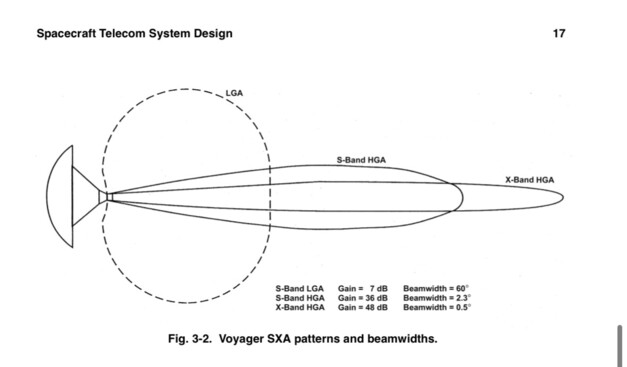
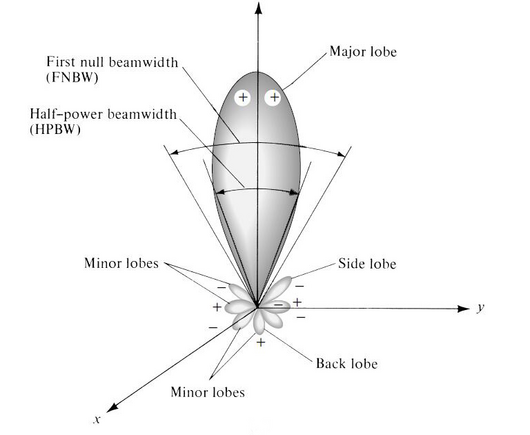
@johncarlosbaez Directional antennas, like a parabolic reflector, generally have one main beam surrounded by sidelobes, which are like smaller beams with much less gain that shoot off in undesired directions.

In this case, it sounds like that worked in our favor, as one of the “undesired” sidelobes must have been pointing to Earth – or close to it – enough so we could “shout” loudly to make up for the difference in gain.

Image sources: https://descanso.jpl.nasa.gov/DPSummary/Descanso4--Voyager_ed.pdf and http://www.antesky.com/principledesign-of-parabolic-antenna-prime-focus-antenna/

@johncarlosbaez

The 2 degree pointing error happened because some deparments of NASA are now using degrees Celsius while others are still working with degrees Fahrenheit.

@johncarlosbaez My guess:

The receive side of the Voyager's radio has a wider margin for error than the transmit side. A transmitter on earth has a MASSIVE power budget — many kilowatts — compared to Voyager's meagre 350 watts (roughly) total power budget.

Voyager must whisper, with its tiny power output, so its transmit antenna needs to be carefully pointed for us to hear it.

Earth can shout SUPER LOUD so it doesn't matter if Voyager's receive antenna is pointed slightly wrong.

@tj - apparently Voyager's antenna can detect signals that are 2.3° off center, and the idiot(s) who turned the antenna the wrong way only turned it 2° off. So we are lucky.

@johncarlosbaez Well there you go!

I'd also gently advise against calling the scientists and engineers working on the Voyager mission "idiots". Anyone can make a mistake. Should there be safeguards in place to prevent this? Sure. Is this system VERY old and probably hard to modify? Almost certainly. Was there a failsafe built into the system to re-orient back to earth in this failure mode? Yes.

@tj - 'twas a joke. I bet everyone responsible *felt* like an idiot! But the problem is not with the intelligence of individuals but with the system of cross-checks used before sending a command like this.
@johncarlosbaez @tj i'm sure there's some poor sod, who's generally very good at their job, who's been sweating it out the last few days. everyone will have been very kind and knows the process is what failed really, but still, they know that one day their name will leak and they will forever be known as the person that lost Voyager.
@StrangeNoises @tj - heh, maybe. But actually any decision this big should be vetted by a team of people. So it'll be interesting when we finally find out what happened. Only by studying what happened can NASA improve their procedures.
@johncarlosbaez @tj it's not like there is a limit where there is no reception at all. The antenna has a very strong directional preference, but basically if you shout loud enough from amy direction the antenna will pick it up. 2,3° might be the error margin of the transmitting power used. So I guess they shouted a bit louder than they needed to.

@johncarlosbaez

"In December 1977, it entered the asteroid belt."

... and **survived** !!

(yeah, I know; too many viewings of The Empire Strikes Back. shoot me now.)

(I was nearly today years old when I learned the total mass of the asteroid belt is less than Earth's moon. Sorry, James Hogan and whoever else wrote stories about there being a planet there that [somehow] blew up however many million years ago...)

@wrog - I hate all SF shows that depict asteroid belts as thick with mountain-sized rocks. Some recent Star Trek episodes do it too. The majesty of space is the majesty of something very dark and empty.

@johncarlosbaez

Auto5-star review from me for first movie with The Scene:


ALICE: Entering asteroid belt in 5 .. 4 ..

BOB [exasperated]: We're doing this *again*?

CAROL [mock terror]: Oh, noooooo!!!!

ALICE: .. 2 .. 1 .. Contact! [toggles switch]

[music: dramatic sting]

ALICE [with reverb:] "Attention all hands! We are now **in the asteroid belt**. [toggles it back]

CAROL [more mock terror]: We're all going to **die**!

[cut to ship exterior with Sun + total blackness. Camera zooms out really far. Absolutely *nothing* *else* there.]

[Music sputters into silence.]

BOB: That was funny maybe the first two times.

CAROL: Buzz kill.

DANA [over intercom]: Fuck you guys. I was *sleeping*.

BOB: Happy now?

@johncarlosbaez

CAROL [looking at display]: Uh oh, proximity alert!

ALICE: What is it?

CAROL: Dense, nickel-iron body, about a million klicks out.

ALICE: Prepare for *evasive action*!

CAROL: It's maybe 2 micrograms.

[BOB rolls his eyes]

CAROL: Actually, it's already going to miss us by at least ten thousand klicks.

ALICE: Yay! That was easy.

BOB: Are we done yet?

ALICE: Yeah, I guess.

@wrog @johncarlosbaez

I was going to add something like:

"camera keeps panning back,further and further until eventually the ship is a dot, before one dinky rock comes into view, slowly rolling by"

But this is much better.

@wrog @johncarlosbaez Bonus points if their dialogue is encrypted.

@johncarlosbaez @wrog Elite Dangerous (game) keeps the pretty rocks by putting you in planetary rings instead! There are "belt clusters" but even they are sparse.

...But it's a whole game about the dark empty void.

@johncarlosbaez apparently the antenna was "only" 2 degrees off from Earth, and the terrestrial radios they use to communicate with Voyager are able to send pretty powerful signals. What's really wild to me is that even if they hadn't done this, Voyager is so well designed that in a few months it would have fixed *itself* just by checking for the brightest object in its field of view (the sun, still) and reorienting toward that.

This pdf has some info at page 16-18 https://ntrs.nasa.gov/api/citations/19810001583/downloads/19810001583.pdf

@tedric - thanks, I'll check out that PDF.

It seems Voyager 2 was designed back when we knew how to do things right.

@johncarlosbaez @tedric Opportunity’s 90 day lifespan ran 15 f***ing years. There are still super-competent people at NASA and JPL.
@dan131riley @tedric - yes, my comment was sort of stupid.
@johncarlosbaez
Humans have accomplished astounding things.