if you feel tired very often, and can find a little bit of time in the afternoon to do it, try polyphasic sleep instead of coffee.

  • more refreshing
  • even less sleep required than with coffee, without health compromise (i am confidently willing to debate you on this!)
  • no addictive properties
  • effect does not diminish over time

#polyphasic #polyphasicsleep

POLYPHASIC SLEEP | Sleep Right, Live Well - Learn to nap

By using naps, polyphasic sleep schedules can reduce sleep time and/or improve sleep quality. A very unique lifestyle to consider.

POLYPHASIC SLEEP | Sleep Right, Live Well

@TudbuT
Sounds awesome! Are there any research studies or data science stats on this? (Coffee/tea addict here)

#Sleep #Coffee #Caffeine #Health

@hobs actually quite a lot! while there arent many studies on the benefits, there are a lot trying to show that it's unhealthy, but i have not found a single one that doesn't have a very major flaw in methodology that goes completely against any advice given in the polyphasic sleep community.

let me dig up some of them, hold on.

@hobs

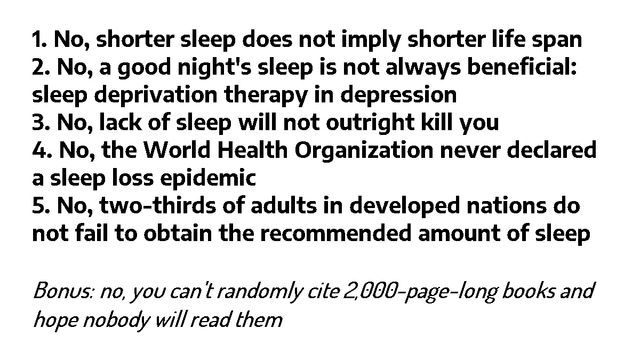
There's a book called "Why we sleep" meant to debunk polyphasic sleeping.

And here is a wonderful article about this book: https://guzey.com/books/why-we-sleep/.

I have also found many studies about polyphasic sleep, including but not limited to:

  • https://pubmed.ncbi.nlm.nih.gov/33795195/ - This study is not in support of polyphasic sleep, but should serve as an example of bad methodology to look out for. This study looks almost exclusively at <4h schedules, and does not give any of the participants enough time to adapt. The adaption times here are usually 1 week or less, which is highly insufficient for any conclusive result
  • https://pubmed.ncbi.nlm.nih.gov/10607034/ - This study supports my claim that human sleep is naturally biphasic when the daylight time is longer (e.g. no artificial lighting is used). This already shows many issues of the book and other studies, because they do not consider things like this at all.

1/2

Matthew Walker's "Why We Sleep" Is Riddled with Scientific and Factual Errors - Alexey Guzey

Note: I link to a bunch of paywalled studies in this essay. Please do not use sci-hub to access them for free and do not use this trick (a) to easily redirect papers to sci-hub. For the clearest example of deliberate data manipulation, see how Walker edits out the data that contradicts his argument from the graph. Also see UC Berkeley’s official response regarding this essay – all problems with the book I discovered are “minor”. Also see Walker’s post. Note: the …

Alexey Guzey

@hobs

  • https://pubmed.ncbi.nlm.nih.gov/17053484/ https://pubmed.ncbi.nlm.nih.gov/19645971/ - These are simply studies about why napping is good. Combine this with the fact that napping during the day makes you feel less sleepy at night, naturally shortening your core sleep, and you get anotherargument in support of polyphasic sleep
  • https://pubmed.ncbi.nlm.nih.gov/34156468/ - A study showing naps can reduce sleep deprivation symptoms. From there, one can assume that when adapted to polyphasic sleep, this effect is enough to make up for the lost sleep in the core. It is similar to simply moving your core to a different time: Before adaptation, it will only reduce symptoms, but not completely fix them
  • https://pubmed.ncbi.nlm.nih.gov/33674679/- A delightful study showing 6.5h of split sleep are not only as good but even slightly better than 8h of continuous sleep. (8h of split sleep being even better, just hard to reach for the average human nowadays)

2/2

Good sleep, bad sleep! The role of daytime naps in healthy adults - PubMed

A nap of less than 30 min duration during the day promotes wakefulness and enhances performance and learning ability. In contrast, the habit of taking frequent and long naps may be associated with higher morbidity and mortality, especially among the elderly. The benefits of napping could be best obt …

PubMed
@hobs fyi, this is a thing i just have in a file which is why it took me so little time to send