🚨New paper in press @ JEPG🚨
Http://psyarxiv.com/8fkpy
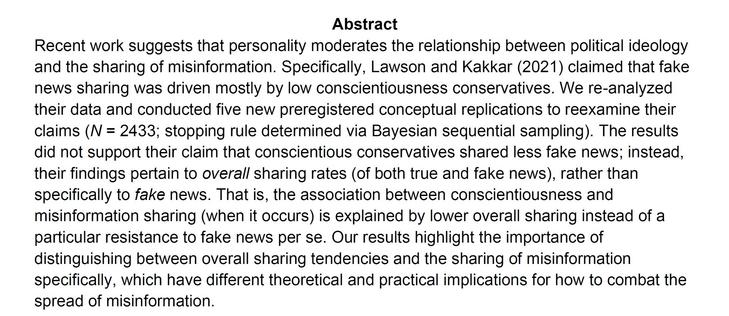
Remember the paper showing that it’s specifically *low-conscientious* #conservatives who share fake news? It got lots of coverage. BUT it seems like that claim isn't actually true - in a new paper, we fail to replicate it in 5(!) times and also show that even the original data don't support the claim (because they look at overall sharing, not specifically at sharing of false claims).

Bottom line: conservatives are more likely to share #misinformation, regardless of their level of #conscientiousness.

Check out the ungated paper: "Conscientiousness does not moderate the association between political ideology and susceptibility to fake news sharing" at http://psyarxiv.com/8fkpy

#ideology #politics #fakenews #personality

@Drand This is an excellent line of inquiry. Thanks to you and your colleagues for studying the rise of fake news and misinformation
@krschwarz Thanks! If you'd like to read more of our work studying misinformation and what to do about it, this doc has links to everything https://docs.google.com/document/d/1k2D4zVqkSHB1M9wpXtAe3UzbeE0RPpD_E2UpaPf6Lds/edit?usp=drivesdk
Misinformation-related papers

Papers related to misinformation from David Rand and Gordon Pennycook’s research team Articles summarizing our work on misinformation & fake news The Psychology of Fake News TiCS 2021 [Tweet thread] [15 minute video summary] Nudging Social Media Sharing Towards Accuracy Annals of the American Ac...

Google Docs
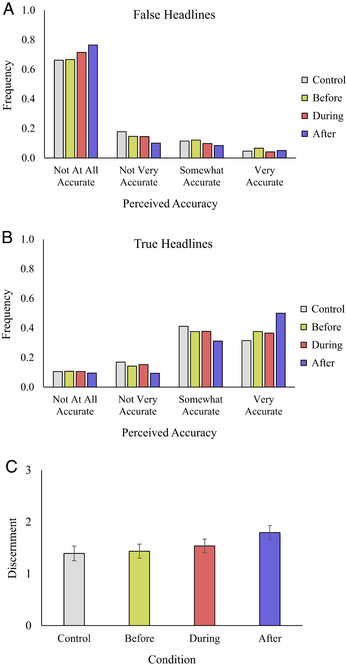
@Drand Thank you. I found the study on timing of rebuttals of misinformation to be interesting. You would think after the fact rebuttals would be less effective than prebuttals or marking at the time, but apparently not.
@krschwarz Agreed, we also found it surprising! (and that's why we ran a replication before publishing). One clarification - in terms of reducing belief in false claims, showing the correction *during* and *after* exposure were equally effective (whereas showing *before* was less effective). But in terms of overall ability to tell true from false, *after* was best because *after* was also good at increasing belief in true statements.
@Drand Interesting subtleties!