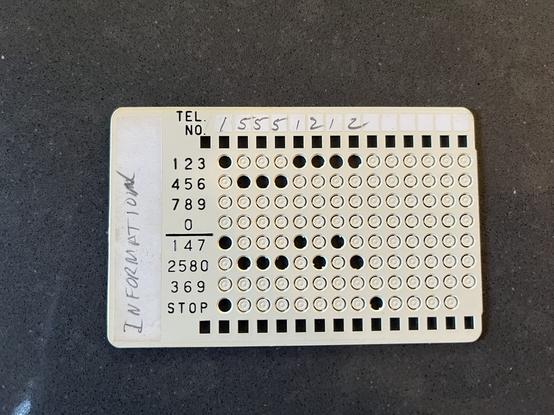
New phone. Looking forward to all the time I’ll save dialing by storing my contacts… on punch cards!
example card
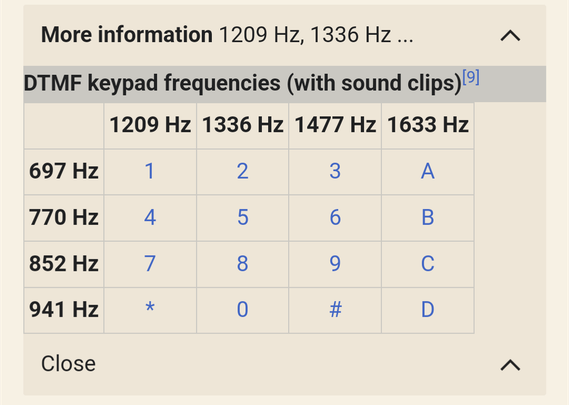
@dan Oh, that's the coolest thing. But wait, it's a rotary dial phone, but the cards use the same matrix as DTMF to encode the number
@recursive whoa, I hadn’t thought of that!
@dan fun fact @eeide 's campus phone number is such that people dialing this number without first dialing 9 to get an outside line get him instead. Being @eeide , he helps them
@dan looks like you are explicitly selecting the two touch tones, which means you could also encode * and # if you wanted
@dan Interesting encoding. I wonder how the decoder works.
@dan
So although a rotary phone, looks like the cards may have generated DTMF tones, selecting the row and column frequency?
@dan I'm oddly delighted that the punch card system uses an ingenious and self-explanatory scheme to cut the thing down from needing 11 holes per row to ... eight holes. I'm sure the advantage is significant on The Phone Company's scale but to the individual user it seems a little chintzy.
@Austin_Dern @dan As others have pointed out, if each hole here produced a unique tone, then you get touch-tone dialling (DMTF). This particular phone happens to be pulse dialling, but it's likely the punch system was designed for DMTF which was just coming into use at the time.
@dan It's a ternary number system. A "digit" consists of three positions. Ignoring the "STOP" line, which only encodes control, and 0 which is encoded separately, the bottom three positions form the least significant digit while the top three are the most significant digit. The annoying thing, though, is that the most significant digit is offset by one. Dang.