 haitchfive
Brian Swetland's mechanical keyboard for the ZX81
https://github.com/swetland/zx81-keyboard/
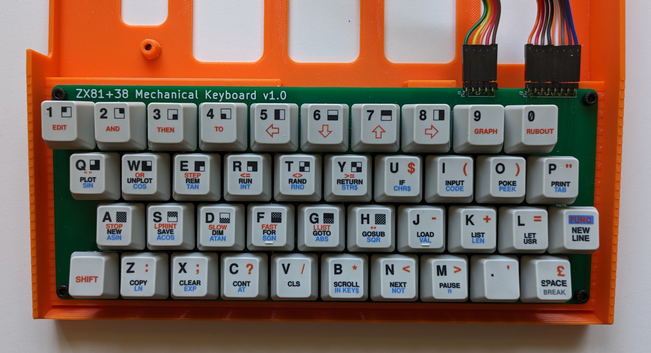
Brian Swetland's mechanical keyboard for the ZX81
https://github.com/swetland/zx81-keyboard/
There are two points of view about this:
1) People who weren't born with a ZX81 or a ZX Spectrum under their arm, and see the ZX input method as abnormal, or subpar.
2) People who actually used it and understand that it's what it made the rest of its success possible. The ZX Spectrum designers created an input method that enabled a completely unskilled programmer without need to remember all commands, one who couldn't type, to assemble PCODE very close to an AST in memory, without a complex parser or syntax checker, allowing BASIC to run reasonably fast and relatively complex software if you compare it to other BASIC-based computers of the era.
It's one of those "you had to be there" things.
The ZX Spectrum is genuinely something else, deceivingly simple, and it doesn't make a lot of sense at first. It's the Pink Floyd of computers.
@haitchfive @mos_8502 I’ve always assumed part of the reasoning was to make the input parser a lot simpler. Thereby cutting down on the ROM space needed.
Either ways, ISTR my muscle memory learning the keystrokes fairly quickly and getting along well with the system. Although, at 10 years old I didn’t really have a lot to judge it against.
I think that's genius design.
The 128k introduced the more normal code editor, and that occupied another ROM, and the editor ROM is paged on top of the 0x0000 - 0x4000 area of system ROM.
It probably gives a more "professional" feel to people who don't understand the ZX BASIC input system. But really, if you compare the Sinclair editor to what was available on Unix at the time, it wasn't vastly different from vi and ed.

 Studio 8502
 Bread80