Okay I think for first attempt getting Linux running I'm just going to sigh and install Ubuntu 23.04. If it works ok and I establish a /home on the other drive I'll consider pop!_os later as an experiment in learning (or living without) kernel signing.

My goals:

- Fit on 37 GB spare partition
- Get Vulkan running and execute one webgpu program in Rust
- (win condition) Successfully support a sound card with 16 channels of IO
- (stretch goal) Get Wayland running

I guess I'm going with GNOME rather than KDE based on looking at the current state of both on Google Image Search (possibly not an accurate source) and feeling less repulsion when I look at GNOME. I don't understand why the titlebar and the "dock" with the launcher icons are 2 different things in GNOME now. Couldnt u just put the launcher icons in the titlebar I only ever run 3 apps anyway

Last time I ran desktop linux was 2016, I tried to use a late beta of KDE Plasma and it never worked right

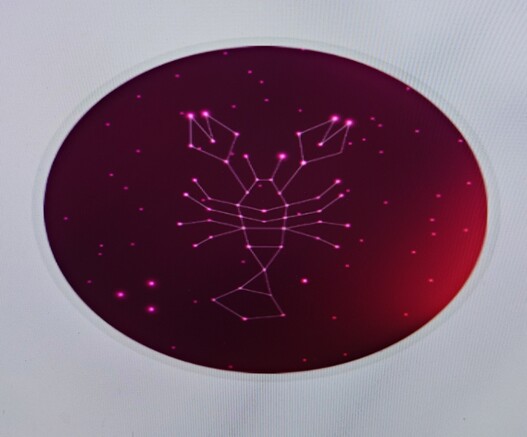
Current status: Lobster

Ok so installation of Ubuntu was smooth and it seems fine now I'm inside. I'm experiencing one problem, and it is totally baffling: Both in the installer and in the OS itself, a giant banner pops up about once every three minutes saying there is no Internet. This despite the installer downloading from the Internet fine, me running Firefox without problems, etc.

EDIT: This is really irritating actually lol
EDIT 2: It's resolved. Apparently Ubuntu HATES intranets

The fonts do look kinda... well, okay, really bad, especially in Firefox. The lowercase "i" looks strangely like an uppercase "I" much of the time. "Private WIndows".
Within half an hour of installing Linux the lack of visual differentiation between tabs in firefox is already annoying me and I'm already trying to figure out how to install Chrome

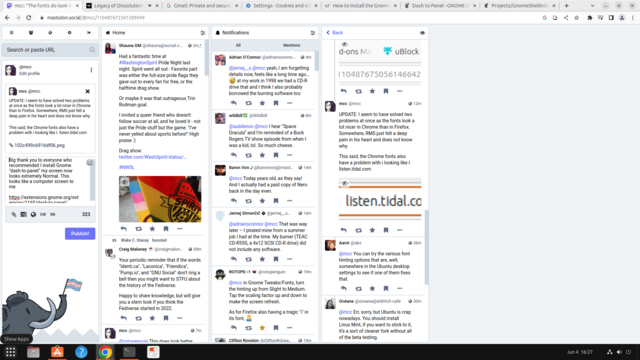
UPDATE: I seem to have solved two problems at once as the fonts look a lot nicer in Chrome than in Firefox. Somewhere, RMS just felt a deep pain in his heart and does not know why.

This said, the Chrome fonts also have a problem with i looking like I. lIsten.tIdal.com

Big thank you to everyone who recommended I install Gnome "dash-to-panel" my screen now looks extremely Normal. This looks like a computer screen to me

https://extensions.gnome.org/extension/1160/dash-to-panel/

Now if I can just I'll be good to go*

* Ready to start the horrible misery of figuring out if nvidia/wayland are working and if not why not

Dash to Panel - GNOME Shell Extensions

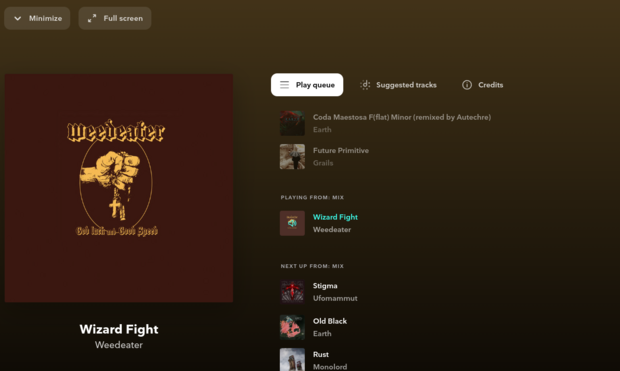
Do not break X Windows. Gnome-tweaks is on, she has water and she is listening to her favorite music

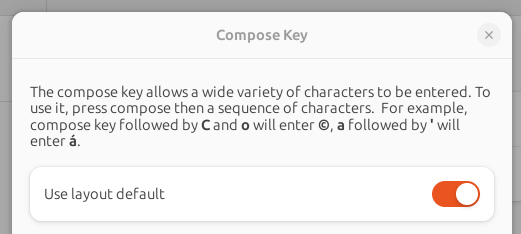
Minor complaints: I want to use the Compose key. In GNOME, if you go to the settings and look up the compose key, you will find a pane helpfully explaining that the compose key is set to the "layout default".

Thanks??! GNOME could you?! Could you possibly tell me what the default *is*!?

Anyway uhhh y'all have been very helpful so: Does anyone know, until I explicitly mapped the Compose key to the Left Super key, GNOME was doing a thing where tapping the Windows key would bring up a kind of Mac OS X Expose screen showing all the Windows. Now Compose is using that key. Anybody know what that shortcut is named. I bet I could map it to something else if I knew what it was named

ALTERNATELY can I just map left super to right alt entire, or something

EDIT: It's "Show the Overview"

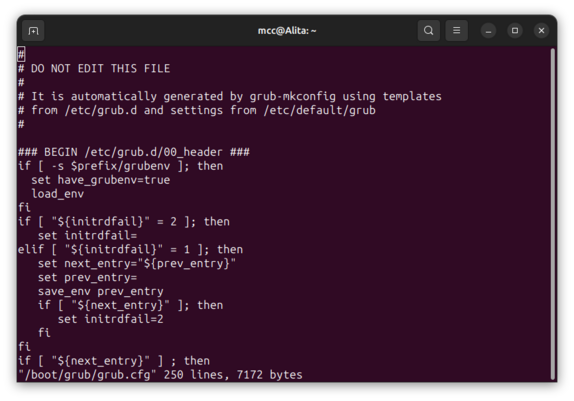
OPINION: It is total garbage that (according to every tutorial?) the way to get grub to default to launching Windows automatically involves manually editing a file (grub.cfg) that begins with "DO NOT EDIT THIS FILE"

Just total unearned confidence that just because I installed Linux on my desktop it *must* be because I prefer to use Linux on my desktop

UPDATE: It doesn't matter that grub is confusing to change the defaults on, because the moment I boot into Windows, it disables grub completely and I have to go into the BIOS boot select menu to get back into Linux.

Which…
was…
…exactly the behavior I wanted to start with.

…the two user-unfriendly OSes on my computers are fighting, and they're canceling each other out.

Extremely surprising outcome: Not only did GNOME mount my Windows/NTFS partition without me even asking it to, it mounted it *readwrite*, and I just opened up /Users and started mucking around with my files and it's just… letting me change things?? Bypassing any and all security?? Did I just fucking accidentally fucking rootkit my own machine by installing Linux?! "lol"
Do you ever post something about computer usability on Internet and immediately worry you have created a major opsec mistake by admitting that last thing out loud
Okay seriously everybody seems to think this is very funny but this is… bad? This is bad practice? Linux distros should not be mounting the entire drive readwrite including files that otherwise would require administrator permissions without at any point, such as during install, asking me if I wanted to do this? I wouldn't have even realized it had done it if I hadn't gone looking? Literally any piece of software on the Linux machine gets owned and it can virusify any part of Windows freely.
Like I want to be able to but ideally it should make me like… enter a password first. Also ideally this should be the default behavior it defaults to until I tell it "no it's okay give every linux app root access to the Windows drive"

OK so unrelated note, a question. I got the compose key working. Now I want to install my custom compose key mappings. I copied over the file from my copy of WinCompose and put it at ~/.XCompose. I logged out and back in.

It did nothing. Not one single app supports my custom compose mappings.

Does… anyone know how to make custom compose work on Ubuntu+Gnome? I'm having surprising troubles finding an answer on Google.

Day one Linux seems to be going okay with my two major issues being:

- Getting apps to respect ~/.XCompose appears to be horrifically difficult, and for "snap" applications, may be impossible
- Getting "click mouse button down to scroll" behavior like on Windows turns out to be horrifically difficult and may be impossible

I *think* I have the NVidia propreitary drivers working. Wayland works, but it causes Chrome menus to glitch out, so I guess I'm going back to Xorg for now

On an unrelated note, I was *very* annoyed to discover that on Linux mousewheel-clicking a tab in Chrome closes it, but now I'm back in Windows, and testing, mousewheel-clicking a tab in Chrome closes it.

…what?

Why would this be the default behavior? That's so weird

I have also discovered that clicking and dragging with the mouse wheel in Sublime Text causes it to do something *incredibly* weird
"I'm a rebel… an outlaw! I use the mousewheel to scroll… on *Linux*!"
Does anyone know how to edit/view the shortcuts in the "dock" in Ubuntu Gnome? (I'm using "Dash to Dock" but I think that only changes how it appears). I want to change the args to one of the icons, but they're just sorta… they're just there, there's nothing like a "Properties" if you right click. It seems like there must be a dotfile or an XML or something somewhere GNOME is using to store what those icons are and what happens when you click them.
Can the GNOME file open dialog really not show image previews? In 2023? It seems reasonable to expect it to be able to show them
I got .XCompose working… I can now type a thumbs up symbol in Linux 👍

Update on my Windows drive being mounted behind my back ( https://mastodon.social/@mcc/110487969478341949 ) : It turns out to be both more normal, and weirder, than I thought

So I thought it was irritating the mount was at this arcane mountpoint and I didn't know it was there until I clicked file browser -> "Other Locations"

Nope, not exactly

The mountpoint *didn't exist* until I went into "Other Locations" in the Gnome filebrowser, at which point GNOME creates it

Ubuntu didn't create it! The Gnome filebrowser did!

Like, it feels much more normal to me that this thing occurs in response to a user action, but weird that the user does not realize they are taking an action (mounting a drive readwrite) by opening a folder
My Linux install is getting closer to working well but one weird problem I have is every time I boot into Linux and then back into Windows the Windows clock seems to be set to like, a totally random time, many hours off. This collides with an interesting existing problem where when the Windows clock goes wrong it doesn't fix itself for weeks. I can force it to sync with NTP but I can't seem to, like, schedule NTP syncs to happen daily or at startup or whatevs. (I do not have Fast Startup on.)
@mcc make sure the Windows Time service is set to start automatically. (run services.msc -> right click Windows Time -> startup type Automatic). that's usually the reason for these types of issues.
@gsuberland Nice, thank you so much

@mcc @gsuberland That reminds me of @fuchsiii which knows a thing from the #ArchWiki on how to force Redmondian #Govware to accept #Unixtime as System Clock yet display #LocalTime on the Desktop...

Maybe she got that link handy...