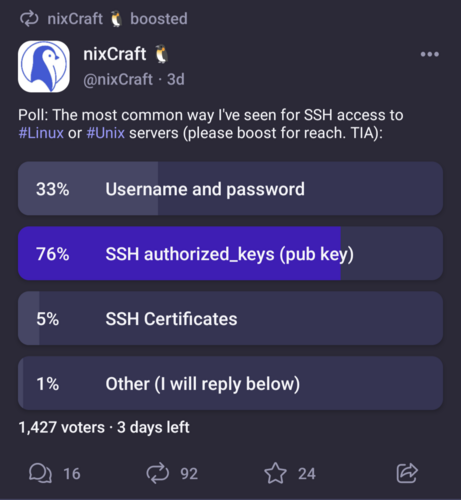
Poll: The most common way I've seen for SSH access to #Linux or #Unix servers (please boost for reach. TIA):
Username and password
29.6%
SSH authorized_keys (pub key)
65.4%
SSH Certificates
4%
Other (I will reply below)
1%
Poll ended at .
@nixCraft I’ve seen mostly user/password but I strongly encourage to use ssh certificates when having to handle more than a couple of machines. They are awesome.
@nielsk @nixCraft passwords are unsafe. Just use certs.
@melroy @nixCraft I use certs but the question was what I encounter most. Not what I use.
@nielsk @nixCraft oei. Maybe advise those others to also use certs 🤔
@nixCraft
Not a scooby, but will boost
@nixCraft I'm surprised and disappointed there are still so many using username password instead of secure alternatives 😢
@nixCraft This is just a data gathering attempt for phising later isn't it?
@nixCraft been mostly using AD integration with sssd for user accounts, SSH Keys (authorized_keys) for functional accounts (Ansible). No local user/password accounts on any machine. Access to the machines is being managed by moving users in/out of AD groups
@nixCraft Yubikey paired with certs! 🥰
@nixCraft SSH keypair, saved in a TPM where possible. I recommend https://github.com/tpm2-software/tpm2-pkcs11/blob/master/docs/SSH.md for setup instructions.
tpm2-pkcs11/SSH.md at master · tpm2-software/tpm2-pkcs11

A PKCS#11 interface for TPM2 hardware. Contribute to tpm2-software/tpm2-pkcs11 development by creating an account on GitHub.

GitHub
@nixCraft I use a username and password but I have a button on my Streamdeck that launches konsole with sshpass so I don't have to type in my login credentials every time I connect to my server.
@nixCraft Wait: seen others or how I access?
@nixCraft
Is there an article comparing ssh keys and certs login?
@nixCraft pubkey auth for prod and passwds for local VMs and other stuff that doesn’t need security
@nixCraft Off topic: Math is harder for Mastodon than authn
@kandersonus
@nixCraft
That's because it's checkboxes and not radio buttons.
@nixCraft

Depends on the environment.

In AD-integrated environments, it's a mix of GSSAPI tokens and password-based authentication.

In IPA-integrated environments, it's been a mix of GSSAPI tokens, SSH authorized_keys and passwords.

In "cattle" environments, it's been SSH authorized_keys (injected at deployment-time via cloud-init or subordinate processes).

A significant percentage of my customers are both RHEL-using and not-exactly-proactive in how they migrate to newer EL majors or (especially) retiring older EL majors. As such, migrating to SSH certificates is pretty much a non-starter since not every RHEL version supports their use (nor do they want instantiate the additional infrastructure to support it).

@nixCraft

SSH in FIDO2 hardware keys does work pretty well already.

@nixCraft
In environments that support it I use Kerberos (usually AD) with GSSAPI. Is cert auth superior?

@nixCraft public keys managed with an initialization Ansible role.

I've tried ssh certs, but it's more annoying to manage for my setup so far

@nixCraft I use pubkey(mainly) or password+totp(for emergency reason)