A group of 18 European Parliament Members have issued a statement officially calling for #Degrowth.

Here is part of what they wrote...
______________________________

We believe that the current economic model, based on endless growth, has reached its limits.

Firstly, continuous economic growth, especially based on the consumption of fossil fuels, is leading to catastrophic global warming.

Secondly, the infinite pursuit of growth relies on the depletion of natural resources, the destruction of biodiversity, and the accumulation of waste and pollution. This also poses risks to our health, our economies, and our societies writ large.

Thirdly, the current economic model is contributing to social inequality and exclusion. The emphasis on economic growth has not translated into equal distribution of wealth or opportunities. Instead, it has resulted in a concentration of wealth and power in the hands of a few leaving many behind.

Fourthly, the current economic model is inherently unstable and prone to crises, as seen, for example, during the 2008 financial crisis and the COVID-19 pandemic. The pursuit of growth at all costs has created a global economic system that is fragile and vulnerable to shocks.

We need an economic system that prioritises human well-being and ecological sustainability over GDP growth, one that recognises that infinite growth on a finite planet is impossible.

We also believe we need to find new ways of organising our economies without relying on the continuous exploitation of resources and the constant increase in production and consumption.

We call for more pluralism in economic thinking within EU institutions and for its alignment with the scientific evidence of climate, ecological, and social sciences.

We call for economic models and other decision-support tools to be more diverse, more comprehensive, and more readable for citizens.

We call for decision-making processes to be aligned with our common policy objectives rather than on the basis of the variation of GDP figures.
______________________________

FULL STATEMENT -- https://www.euronews.com/2023/05/10/moving-beyond-growth-is-not-only-desirable-it-is-essential

Names of those who signed on as co-authors: Philippe Lamberts (BE), Bas Eickhout (NL), Ville Niinisto (FI), Manuela Ripa (DE), Marie Toussaint (FR), Ernest Urtasun (ES), Kim Van Sparrentak (NL) — Greens/EFA; Manon Aubry (FR), Petros Kokkalis (EL), Marisa Matias (PT), Helmut Scholz (DE) — The Left (GUE/NGL); Pascal Durand (FR), Aurore Lalucq (FR), Pierre Larrouturou (FR) — Socialists & Democrats (S&D); Sirpa Pietikainen (FI), Maria Walsh (IE) — European People’s Party (EPP); Katalin CSEH (HU) — Renew Europe (RE); and Dino GIARRUSSO (IT) — Non-attached (NI).

#Europe #EU #Politics #Environment #Climate #ClimateChange #ClimateCrisis #Biodiversity #Pollution #Inequality
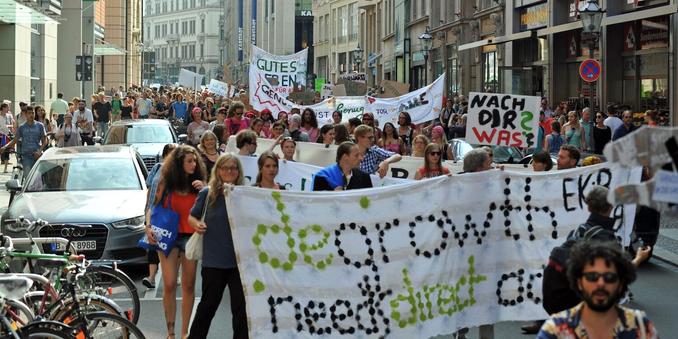
Moving beyond growth is not only desirable — it is essential

VIEW | The pursuit of growth at all costs has created a global economic system that is fragile and vulnerable to shocks, and this needs to change, a group of European Parliament Members (MEPs) write.

euronews
@breadandcircuses I strongly agree with all of this. But "Degrowth" is terrible, terrible branding. It's the first thing people will see, and they will immediately think "But growth is good" and write it off.

@mike @breadandcircuses Although it does beg why people assume growth is good.

After all, cancer is nothing but growth.

@lispi314 @breadandcircuses I have heard this "cancer is a growth" line before, and while it's not wrong it's a bit facile.

Cancer is the growth of tissue with no purpose. When capitalism is working right, it's very much growing things that do have purpose: scientific advances, health care, infrastructure, education, etc.

The problem is not growth per se. It's uncontrolled of goalless growth.

@mike @breadandcircuses Not really, capitalism promotes growth for the purpose of capital and/or power accumulation. It is either circular & pointless or actively harmful, depending on which it is.

The value of things has absolutely nothing to do with it, otherwise #ChokePointCapitalism (https://time.com/6219423/chokepoint-capitalism-doctorow-giblin/), #Monopoly and other things associated with late-stage capitalism wouldn't be a thing.

Why We Should All Be Worried About 'Chokepoint Capitalism'

'Chokepoint Capitalism', by Cory Doctorow and Rebecca Giblin, argues corporations succeed by crushing competition and locking-in customers

Time

@lispi314 @breadandcircuses The verdict of history on non-capitalist societies has not been kind.

The question really is how we make capitalism work for everyone, not just for the 1%. The recapture of economies by the top 1% is relatively recent: see e.g. graphs of the gap between CEO pay and regular worker pay from 1970 till now.

@mike @breadandcircuses There's a very clear correlation between the weakening of antitrust & consumer protections and what has happened since.
@lispi314 @breadandcircuses Yes indeed. One of the most successful things the toxic capitalists have done is mislead people into thinking that the phrase "free market" means "free from regulation" — whereas it really means "regulated in such a way as to enable free competition".
@mike @lispi314 @breadandcircuses I mean, if you really want to carry the analogy through, it's not like, say, your brain could just keep growing forever as long as all the new neurons served some purpose. As much as we might imagine and want a scenario in which we just keep accumulating more and more nice things indefinitely, for better or worse growth in a physical world necessarily has limits and ultimately has to reach some dynamic equilibrium that's compatible with those limits.
@chrisblake @lispi314 @breadandcircuses I strongly agree that the physical world places limits on physical growth. But that is very far from the only available from of continuing economic growth. We can and must reach an equilibrium with the natural world — but that doesn't mean economic growth has to stagnate.
@mike I see. You seem to be taking the "absolute decoupling" position, that we can continue economic growth indefinitely without any further growth in our material footprint. Again, since you brought up historical track records, I'll point out that absolute decoupling simply doesn't have one. So far it's been very heavy on hopeful speculation and very lean on results. I don't think it's prudent to be placing huge bets on that in the face of multiple accelerating existential threats.
@mike Though I guess it's largely a question of priorities. If you're saying, "We absolutley must get our material consumption down to a sustainable level, and if in the process we happen to find some ways of also continuing to grow GDP in some immaterial sense, that would be nice," I would find that much less objectionable.
@mike But mostly when I see people making decoupling-based arguments it seems to be coming from a position more along the lines of, "We absolutely must ensure the economy keeps growing at all costs, and hopefully at some point somebody will find some way to do it within ecological limits." That's what I find really troubling.
@chrisblake Fear not: this is not my position at all. (I mean, by all means fear — but not for that reason.)
@chrisblake That's mostly it. I mean, GDP is a terrible measure of anything, anyway. But for people with pensions (i.e. nearly everyone), some kind of economic growth is not really just a luxury.
@chrisblake No, I don't go nearly as far as that. All I'm saying is that most economic growth and lifestyle improvement over the last 50 years has come about by means not directly related to exploiting the environment — most obviously, the rise of computing. I'm not saying that needs no resources. But think we can have 90% of the growth for 10% of the cost. IOW, we don't need to burn rainforests to have smartphones.
Historically, no nation-state (capitalist, "Communist", feudal, or whatever) has ever had a remotely sustainable economy. They've been wrecking topsoil, exhausting mineral reserves, and converting forests into sterile wastelands for as long as they've existed. But, as long as they've existed only amounts to about the most recent 0.2% of human history...
It's really hard for most of us to imagine today, but if we're going by historical track records, any sustainable society is very likely to resemble that of, say, most pre-Columbian North Americans much more closely than any of the ones you're thinking of. Obviously that's not going to happen all at once tomorrow, or even in our lifetimes, but that's the general trajectory we need to be aiming for (again, if we're going by historical examples).