The other day, talking about issues on the fediverse, @mekkaokereke proposed an (apt) analogy which led to a tangential conversation about racism in Boston. I noticed, as I have whenever this comes up, a curious thing about what “Boston” seems to represent in the public imagination.

A thread (a rant?) about #Boston #demographics
1/7

https://musicians.today/@mcmullin/110283766606470442

David McMullin (@[email protected])

@[email protected] @[email protected] @[email protected] Boston resident here with one clarification: Boston is _not_ especially white. What it is is segregated. But there are plenty of Black people here and they’re not hiding. (Imagine listening to everyone agreeing about how white NYC is, as if the Upper East Side below 96th St. is the whole city.) Whether Boston is as racist as everyone thinks, I’m not qualified to say. (Black Bostonians can tell you.) But compare it to NYC, Philadelphia, New Haven—not VT.

Musicians Today

I’m not going to offer an opinion about racism in Boston, because there are 1.3 million residents of color in the Boston area who can speak about that with more authority.

Does that surprise you? That’s actually what I want to talk about.

2/

One thing everyone seems to agree on is that “Boston” is about the whitest city there could ever be. That’s apparently its defining feature. People say things like “I lived there for a year and there were no Black people anywhere!” Then it turns out they’re talking about Cape Cod or the exurbs beyond 495. Or Vermont, even.
3/
You could never get away with saying “New York City has no diversity at all,” and then trying to back that up by talking about Greenwich or the Hamptons. But use that logic for “Boston” and everyone just nods along. Whatever this place is that people mean when they say “Boston,” it’s not the actual city of Boston.
4/

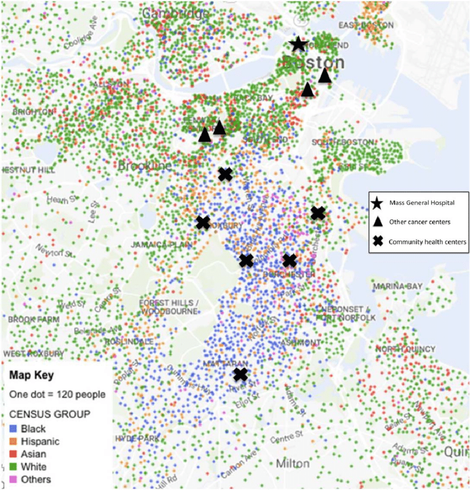
The City of Boston itself is less than 50% white. Granted, the city lines are rather arbitrary, and it’s part of a larger metropolis including several other municipalities and rings of suburbs. But many of the nearby communities are also quite diverse. It gets whiter the farther out you go, but however you define Greater Boston, it’s going to include a substantial nucleus of non-white residents: 1.3 million, according to the Census Bureau.
5/

https://statisticalatlas.com/metro-area/Massachusetts/Boston/Race-and-Ethnicity#figure/place/non-white-population

The only way Boston could be as white as everyone thinks is if these people just don’t count.

The “Boston” people are thinking of seems to mean: just the white parts of the largest possible geographic area around the city, excluding most of the city itself. And sure, if you do it that way, then “Boston” is all white.

But so is Chicago. So is Detroit. And no one ever talks this way about those places.

6/

Why are people so committed to this odd mythic conception of an all-white “Boston,” and what agenda does it serve?

(Not a rhetorical question; I’m honestly curious.)

7/end

@mcmullin

I think what may be going on, is that white visitors to Boston are completely unprepared for how segregated the city is.

If you're white, and you visit Boston and go to white places, you see almost no Black people. So if you're baselining on a "normal" level of segregation, you might reasonably conclude that "Boston is super white!" When the truth is that Boston is super segregated and super racist.

@mekkaokereke

Oh it’s segregated, no doubt—and that surely reflects racism. I don’t blame people for getting the wrong idea who visit once and just walk down Newbury Street.

But a lot of these comments come from folks who claim to know the place better than that. And from people who don’t know anything but are quite confident that places like Roxbury, Dorchester, Mattapan etc either can’t exist or if they do, they aren’t “Boston.” That’s what bugs me.

@mcmullin @mekkaokereke I grew up in Arlington, which is only 6 miles from Boston, not an outer suburb. In the 1960’s and 1970’s when I lived there, I never saw a single Black person in Arlington or the neighboring cities and towns. I see on Wikipedia that in 2010 Arlington is still only 2.3% Black. I did not hear people explicitly saying racist things, but that level of segregation is not random variation.
@EricFielding @mcmullin @mekkaokereke Arlington's stopping the Red Line extension was explicitly racist, "not wanting those people coming here", so yeah, not random demographics
@DemonHusky @EricFielding @mekkaokereke
It’s funny this thread from a few months ago came to life again today. Anyway, yes, Boston’s racism was built into its infrastructure in ways that are not subtle at all. I don’t know the specific history, but a quick look at the transit map shows the T lines all seem to be drawn to avoid serving the non-white areas or connecting across racial lines.
@DemonHusky @EricFielding @mekkaokereke
The point of my original thread was not to deny or defend Boston’s historic or current racism, but to remind people that half the city’s residents are POC—who are the people most affected by this and the ones we should listen to about it. It’s not helpful to pretend they don’t exist.
@mcmullin @EricFielding @mekkaokereke I didn't even realize it was an old thread, but I think people noted pretty well how segregated the city is, and how the "destinations" are more centered on the whiter areas. I was just adding how explicit some of the decisions that still segregate the region were about race.
@DemonHusky @mcmullin @mekkaokereke Mastodon and the Fediverse has a more relaxed interaction rate, one thing I like about it compared to the former bird site.
@mcmullin @DemonHusky @EricFielding @mekkaokereke
Relevant anecdote. My wife and I (both white) live in the Dorchester neighborhood of Boston, very much majority black. For a while, my wife (who is blind) would be taking the MBTA home from JFK Station every day. Now, at JFK, the Red Line bifurcates, one branch going to Dorchester, the other going to (mostly-white) Quincy. (continued)
@mcmullin @DemonHusky @EricFielding @mekkaokereke
Since people tend to assume that blind people are incompetent, on multiple occasions "helpful" white commuters earnestly informed my wife that she was "on the wrong side". Because why ever would a white woman go to Dorchester? (To be clear, there are a *lot* of white people here, just more black people.)
@AlexxKay @mcmullin @DemonHusky @EricFielding @mekkaokereke It wasn't always majority Black. Boston neighborhoods still segregated smh.
@venitamathias @AlexxKay @DemonHusky @EricFielding @mekkaokereke
Just to clarify, without looking it up, it’s a long way from majority Black, but it’s no longer majority white. And it remains very segregated. Since this thread sparked some misunderstandings before, I’ll reiterate that Boston’s problems with racism and segregation are real and longstanding. But that’s different from being an all-white city like people think.
@mcmullin @DemonHusky @EricFielding @mekkaokereke The T lines are mostly very old however, and Boston was very white for a long time. Perhaps more likely that lower-income groups tend to move into less-served neighborhoods.
@havhmayer @EricFielding @mekkaokereke
It can be a self-reinforcing phenomenon either way, but as @DemonHusky and @knizer pointed out, at least some of those choices were definitely intentional.
@mcmullin @havhmayer @EricFielding @mekkaokereke @DemonHusky @knizer a lot of the segregation started out as anti-immigrant (anti Irish & anti Italian mostly) & anti-Semitic. But by the post-WW2 era it was largely about race. The story of Arlington blocking the Northeast Expansion of the Red Line is a perfect example of anti-Black racism, as is the busing crisis of the 70s.
@mcmullin @havhmayer @EricFielding @mekkaokereke @DemonHusky @knizer it’s also important to recall that many late 1800s/early 1900s European immigrants were not considered “white” back then (nor were Jews). So the segregation has its own internal consistencies, even if it’s all just bullshit bigotry.

@mcmullin @havhmayer @EricFielding @mekkaokereke @DemonHusky @knizer the major T railways were laid out in the early 1900s, when Roxbury & Mattapan were very different demographically, but still considered “not white” by many in power.

Things changed, but didn’t really get better, when Irish American folks began to gain power. That’s changing again, since Boston has been majority-minority for a while now. We regularly refer to “old Boston” and “new Boston” when talking #BOSpoli.

@mcmullin @DemonHusky @EricFielding @mekkaokereke when the orange line was built, 1901, the city's racial makeup was quite different. I believe Roxbury was largely Jewish then. Not saying you're wrong, but the story is not simply black and white
@msokolov @DemonHusky @EricFielding @mekkaokereke
Thanks—I don’t really know this history, or when Roxbury became a Black neighborhood, except that it wasn’t recently. But if it turns out antisemitism rather than racism is why the trains mostly avoid the neighborhood, I guess that wouldn’t be shocking either.
@mcmullin @DemonHusky @EricFielding @mekkaokereke another nuance is white suburban neighborhoods not wanting the train to go there because they didn't want city people coming (Arlington), or something. So I really don't think it's simply a story of the trains avoiding minority neighborhoods of whatever complexion
@msokolov @DemonHusky @EricFielding @mekkaokereke
Right, that’s the specific case that was brought up before. I don’t claim to know the actual history here, and would defer to anyone who does—Things are usually more complicated than they seem. (And sometimes, as when white suburbanites express concerns about mixing with “city people,” they’re not really so complicated.)

@EricFielding @mcmullin @mekkaokereke

If anyone else is interested in pulling at that specific thread because it also surprised them, here's citation backing up @DemonHusky's assertion:

https://tuftsobserver.org/red-tape-why-the-red-line-stopped-short/

Red Tape: Why the Red Line Stopped Short – Tufts Observer

A working-class, Irish-Catholic community on the edge of suburbia, with access to downtown Boston, and a small-town feel that no one wanted to change—this is Arlington, MA in the 1970s. Most families had lived in the town for their entire lives, and connections ran deep. The church parish was strong (“devout, conservative and traditional”) and

Tufts Observer – Tufts's Student Magazine Since 1895

@mekkaokereke @mcmullin was on a plane and a super-racist lady was telling us that Boston seemed "safe" after telling us about how Chicago was dangerous because her neighbors were shady or something.

Clearly she hadn't seen many Black people and figure it was safe.

@mcmullin I am an immigrant who is not white who has visited Boston only occasionally, the perceived whiteness feels to me like the lack of cultural dominance and power from non-white cultures in ways I don’t associate with other American cities. Boston reminded me a lot of Australia: very diverse, but white people call the shots, and if anyone talks about racism too much people get awkward and defensive. I don’t feel that way in the other cities you referenced.
@skinnylatte
That’s a fair point. I hope that’s finally starting to change, as our City Council and elected officials look much more like the city than they used to… Still a long way to go though.
@skinnylatte
Oh and what you say about the defensiveness is certainly true. Which makes the ordinary racism harder to take, as @mekkaokereke was saying the other day. “We’re too liberal to possibly be racist…”
@skinnylatte @mcmullin
As someone who's moved from Australia to eventually Greater Boston, you are 100% correct.
@mrb82 @mcmullin You should see the number of Australians who respond to *my posts* about experiencing racism in America with ‘move to Aus it’s better’ then block me when I tell them about my experiences with racism there lol
@skinnylatte @mcmullin Yep. IMO one of the biggest blind spots of Australians is the fierce egalitarianism streak that permeates the country. It also makes it extremely hard for them to see things in terms of power differentials because there are very few overt power structures left. Like Aussies call bosses by first names. No sir or ma'am. So when they engage in casual racism they see it not as racist but as an act of endearment which is just so fucked up and probably why they get so defensive.
@mrb82 @mcmullin Spent some time there. “Other countries just don’t understand that in Australia it is totally fine to call Black people *** and Indian people ***, that means we like them and the rest of the world are pansies.” Meanwhile, they faint when someone says “white people”

@skinnylatte @mcmullin YES! EXACTLY THAT!

It's such a huge problem that the Australian Human Rights Commission runs campaigns about it.

https://itstopswithme.humanrights.gov.au/

https://humanrights.gov.au/sites/default/files/casual-racism-faqs.pdf

Home

Racism. It Stops With Me is a national campaign that provides tools and resources to help people and organisations learn about racism and take action to create change. The campaign invites us to ask ourselves important questions about the role of racism in shaping society, the way we see ourselves and how we interact with one another. To explore these questions and find out more information, visit the About the campaign section of this website.

Racism. It Stops With Me

@skinnylatte @mcmullin
Also, lol @ "ThE CiTy oF BoStOn iTsElF Is lEsS ThAn 50% wHiTe."

It's not mixed diversity. You can literally see the segregation and the red lines of demarcation in the census.

@mrb82 @skinnylatte
I never said it was mixed diversity (or that it isn’t racist, for that matter). Boston is both highly segregated and less than 50% white. These two facts don’t negate each other.

Your comment is actually a perfect example of what I’m taking about: Half of Boston are POC, mostly living in non-white neighborhoods. And it’s somehow wrong to say that, or we’re supposed to pretend they’re not here, because… what? Only the white neighborhoods count?

@mcmullin @skinnylatte You're arguing that Boston is diverse when in practice it's segregated. Where the wealth is, where the wealth goes, where the wealth plays, it's white people as far as the eye can see. This is what people mean when they say that Boston feels like a really white city. It may be 50% black on paper but the culture, services, the hegemony radiates from white areas.

@mrb82 @skinnylatte

I said it’s segregated up front. I bet you and I agree almost completely about Boston’s racial problems and what makes it “feel like” a white city.

Where we disagree is that I don’t think the other half of Boston is just on paper; I think it’s 360,000 real people, who have the biggest stake and the most relevant perspective on these issues. It’s weird to just sweep them all out of mind when talking about race in Boston.

https://musicians.today/@mcmullin/110283766606470442

David McMullin (@[email protected])

@[email protected] @[email protected] @[email protected] Boston resident here with one clarification: Boston is _not_ especially white. What it is is segregated. But there are plenty of Black people here and they’re not hiding. (Imagine listening to everyone agreeing about how white NYC is, as if the Upper East Side below 96th St. is the whole city.) Whether Boston is as racist as everyone thinks, I’m not qualified to say. (Black Bostonians can tell you.) But compare it to NYC, Philadelphia, New Haven—not VT.

Musicians Today

@mcmullin I lived in and around Boston for several years. My experience is it is the most overtly hostile toward POCs of the 5+ major US cities where I have lived. Anecdotally, many other POC can relate to my experiences there.

One quick bit: Boston is the only US city where I have been told Black people absolutely should not visit a part of the city at any time of day (Southie, obviously). It’s a huge outlier in expressed personal racism of the kind that each POC will encounter.

There’s a stat going around that the median net worth of a Black household in Boston is something like $20. Think for a moment how bad structural conditions have to be for that to be a plausible outcome.

And don’t get me started on the police forces there.

The reputation is earned; it’s not just received wisdom.

@runako
Thanks for your perspective. For what it’s worth, I’m not denying any of that—like I said, ask Black Bostonians. They know. My point is just that whatever the reasons for it are, it’s not because Boston is the homogeneous white place so many seem to think. And I’m curious why people are so determined to think that.

@mcmullin I went to school in Mass (UG and PhD), and I research urban place politics. A coupla comments here.

One: Boston in the 1940s/50s was *very* white. Two: it was for decades significantly whiter than peer eastern cities (DC, NYC, etc) even as it diversified.
Three, saying Boston is "very white" is a way to gesture at the specific history of racial animus there without unpacking it. White residents defended the essential whiteness of Boston in a way that felt different than in DC or NYC.

@mcmullin People may not have a good vocab for it, and you're surely right that there's some spatial segregation-driven ignorance. But if people visited the city 20 years ago and lack a vocabulary to say "the race politics in this place felt somehow less progressive than in other similar cities," saying the city is "very white" is a way to reference it. That's my experience of how whiteness is used when talking about Boston, anyway.
@joepierce @mcmullin this exactly. And coming from the south, it was jarring.

@joepierce

Yes, I think that’s it. Because it can’t be the actual demographics, unless you’re willfully ignoring them, which itself would say something too. The 1.3 million people I mentioned cannot really be that well hidden.

@mcmullin As someone who grew up in the suburbs of Boston, I feel like it's exacerbated by the fact the places visitors go are in the places dominated by white culture, and it's not clear unless you spend time in the area that the other cities in the greater Boston area are more akin to boroughs in NYC, for example. As for locally, I know in my internal biases I think of Dorchester and JP as different cultural entities than Boston.
@absconded
That’s true, as others have also noted, about where visitors go. Your last sentence is interesting, also commonly true, and relates to what I was asking about. The Upper East Side (below 96th) is as white as Back Bay. But people know that Harlem is right there too, and it’s also NYC, as are (in a different way maybe) the outer boroughs. Why it works differently for Roxbury (vs. Harlem) and Dorchester (vs. Queens) is what I’m curious about.
@mcmullin Hope someone can come with more insight on the whys about that frame of mind beyond the generic platitudes I have. I can say that Roxbury and Dorchester are not in media the way Harlem or Queens are. Even from the suburbs, the only reason I knew either of those places was fearmongering stuff (granted, I do come from a pretty white town of privilege).
@absconded
Yes, Harlem is a cultural symbol of international significance in a way no other city’s most-equivalent neighborhood is. Chicago’s South Side kinda maybe. Let’s say North Philly then for a better Roxbury analog, though I’m not as familiar with that.
@mcmullin I think it’s marketing. They’ve in effect made their brand “whitest city” even though it’s untrue … now I’m going to watch all the tv shows and movies about Boston to just to fulfill my curiosity. I feel the city’s mayor, management, rich people would have made it urgently and abundantly clear that they want to include everyone….. if that was what they really wanted

@mcmullin
Not lots of times, but it has happened, when I say I live in Roxbury. The reply was, oh you mean West Roxbury?

If you don't know Boston. Roxbury is mainly folks of color, while West Roxbury is almost totally white folks.

Also fun trivia, these two neighborhoods don't share any borders. 🤔 And lots of people who live in Boston don't appear to know that. 😆

@mcmullin As a foreigner who cycled from San Francisco to Boston (2014), I observed lots of segregation all across the US. Chicago specifically surprised me as to how segregated it was compared to my (limited) expectations from TV. As I rode around/through the city I could literally feel (through my bike) the sudden changes in road surface quality that seemed strongly correlated with segregation. It gave me a physical grasp of redlining that I hadn't had from outside the US.
@slowe
That’s amazing, to cycle coast to coast! I bet that gave you an intimate feel for the country in lots of different ways.