 James Dreben
#ELI5 Why is water see through?
I'd never thought about it like this. Wow.
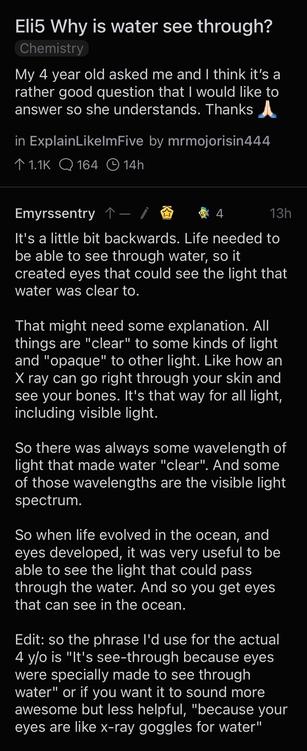
Another angle to look through. (pun)
An interesting property of water is that stuff that would obscure your view, either settles out , or tends to float away. Nothing is permanently suspended.
@Jdreben "This must be wrong," I thought, "surely other parts of the spectrum also pass through water." But no, it's exactly right.
(Well, you could nitpick and point out that not all substances would have allowed eyes to evolve that could see through it as well as we can see through water. But that's nitpicking.)
@victorgijsbers @Jdreben i think it's an deceptively easily answer. Not noticing that many substances are basically opaque to everything biological eyes could see, points that direction.
It also ignores that we evolved on land too, over 300 million years, air has a much wider range of transparant frequences, it does not explain why the frequences we see did not drift since leaving the water.
Also there is a question of why these absorption spectra are what they are in the first place.
@UrbanEdm @Jdreben @Daveography that's not what IR spotlights, lasers and cameras show.
Water vapour in air blocks IR, heated air generates IR which can obscure vision, but the primary gaseous components of our atmosphere don't block IR.
Remote sensing is the science and art of identifying, observing, and measuring an object without coming into direct contact with it. This involves the detection and measurement of radiation of different wavelengths reflected or emitted from distant objects or materials, by which they may be identified and categorized.
@gfwellman That seems less interesting. If air and water weren't the right amount of transparent at the right frequencies to match with our star, we wouldn't have evolved here to be able to ask the question. If it were otherwise, would life evolve in different gas and liquid mixes? Maybe.
I was more trying to get at the "what's the commonality between these two substances."
@UrbanEdm Hmm, I'm not sure there is an obvious commonality. Air is almost entirely made of non-polar molecules, while water has dipole. That makes a big difference at microwave frequencies, but not to "visible".
What I was getting at is the likelihood of life. It's very nice that such a common class of star outputs energy that can be chemically captured. If that energy couldn't reach the surface, life might be very different and likely less common. Presumably there's a minimum energy photon below which something like photosynthesis just isn't possible, so bad news for deep red dwarfs, etc.
@UrbanEdm @Jdreben @Daveography air is more transparant all around: https://en.wikipedia.org/wiki/Absorption_%28electromagnetic_radiation%29#/media/File:Atmospheric_electromagnetic_opacity.svg
water: https://en.wikipedia.org/wiki/Electromagnetic_absorption_by_water#/media/File:Absorption_spectrum_of_liquid_water.png
It is transparant to some IR too. But notably most of the spectrum of ~30C objects radiate at frequencies it largely blocks.
See also (heh) air
Okay, here's one: why do both air & water pass as many of the same wavelengths as they do?
Where do they (or do they?) differ & why?
@cavyherd @Jdreben eyes evolved to process wavelengths that can pass through both water AND air: not either/or, but both...
A good counter example is near IR and coke: coke doesn't pass visible wavelengths, but does pass IR, as does air. Stick an IR pass filter in front of a camera and you can take a photo *through* a pint of coke.
😂 TIL about Coke!
But my question was a little different: it wasn't about why the eye can see through both water & air—that was very nicely covered in your first response.
Rather, why are both air & water transparent to the same wavelengths (or at least a large overlap in the range that we can also see)?
For that matter, why is Coke NOT transparent in that range? (One presumes this has to do with transmission/emission spectra.)
@Jdreben Isn’t it just because a lot of light passes through it? And so if you throw stuff like dirt into the water, which doesn’t allow light to pass through it, the water is harder to see.
Generally, AFAIK, liquids tend to be see-through, solids tend to be opaque, and gasses tend to be somewhere in the middle.
@Jdreben
I was.going to say that we've evolved to live on land, but checked, and also there water is an important absorber! not the only one but still:
https://en.m.wikipedia.org/wiki/File:Atmospheric_Transmission-en.svg
Alt: absorbtion spectrum of the atmosphere -- water is absorbing a lot at many wavelengths, but a window around optical wavelengths has little absorbtion
I am reminded of the question, "If plants don't want to be eaten, why aren't all plants poisonous?" I *think* the answer is that they are, but it's advantageous for herbivores to resist the poison, so they evolve to.
Also, "Why are there three primary colors, not two or four?" This one I'm more confident about: Most humans have three types of color sensors, so some mix of three primary colors can reproduce those sensors' response to any "natural" color.
@squeakyears @Jdreben it depends on whether you’re in an additive (starts with black; colors add up to white) color system such as a screen, or a subtractive (starts with white; colors add up to blank) one such as a printer. The latter typically has four colors; sometimes six or more to make mixing more precise. And the former these days also sometimes has four; some TVs use RGBW.
And I think you need three for a proper gamut (a triangle-like shape that shows which colors can be mixed).
@uliwitness @squeakyears @Jdreben I was confused as a kid who was told in kindergarten that the “basic colors” are red, yellow, blue (RGB in German), then found that displays used red, green, blue (again, RGB, but a different G).
It clicked once I realized additive and subtractive are opposite starting points, so blending colors also accomplishes the opposite.
@Jdreben strikes me that it's a smaller-scale version of the anthropic principle - we only exist because this is the case so it has to be true.
@zeborah @Jdreben indeed! I missed that implication.
Also, thinking further, UV (and up) becomes irrelevant, as at smaller wavelength it should scatter fast due to all the micro-stuff in the body of the water. On the other hand, scattering doesn't mean it's invisible. There should be plenty UV in the first 10 meters…
Anyway, don't mind me, I'm just thinking aloud :-)
@lothar @zeborah @Jdreben oh, I'm well aware of that one :-) But if UV vision was giving advantage, life would likely adopt that. I'm just trying to figure out why it doesn't (apparently) give any advantage.
P.S. As for X-Ray and generally higher-than-UV energy radiation, the answer, I think, is pretty simple: it didn't exist on Earth in appreciable quantities until humans started producing those.
 Rejin
Rejin SpaceLifeForm
 Victor Gijsbers
 Jasper 🍉
 AccordionBruce
 UrbanEdm
 Biggles 20X6!
 Greg Wellman
 2xfo
2xfo
 Hugh Young-Bish
 So many dynamos
 Sören
Sören Kit Bashir
 Ben Aveling
 Cavyherd
 The_LazyKnight
 realcaseyrollins ✝️
 sj_zero
 Iwillyeah
 Tido
Tido Raven667
 skategoat 🐐 🇵🇸
 Jacob Christian Munch-Andersen
 Knut Morå
 Matt Stewart
 التنينوكس
 Uli Kusterer (Not a kitteh)
 MrCheeze
 Stefan Ihringer
 kira :3
 Sam Wade
 Russ Garrett
 Ivan Sagalaev
 Zeborah
 lothar
 Alex R