 James Dreben
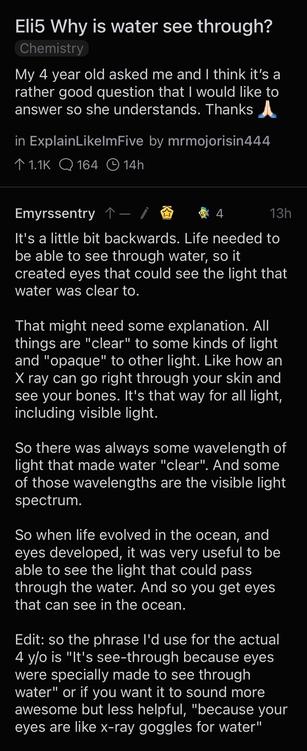
#ELI5 Why is water see through?
I'd never thought about it like this. Wow.
I am reminded of the question, "If plants don't want to be eaten, why aren't all plants poisonous?" I *think* the answer is that they are, but it's advantageous for herbivores to resist the poison, so they evolve to.
Also, "Why are there three primary colors, not two or four?" This one I'm more confident about: Most humans have three types of color sensors, so some mix of three primary colors can reproduce those sensors' response to any "natural" color.
@squeakyears @Jdreben it depends on whether you’re in an additive (starts with black; colors add up to white) color system such as a screen, or a subtractive (starts with white; colors add up to blank) one such as a printer. The latter typically has four colors; sometimes six or more to make mixing more precise. And the former these days also sometimes has four; some TVs use RGBW.
And I think you need three for a proper gamut (a triangle-like shape that shows which colors can be mixed).
@uliwitness @squeakyears @Jdreben I was confused as a kid who was told in kindergarten that the “basic colors” are red, yellow, blue (RGB in German), then found that displays used red, green, blue (again, RGB, but a different G).
It clicked once I realized additive and subtractive are opposite starting points, so blending colors also accomplishes the opposite.
 squeakyears
 Sören
Sören Uli Kusterer (Not a kitteh)