Since some people have asked me, here's a quick thread on initial experience comparison between Bluesky and the fediverse. It's important to note that this comparison is somewhat absurd by default because Bluesky is still tiny & unproven, but there's interest so I'm happy to share what I've observed. Also, I don't get into protocol differences because honestly who cares. So:

The fediverse (including Mastodon) is better at: having been proven to scale, having multiple places running different services, offering more choice of apps, giving a choice of legal jurisdictions and business/non-profit models, and is still growing far faster, especially globally.

Bluesky is better at: Onboarding & signup experience, having fewer choices to make, quality of the default app, familiarity for people used to Twitter's design, discovery of other users within the existing service.

Here are things we don't know: What Bluesky's trust, safety & abuse policies will look like at scale, compared to fediverse services. Mastodon and other fediverse services have been uneven at times, but have matured over years; Bluesky is still tiny and hasn't been tested at all. We don't know if Bluesky can scale, either technically or socially.
There are also platform features that people might legitimately have different goals for. Bluesky makes content & people searchable by default, which Mastodon only does for hashtagged content. This aids discovery, but can also enable kinds of abuse. Fediverse partisans argue this constraint helps build healthy community, but many newer users find it a frustrating omission. Both platforms let you use your own domain, but it's much harder to do so on the fediverse right now.
People's perception of the overall fediverse is (probably unfairly) shaped by Mastodon, though many other services make different choices around key features that others might find meaningful. Understanding federation is a huge barrier for people who just want to (re)connect with friends or institutions. People's perception of Bluesky is shaped by Jack Dorsey's role in its initial conception; we don't yet know whether that's fair, though he doesn't seem very involved at all.
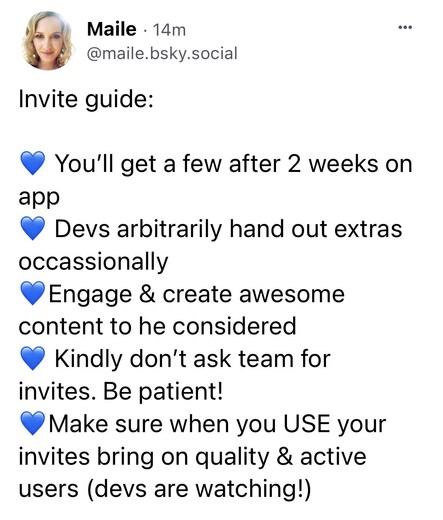
@anildash anyone else tired of the limited “exclusive” invite baloney?
@barbarakb I understand some people don't like the social dynamics of that, but it's also a reasonable way to limit scaling problems.
@anildash @barbarakb often seems too limiting.
@barbarakb @anildash agreed. Frustratingly from a product marketing perspective it can be quite effective, so we’re probably going to keep seeing it. Personally speaking I’m not cool enough to get invited to anything unless I built it myself.
@barbarakb @anildash What I don’t like about it is how the developers are playing favorites with the invites; or how some people begging for them are getting them. Feels like there's an "in crowd" already and it's kind of icky. That's already part of the platform culture and that's not going to go away.
@Theblueone @anildash yes, I’ve noticed that as well. there has been some recent activity and time element clarification about invites. but there’s still some randomness.
@barbarakb @anildash Like I really do not like the vibes this stuff at Bluesky gives off. As much as people say Mastodon has learning curve etc etc at least it doesn’t exude the cool kids peaking in high school energy. This is People Producing Content As Product Pavlovian vibes.
@Theblueone who is she? not on the Blue Sky team. but as I said, it seems to be an odd way to launch. I think it’s overwhelmed.
@Theblueone @barbarakb I mean, the biggest mastodon instances have just straight up shut off signups at some points. It’s a common part of scaling, despite how people feel about it.
@anildash @Theblueone @barbarakb limiting signups isn’t issue. it’s *how* they’re deciding to limit and hand out invites. it’s getting them in trouble.
@anildash Thanks for this. I feel like the kremlinology on how Bluesky plays out is a little out of control on here. Nice to see more people talking about both the protocol and the experience in relatively chill ways.
@kissane if there's one thing I'm known for, it's not having strong opinions! LOL.
@anildash as a 59yo user of mastodon - and had an account on twitter from 2007 on until October of last year I agree on the difficulty of onboarding and the lack of search BUT I also have found that my conversations here are much more engaging and I appreciate the reasoning behind the decisions made. I am not giving up my data to a social media company run by one person ever again. The activity pub protocol makes the potential for the fediverse much more palatable in my mind.
@anildash oh and BTW thank you for this thread - it's been highly interesting!
@anildash Anil, I will start by saying that I don't have any first hand experience of Bluesky. It seems to me though that the main difference is that the Bluesky protocol is designed in a way that it can be monetized and can help create echo chambers and viral engagement, while the ActivityPub protocol was not designed with that goal. In fact, Mastodon is currently designed with some specific anti-viral and open features.
@Fourth_Dogma they're both eminently monetizable and also enable communities that aren't run that way. Given that there are fediverse servers that are literally disconnected from the rest of the web by choice, anything can be an echo chamber.
@anildash Good points Anil -- a tool is a tool and how it's used depends on the user. Having said that, there is such thing as inertia and original design choices. It's possible that the Bluesky protocol will become a haven for non-profit groups who will choose not to use cookies or profile their users. It's also possible that Mastodon will see the rise of data mining and advertising. So far though these two protocols and their users seem to be different.
@anildash its absolutely bonkers to me that this late in the game a brand new social media network wouldnt staunchly and proudly say "zero tolerance for nazis, racists, etc etc". they havent learned anything.
@Viss I think they're approaching it from a technocratic standpoint ("we'll make a framework for blocking that stuff!") but I'm curious to see what the framing is once they get their abuse/blocking stuff in place.
@anildash i read a headline today or yesterday about how they're "just going to label hate groups, but not prevent them from joining the platform", and today, in 2023, thats a death sentence.
@Viss @anildash That's mastodon too, though. We rely on our server admins to defederate where the Nazis join, but they can't be prevented for signing up for the fediverse. That's going to be inherent to any decentralized system. I agree with you that it shouldn't have to be that way, but it does seem like an unfortunate reality imo
@sgrif @Viss @anildash Not the same. Any Mastodon Covenant website will ban Nazis on sight. They’re banished to the defederated fringes. Actually blocked. Jack’s allowing them to stay, right alongside you, but saying if you don’t avert your eyes and ignore them then it’s your fault for opting in to viewing “hate speech” or choosing the wrong labelling provider from the vapourware “moderation marketplace”.
@MetalSamurai @sgrif @Viss But ActivityPub is available to Nazis too, and they do use it. So Bluesky has to build similar tools around the AT protocol as mastodon has around the ActivityPub protocol. If they don’t, then we hold them accountable. But by your logic we should blame mastodon’s maintainers for the fact that Nazis also use the protocol.
@anildash @MetalSamurai @Viss Email is bad because spammers can still send you an email and it just goes in your spam folder
@sgrif @MetalSamurai @Viss I mean, there have been hundreds of billions of dollars of harm caused by shortcomings in the protocols behind email. We just don’t look at it that way.
@anildash @sgrif @Viss Nazis are removed from instances when they show themselves and instances that don’t are defederated and ostracised.
I don’t see anything like that even being discussed as a future possibility. It’s literally just “pretend the bad stuff isn’t there”.
@MetalSamurai @anildash @Viss I suspect the reason you don't see it being discussed is because it's just less fundamentally important when the protocol decouples the client that shows you a feed from the server hosting your content to the extent that AT does. Ultimately it's a federated protocol and there's no reason you can't defederate an instance. The practical differences between defederating and refusing to show the content is ultimately pretty minor
@MetalSamurai @anildash @Viss Personally I find the notion of not having to couple the decision of where to host my account with what moderation actions happen to be quite compelling. And the idea of having more control over what ends up in my feed beyond just who I follow also seems compelling. It's entirely possible that none of it works out in practice, but imo the ideas are sound and worth exploring
@MetalSamurai @anildash @Viss Mastodon's alternative widely depends on the efforts and goodwill of volunteers who are largely both unpaid and unaccountable. That strikes me as problematic for a whole host of other reasons. Ultimately both approaches leave much to be desired, but decentralized media makes this hard by design

@sgrif @anildash @Viss Lots to unpack in that.

The idea of a sort of plug and play composable system sounds great. If I can take my own user handle, pick an instance to host my posts, choose a moderation style I like, pick a timeline weighting and display system from somewhere else, pick a mobile client that suits me and have it all just work together sounds great.

@sgrif @anildash @Viss I’d rather see it built on ActivityPub as that’s where the interesting people and the existing anarchy of instances already is.
@sgrif @anildash @Viss Mastodon’s moderation is far from perfect, but works just fine for reasonably small self policing instances, especially if they’re based on a common group and language. Moderating the large instances with multiple languages and all different kinds of social groups all jammed together is harder.
@sgrif @anildash @Viss It’s not great and certainly could be better and often the threat of defederation can come across as blackmail or overkill and we end up with things like Raspberry Pi, dot lol, pre-emptive defederation with instances that don’t publicly display their moderation policies, the apparently growing movement to defederate mastodon.social and so on. It’s an anarchy and that’s how things work.
@sgrif @anildash @Viss For the system as a whole it’s probably pretty healthy; for individual users it can be really harmful. Proper nomadic, portable accounts would be a massive help in allowing users to jump ship when inter-instance problems arise.
@sgrif @anildash @Viss There’s a huge difference, philosophically and practically between Mastodon style moderation and Blue Sky’s “moderation”. I won’t call Blue Sky’s scheme moderation as it’s simply muting. They’re not talking about removing bad actors or unwanted content from the platform, merely sweeping it under the carpet.
@sgrif @anildash @Viss This is where Mastodon is very different - if you’re spewing transphobic hate, or Ivermectin tips, antisemitic conspiracy theories, you’ll get kicked off the instance that you’re on. If you’re an instance that chooses to host that sort of content, you’ll get defederated. This stuff gets stopped at source and doesn’t get spread to the wider fediverse.
@sgrif @anildash @Viss In the same way, I run many mail servers. They all have blacklists, spam filters, support SPF and DKIM, greylisting and other strategies. You stop it at the border. You don’t let it wash all over your network and then tell end users to just keep training their own personal spam filters.
@sgrif @anildash @Viss Jack’s vision looks like a sea of spam, disinformation, trolling and hatred but he’s providing special tunnel vision systems so woke snowflakes won’t see what they’re stepping in, while stout hearted alt-reich channers can turn off the filters and spread racist memes with impunity. It’s arse backwards, wrong headed and, I hope, doomed.
@MetalSamurai @sgrif @Viss No, there are, in fact, instances specially for Nazis to connect with one another. But they do have tools for filtering content above the protocol level, just as Bluesky says they’re doing.
@anildash @sgrif @Viss I think that’s what I was saying. The “free speech” instances are a separate island. As new instances come on line they quickly learn about Oliphant’s blocklists to cut off that part of the Fediverse. They can howl at each other on their side of the fire break, the rest of us don’t need to deal with it.

@MetalSamurai @sgrif @anildash @Viss - but that’s not what’s happening on Bluesky.

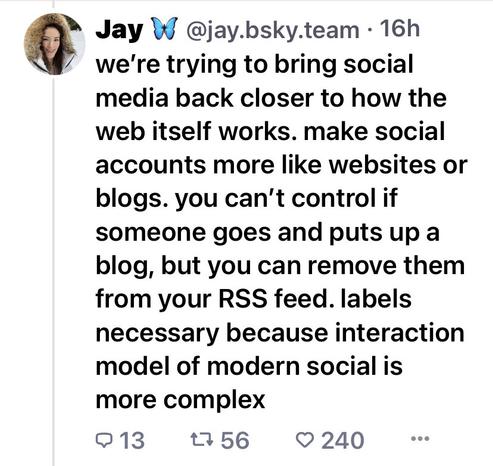
The couple of times a transphobe or Nazi has been invited in, CEO Jay Graber has kicked them from the platform; and she can kick or restrict the whole invitation tree, like who invited them and who they invited. So they’re not “pretending the bad stuff isn’t there”.

@MetalSamurai @sgrif @anildash @Viss - Obviously it can’t scale by having the CEO personally kick people. The dev team there is pretty openly talking about it, and have opened a Discord to take in community suggestions.
@FlyingTrilobite @sgrif @anildash @Viss This was written when they announced their “moderation” system which was nothing of the sort. It was a labelling and muting system that they misleadingly named. I think they really thought that would be good enough. Unsurprisingly it was not good enough and they rapidly had to implement some user removal code they didn’t think they needed, but absolutely should have had in place before launch.
@FlyingTrilobite @sgrif @anildash @Viss They were nowhere near ready for even a semi public launch, and every mistake they’ve made has been an unforced error of an entirely predictable nature (the TOS, the absence of moderation, the absence of federation, the inability to keep up and being overwhelmed, the guessable invite codes, and so on). Incidentally the “banned” users can return if and when another node is added and federation happens …
@FlyingTrilobite @sgrif @anildash @Viss (assuming it ever does - I have my doubts), as they will have a complete archive of all their content and it will return to the network as soon as they can reconnect. That’s the way it’s designed.
@FlyingTrilobite @sgrif @anildash @Viss I’m not going to give a project that started up several years ago with mountains of VC money and guidance from people who’d been involved with the legal and other issues of running a major social media site for years anything like the same kind of pass I’d give a garage based plucky startup.
@FlyingTrilobite @sgrif @anildash @Viss They should not be in the position of having to canvas opinions from end users over Discord for how to fix problems of their own making.
@MetalSamurai @sgrif @anildash @Viss - Listening to users is precisely what a lot of people want out of a platform though.
@FlyingTrilobite @sgrif @anildash @Viss “How to deal with bad actors” should have come up at the very first design meeting. Flailing about now, asking end users for help deciding what to do and apparently building things that were not on their roadmap is farcical.

@sgrif @Viss @anildash

One difference: individual server admins CAN ban and remove Nazi's, I'm digging thru documents at Bluesky and I'm still unclear if Bluesky admins can remove accounts, nuke content, or "Fediblock" content from other BlueSky servers to their own.

Or just label and hope.

@tchambers Protocols don't dictate what servers can do internally. I'd be shocked if the official implementation didn't provide those tools, since it'd just be begging for an alternative impl to come up and provide it.
@sgrif Me too. But not clearly finding it. And some statements that imply the opposite…
@tchambers We'll have to see once their server impl is available for us to play around with. They've been pretty clear that they're expecting multiple impls either way
Lauren Weinstein (@[email protected])

Attached: 1 image It appears that Bluesky is creating a content hellscape, in the mistaken belief that by allowing users to hide content, the ecosystem can escape the negative regulatory implications and social damage of permitting such content. Nor will their distributed/federated model prevent these outcomes.

Mastodon
@zop @Viss they're building moderation at a level above the protocol, which is exactly what Mastodon does with ActivityPub.
@anildash @Viss Which is to say, they are following the lead of IBM in the 1930s and 40s. (edit: checked the book and corrected the date range)
@anildash in terms of governance, which is the main attractive for me, Mastodon/Fediverse is vastly superior. I learned this lesson the hard way last year
@anildash I haven't had a chance to mess with Bluesky, though wondering whether or not I should?