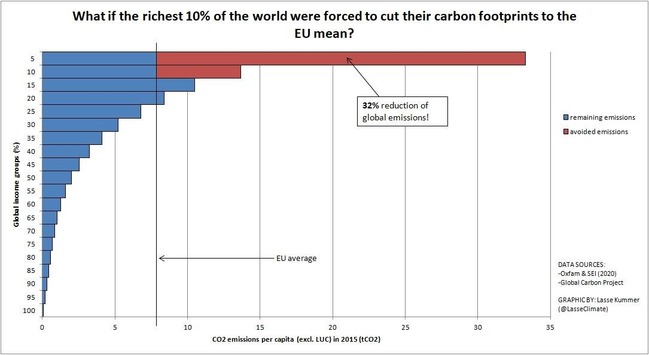
What would happen if the richest 10% reduced their CO2 emissions to the EU average (which BTW is a nice standard of living).

Answer, there would be a 35% decrease in global CO2 emissions.

So, all would be fixed, if we could limit the excesses of the top 10%.
@MarkHoltom Hi. You’ve made an excellent point, but I don’t feel able to boost the post because you haven’t added an image description to the photo attached to the Toot.

There are a lot of visually impaired people on Mastodon, & adding descriptions is encouraged in order to make the place more inclusive than other social media platforms. It would be a great help if you could help maintain this culture by explaining what the photo shows. Thanks.

@RabBrucesSpider1

firstly, I add text to EVERY post I can

Next, the graphic is too complicated to explain easily - however, the text of the toot explains it perfectly, so IMHO the point is explained and made.

@MarkHoltom @RabBrucesSpider1 That makes sense, BUT a visually impaired user wouldn’t know that, so they still might wonder what they’re missing. Something like “graph illustrating point made in post text” might be helpful for such a person.

Anyway, I know we don’t know each other, and I hope this hasn’t been too irritating. Have a good day!

@betsythemuffin @MarkHoltom Yes, that’s exactly the problem. Without some sort of explanation, screen reader users have no idea what is in the photo. Even a short explanation would be a massive help, and posts would reach more people as many users, like me, won’t boost a post if the image is not described. It’s unfair on our viusally impaired followers to do so.

@RabBrucesSpider1 @betsythemuffin @MarkHoltom
I am glad that Kingbeard added an #ALTtext description after it was brought to their attention.

I boosted it despite the false statement in it that "all would be fixed, if we could limit the excesses of the top 10%" because it still well illustrates how unequal carbon emissions are between low- and high-income people are.

@betsythemuffin @MarkHoltom I do apologise if my remarks came across as too aggressive. That wasn’t my intention, but if people aren’t informed about the importance of Alt Text Image Descriptions, they’ll keep posting inaccessible information. I do hope you’ll adopt the habit. Many thanks.
@MarkHoltom
Thank you. Sometimes the only question an alt text need address is “What am I missing, here?”

@MarkHoltom

If I'm eyeballing it correctly, it would seem from the graph that even reducing the top 0-5 % emission to the emission of the top 5-10% would already be a considerable change!

@[email protected] is that individuals or includes industry? Because those big CO2 industries are usually the most challenging to change. But we need to financially back them if they want to try new energy sources BECAUSE the impact if they succeed is worth it and then some.

@MarkHoltom

Language like in this graph creates an illusion that *we* are not responsible for the CO2 emissions but the 'richest' in the world are.

10% of earth's population 8B is 800M.

The richest 10% _in the world_ are likely people living in US, Canada, Western Europe, Middle East, and Australia.

https://www.worlddata.info/average-income.php

*We have to limit _our own_ excesses _now_*. _OUR_ consumption is making it worse for the remaining 7.2B.

Average income around the world

A comparison of the average income per capita over 91 countries worldwide

Worlddata.info
How much money you need to be among the richest 10 percent of people worldwide

According to the 2018 Global Wealth Report from Credit Suisse Research, this is the net worth you need to be in the top 10 percent, worldwide.

CNBC
@MarkHoltom what is the revenu of the poorest of the top 10% ?

@ciredutempsEsme @MarkHoltom If you have the equivalent of 93 170 US dollars or more, you’re a part of the upper 10%.

https://www.cnbc.com/2018/11/07/how-much-money-you-need-to-be-in-the-richest-10-percent-worldwide.html

How much money you need to be among the richest 10 percent of people worldwide

According to the 2018 Global Wealth Report from Credit Suisse Research, this is the net worth you need to be in the top 10 percent, worldwide.

CNBC
@MarkHoltom ⬆️ "On n'arrivera jamais à changer les comportements de millions de gens". Pas besoin ! Il suffit de réguler 10% de parasitoïdes.
@MarkHoltom @derek Sincere question: for what values of "all", in this case?
@MarkHoltom 35% drop is big. But it's 65% less than needed.

@quixoticgeek
@LordCaramac
@herrmannpierre

This is not true.
The Global Carbon Project produced the image below.
1) that a certain level of CO2 in the atmosphere is fine (<>280-300ppm)
2) We do NOT have to reduce our emissions to zero. Just emit no more than the sinks can take up.
3) to get from 400ppm down to 300ppm, we will need to reduce more than the sinks can uptake, but this still doesn't mean NO CO2 emissions.
4) we don't have to go back to a medieval lifestyle to achieve this.

@MarkHoltom All fixed?

I support the idea to reduce that part of emissions but we would still have many other existential issues.

https://www.stockholmresilience.org/research/research-news/2023-09-13-all-planetary-boundaries-mapped-out-for-the-first-time-six-of-nine-crossed.html

All planetary boundaries mapped out for the first time, six of nine crossed

For the first time, an international team of scientists is able to provide a detailed outline of planetary resilience by mapping out all nine boundary processes that define a safe operating space for humanity.

@MarkHoltom A 35% decrease is not near enough, we need a 100% decrease ASAP.

@MarkHoltom @baldur what seems intriguing is the conflation of two different metrics.

In 2018, Credit Suisse concluded that if one has a net worth of $93k or more, one is in the global richest 10%. So I’m in that bracket.

I can’t readily find what the EU average net wealth is but, seeing as EU average income is about $26k per year, I’d hazard a guess that EU average emissions substantially overlaps with the global richest 10%.

My point being that…

@MarkHoltom @baldur …we really need to focus on the *behaviours* which generate emissions and less on poor proxies for that which sets up an “us” vs “them” narrative, while obscuring the fact that the “them” is usually “us”
@MarkHoltom How much must one earn per year to be in that top 10%? Is there somewhere that data is convenient?

@GregStolze
Maybe these will have an answer:

DATA SOURCES:
-Oxfam & SEI (2020)
-Global Carbon Project
GRAPHIC BY: Lasse Kummer (@LasseClimate)

@MarkHoltom Another issue with this, is that it expects the poorest *not* to improve their standard of living. Alas, it's not so simple.
@MarkHoltom yeah but apparently not driving a studio apartment with a lift kit 3 miles to get a cup of coffee is "radical"

@MarkHoltom "all would be fixed"= nothing would be fixed.
If you have a burning house like we have a planet in a climate crises fueled by burning fossil stuff, cutting down global emissions by 32% is like putting out 35% of the flames.
The house is still burning. Even if we put out all flames nothing is fixed yet nor is it a complete solution to the problem in the first place.

See "Brighter" by Adam Dorr, RethinkX for further investigation:
https://rethinkdisruption.com/brighter-1-the-future-of-the-environment/

Brighter transcript: Episode 1 - The future of the environment is brighter than you think - Rethink Disruption

This is a transcript of 'Episode 1 - The future of the environment is brighter than you think’ by Adam Dorr. The entire series is available on YouTube. The

Rethink Disruption
@MarkHoltom ... link to the source study please? I'd like to better understand the findings.

@Marty
I often ask this myself of unsourced “facts” posted on-line. Examining the graphic can usually reveal the souce. In this case:

DATA SOURCES:
-Oxfam & SEI (2020)
-Global Carbon Project
GRAPHIC BY: Lasse Kummer (@LasseClimate)

@Voline Thanks. The data sources are important but the synthesis of their data and the reporting might be important on its own.
@MarkHoltom All right, now how do I figure out whether I'm in the top 10%? It seems wrong to propose a fix that conveniently only requires other people to do something.

@matt @MarkHoltom

DATA SOURCES:
-Oxfam & SEI (2020)
-Global Carbon Project
GRAPHIC BY: Lasse Kummer (@LasseClimate)

@MarkHoltom "all would be fixed" is an extremely dubious assertion.

The extinction is worse the faster we increase the atmospheric carbon load, but the consequences happen due to the amount of atmospheric carbon load, not the rate at which it arrives.

We're not OK until fossil carbon extraction goes to zero, and we're not OK until everyone has enough to eat within a zero fossil carbon extraction economy.

@MarkHoltom Would that be enough for 1,5°?
@grouchox @MarkHoltom No, for that emissions need to be essentially zero. But it would get us 1/3 of the way there without making anyone's life hard.