"Overall, there is almost no ice over four years old remaining—it now comprises just 3 percent of the total ice cover. This is the same percentage as last year and contrasts starkly with the late 1980s when 30 to 35 percent of the Arctic Ocean’s ice was older than 4 years."

End of winter NSIDC update: http://nsidc.org/arcticseaicenews/2023/04/polar-dawn-to-dusk/
From polar dawn to dusk | Arctic Sea Ice News and Analysis

@ZLabe

New cataclysmic consequences of vanishing pole #ice?

(1)

Sometimes I wonder whether scientists are telling us the *whole* truth.
Whereas in the late 1980s, 30-35% of the #ArticOcean was never ice-free, now at a mere 3%, it has been all but exterminated.

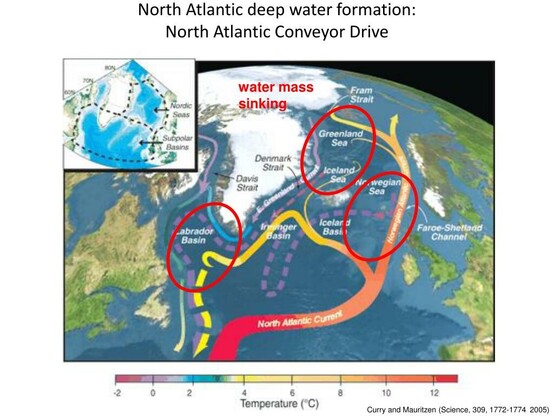
Since at least the early 1990s, there has been talk about the results that the slowing and eventual likely breakdown of the #NorthAtlanticConveyorBelt, part of the the #GlobalConveyorBelt.

In the beginning,...

@ZLabe

(2/n)

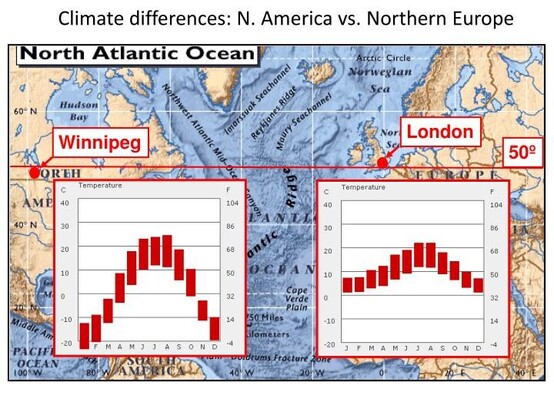
...there was talk of a "small #IceAge for Northern #Europe, , in particular for the #BritishIsles, which are much warmer due to the #NorthAtlanticCurrent being pushed north by the sinking heavier salt-water in the #AntarcticFront. This can make sense, comparing cities on the same latitude in #Europe and #NorthAmerica: the continental #climate in #Winnipeg is much more extreme, in particular in winter, than in #London (see pic. below)...

@ZLabe

(3/n)

...Then, the forecast was for two decades of rapid #GlobalWarming, which we have been experiencing.

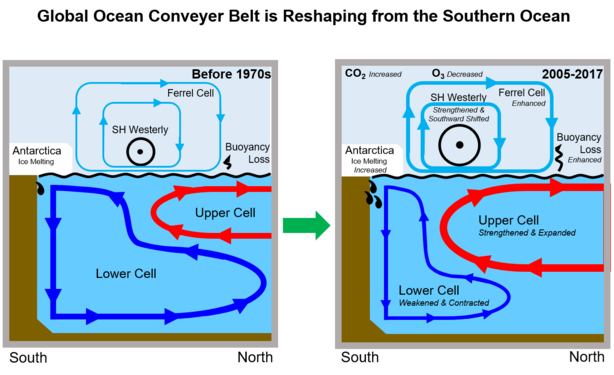
Now, with regard to the latest data the #Antarctica in the south, it shows that the so-called #DeepWaterFormation is not so much "down the drain" anymore, as the oceans and humanity would need it to be:

"The #OceanCirculation, which includes well-known surface and subsurface #currents and the vertical motion of ocean water, appears to have changed in a *major way*..."

@ZLabe

(4/n)

"... over the #SouthernHemisphere in *recent* decades. Increased contributions of meltwater from the #Antarctic #IceSheet, mostly from melting at depth due to increased warm deep water reaching the edge of the continent, has added #freshwater to the sea currents, making the water less dense. This *lighter* water flows up to the surface, increasing the stratification in the near-surface layer.

Because the stratification is stronger,..."

https://fediscience.org/@ZLabe/110154692935201163

Zack Labe (@[email protected])

Attached: 1 image "Overall, there is almost no ice over four years old remaining—it now comprises just 3 percent of the total ice cover. This is the same percentage as last year and contrasts starkly with the late 1980s when 30 to 35 percent of the Arctic Ocean’s ice was older than 4 years." End of winter NSIDC update: http://nsidc.org/arcticseaicenews/2023/04/polar-dawn-to-dusk/

FediScience.org

@ZLabe

(5/n)

"...*the vertical ocean circulation has slowed*."

And with this sentence, we can circle back to my starting point: are we being told the full story?

Yes, #GlobalWarming on the continents and in the seas, with the disappearance of #Permafrost and the #IceSheet is bad enough, it would seem.

However, a further fundamental questions arises from my non-natural scientist perspective, looking at the next two pictures:

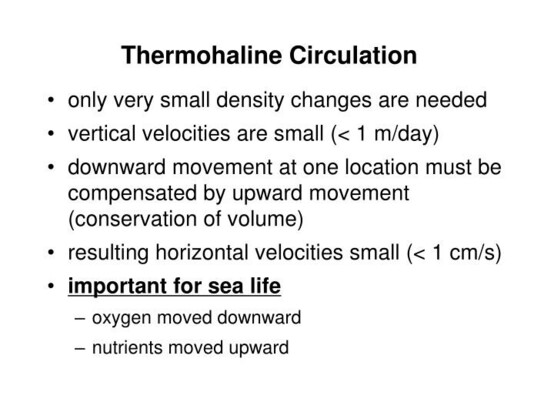
the #ThermohalineCirculation is essential for sea life:...

@ZLabe

(6/n)

...
1) life-sustaining #oxygen is moved downward in the #DeepWaterFormation process of the
- #NorthAtlantic (#NADW),
- #AntarticBottomWater (#AABW), and
- #NorthPacificDeepWater (#NPDW).

2) life-sustaining #nutrients are moved upwards.

Bare with me, there is one more puzzle piece that we should look at:

According to the #US National Oceanic and Atmospheric Administration (#NOAA), 91%
of ocean species have yet to be classified...

https://oceanservice.noaa.gov/facts/ocean-species.html

How Many Species Live in the Ocean?

The number of species that live in the ocean is unknown.

@ZLabe

(7/n)

...

be classified and 80% of the #oceans remain unexplored.

I rarely use all caps, but WHAT HAPPENS IF WE TURN OF THE OXYGEN FOR ABOUT 90% OF THE SPECIES THAT LIVE IN THE OCEAN?!?

Will they largely become extinct?
Will they migrate to the higher water levels?
Will evolutions be accelerated thereby, as these species are accustomed to enormous under-water pressure and might explode by rising?
Will the fish we depend upon for our sustenance in the...

@ZLabe

(8/n)

...upper water levels nowadays vastly become extinct, too as the 1,000-year-circle of nutrients in the #GlobalOceanConveyorBelt?

I don't know what happened to ocean life when the #ChicxulubImpactor, the #asteroid that struck the #CaribbeanOcean off the coast of #Yucatán/#Mexico 66 million years ago and created an #ExtinctionLevelEvent (#ELE):

(If you haven't seen it, this visualization is quite captivating:)

https://www.youtube.com/watch?v=5qJPTjMnwNk

Presumably, the whole food-chains...

Chicxulub impact visualization

YouTube

@ZLabe

(9/n)

...that depended on #plankton died off, too.

Here, however, is a pretty good explanation of the consequences of the #ELE which ended the #Cretaceous of the #Mesozoic Era:

https://www.youtube.com/watch?v=awUzQ8LoA8Q

As a reminder for the none-biologists among us:
"Plankton are the diverse collection of organisms found in water (or air) that are unable to propel themselves against a current (or wind).
In the ocean, they provide a crucial source of food to many..."

https://en.wikipedia.org/wiki/Plankton

Chicxulub: The Asteroid that Killed the Dinosaurs

YouTube

@ZLabe

(10/n)

"...

small and large aquatic organisms, such as #bivalves, #fish and #whales.

#MarinePlankton include bacteria, archaea, algae, protozoa and drifting or floating animals that inhabit the #saltwater of #oceans and the brackish waters of estuaries."
(Wikipedia)

How many #DeepSea species in the deep ocean will survive will probably depend on how many really need #oxygen to survive.

To answer this, #MarineBiologists will...

https://en.wikipedia.org/wiki/Deep-sea_community

Deep-sea community - Wikipedia

@ZLabe

(11/13)

...involved in the research into the #ClimateCrisis, as a tipping point could be reached quite soon because things are getting worse:

"The model projects the overturning circulation around #Antarctica will slow by more than *40%* over the *next three decades*, driven almost entirely by pulses of #meltwater

Over the same period, our modelling also predicts a 20% weakening of the famous #NorthAtlantic overturning circulation which keeps #Europe’s...

https://theconversation.com/torrents-of-antarctic-meltwater-are-slowing-the-currents-that-drive-our-vital-ocean-overturning-and-threaten-its-collapse-202108

Torrents of Antarctic meltwater are slowing the currents that drive our vital ocean 'overturning' – and threaten its collapse

In a plot reminiscent of the 2004 movie The Day After Tomorrow?, Australian scientists are warning that the Southern Ocean’s deep “overturning” circulation is slowing and headed for collapse.

The Conversation

@ZLabe

(12/n)

"...mild. Both changes would dramatically reduce the renewal and overturning of the ocean interior."

As we were talking about the #DeepSea community:

"With a collapse of this deep ocean current, the oceans below 4,000 meters would stagnate.

"This would trap nutrients in the deep ocean, reducing the nutrients available to support marine life near the ocean surface," says Prof England."

https://phys.org/news/2023-03-deep-ocean-currents-antarctica-collapse.html

PS:
Here, you can access...

Deep ocean currents around Antarctica headed for collapse, study finds

The deep ocean circulation that forms around Antarctica could be headed for collapse, say scientists.

Phys.org

@ZLabe

(13/13)

...the complete presentation from which I have been quoting:

https://www.slideserve.com/tad/great-ocean-conveyor-belt-illustration-of-thermohaline-circulation

/END

Great Ocean Conveyor Belt illustration of thermohaline circulation

Geography 104 - “Physical Geography of the World’s Oceans”. Great Ocean Conveyor Belt illustration of thermohaline circulation shows link between surface and deep circulation demonstrates connectivity of the world ocean transport of energy and biogeochemical tracers

SlideServe