Crazy numbers from #Anthropocene Earth:

Weight of all wild mammals on land: 22 million tons

Weight of all wild mammals in ocean: 40 million tons

Weight of all humans: 390 million tons

Weight of all land mammals domesticated by humans: 630 million tons.

Interesting to test some of figures as e.g. sperm whales alone should be 20m t not 7m t.

But overall ratios are impressive.

New Study in PNAS:
https://www.pnas.org/doi/10.1073/pnas.2204892120

Article in Guardian:
https://www.theguardian.com/environment/2023/mar/18/a-wake-up-call-total-weight-of-wild-mammals-less-than-10-of-humanitys

@christianschwaegerl hmmm I'm doubting this. I sperm whale weighs 70-75 ton. Estimated population is 200k-1.5M. So sperm whales alone would be 14-115M tons.

Maybe the proportionsof different in weight are right though, idk.

@lisards @christianschwaegerl
You are right they have thrown out som curious numbers.🥸
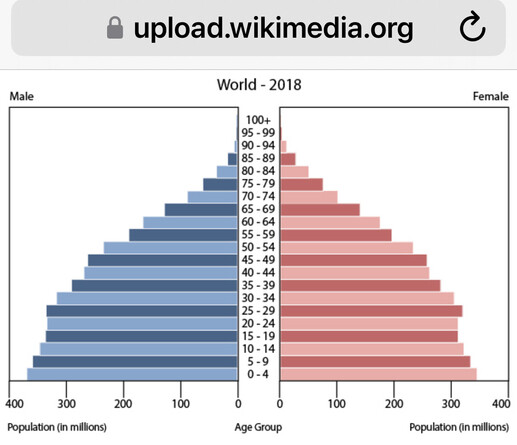
Human race weights less then 100 Million, which you also can countdown easily, while then counting more then 4 Times 🙄
@BlackHeroe @lisards Your 100 Million t for 8bn people wd mean average weight of a human being is 12.5 kg. I find 49kg more plausible.
@barrygoldman1 @BlackHeroe @lisards Majority in grown-up stages of life
@christianschwaegerl hmm didnt realize world avg bulging in th middle yrs these days..

@christianschwaegerl @lisards

Ja nicht sich durch Ami Maße verwirren lassen, ist mir wohl in dem Zustand nicht mehr möglich 😶‍🌫️

Dann nur ein bissl zu wenig 😉

@lisards Average figures are 14t for females and 41t for males, and latest population estimate is 736.000, so that would bring them to 20m t instead of the 7m t given in the study. I will ask the authors about this. https://www.nature.com/articles/s41598-022-24107-7
Current global population size, post-whaling trend and historical trajectory of sperm whales - Scientific Reports

The sperm whale lives in most deep ice-free waters of the globe. It was targeted during two periods of whaling peaking in the 1840’s and 1960’s. Using a habitat suitability model, we extrapolated estimates of abundance from visual and acoustic surveys to give a global estimate of 736,053 sperm whales (CV = 0.218) in 1993. Estimates of trends in the post-whaling era suggest that: whaling, by affecting the sex ratio and/or the social cohesion of females, reduced recovery rates well after whaling ceased; preferentially-targeted adult males show the best evidence of recovery, presumably due to recruitment from breeding populations; several decades post-whaling, sperm whale populations not facing much human impact are recovering slowly, but populations may be declining in areas with substantial anthropogenic footprint. A theta-logistic population model enhanced to simulate spatial structure and the non-removal impacts of whaling indicated a pre-whaling population of 1,949,698 (CV = 0.178) in 1710 being reduced by whaling, and then then recovering a little to about 844,761 (CV = 0.209) in 2022. There is much uncertainty about these numbers and trends. A larger population estimate than produced by a similar analysis in 2002 is principally due to a better assessment of ascertainment bias.

Nature
@christianschwaegerl
It's time to bring #Anthropocene to it's end. ...
@chbmeyer it‘ll be more like what we make it to be. We’re way beyond point of return.
@christianschwaegerl r they counting bats and rodents accurately?
@barrygoldman1 they cover this in methods. Human-associated rodents are included in domesticated animals.
@christianschwaegerl i mean rodents for wild animals. I suspect thats where most biomass is?
@christianschwaegerl numbers also depend on what counts as biomass. Mass of the specimen? Mass of the dry tissue? Mass of the carbon in the specimen?
I can't readily find which method the authors use, but given others' surprise at the numbers it probably isn't the mass of the specimen.
@DaanWilmer it's so called „wet biomass“, i.e. in a living and breathing condition.