Ingenious, Indigenous cartography: The Tunumiit (Eastern Greenlandic Inuit) practice of carving portable maps out of driftwood to be used while navigating coastal waters. These pieces, which are small enough to be carried in a mitten, represent coastlines in a continuous line, up one side of the wood and down the other. The maps are compact, buoyant, and can be read in the dark.
@decolonialatlas Apparently there's also currents encoded in the carvings, but I can't really tell how
(but I do know the left one's upside down compared to the drawn map).
@Mabande it might be a tactile element, like the direction the wood was carved in or something?
@Iwillyeah Yeah, something like that :)
@Mabande @Iwillyeah the one on the left has 3 dimensional features which seems like the obvious way to do it.
@norgralin @Iwillyeah @Mabande I also like how the middle one has a possible portage route between adjacent bays marked. (Notice how the carved channel between inlets corresponds to a short, low-altitude land bridge on the paper map.)

@decolonialatlas At first I thought it was remarkable that a people with no satellites, planes or even basic cartographic tools could make something so accurate...

Then I remembered I'd once read how modern indigenous australians have names for - and can point to the locations of - mountains which have been underwater for thousands of years as a result of rising sea levels. 🌊 🗻

Never underestimate the connection of the indigenous to their home... 🌅 🌍 🌌

#Indigenous #Maps

@ScriptorViator I think local fishers everywhere have always been able to tell areas of deeper from shallower water, up to a point. Currents, temperatures and fish movements probably tell you a lot, if you know what you're looking at.
@decolonialatlas why didn’t they just use Google maps?

@decolonialatlas especially since these are "readable in the dark" would you mind editing to add alt text? My attempt:

Three pieces of carved wood on top of a map showing a complicated coast with lots of promontories, bays, and off-coast islands. Each piece of wood is a short rod, with notches carved into the sides. The image includes lines to show how the notches correspond to bays on the map and the protrusions in between correspond to promontories; each piece of wood matches one part of the map, and is about the right size to fit inside a closed hand.

@decolonialatlas probably should have added more details about the specific correspondences to the map:

One piece is down to match an island, another matches a section of coast, and a third matches the islands that lie off the coast mapped by the second.

@decolonialatlas Wow! Oh my goodness, such quality cartography! That is simple genius. We have much to learn from so many different groups and cultures in our amazing human family.
@decolonialatlas Really cool. when do these date to?
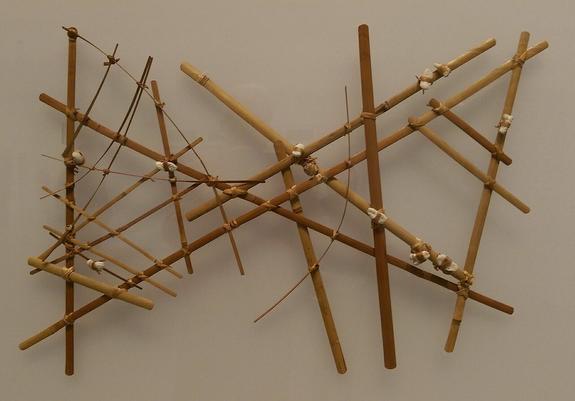
@decolonialatlas Makes me think of Pacific islanders' Stick Maps: https://en.wikipedia.org/wiki/Marshall_Islands_stick_chart
Marshall Islands stick chart - Wikipedia

@decolonialatlas Holy shit, I've never had an object like that feel instantly familiar.
@decolonialatlas @Gerhana these maps are closer to the territory