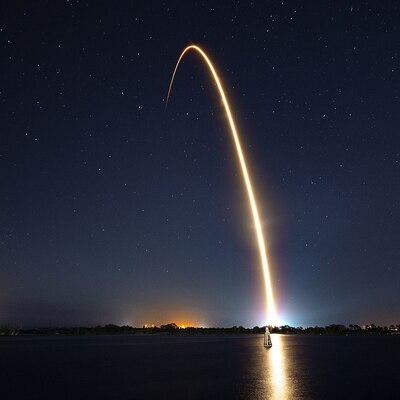
#WashingtonPost 📆 May 2021 "The #first known #report of damage caused by #SpaceDebris came as early as 📆 1969. An #unidentified #object had fallen from #space and hit a #freighter that was traveling off the #coast of #Siberia, #seriously #injuring five crewmen. #Tokyo initially kept that #information a #secret 🕵️, out of a desire to avoid provoking a conflict with #Moscow" https://www.washingtonpost.com/world/2021/05/08/space-debris-crashes

Picture (symbolic)  https://commons.wikimedia.org/wiki/File:The_Royal_Navy_during_the_Second_World_War_A13656.jpg

From a Texas dental office to the Canadian tundra, here’s where space debris has crashed to Earth

With oceans and unpopulated areas covering much of the globe, it’s statistically unlikely that a piece of falling space junk will land in someone’s suburban backyard. But there have been a handful of high-profile incidents.

The Washington Post

Low-risk, high-consequence outcomes, such as a piece of a #rocket stage #crashing into a high-density city 🏙️ or a large passenger aircraft ✈️. In the latter case, even a small piece could cause hundreds of #casualties ☠️. #Internationally, there is no clear and widely agreed casualty #risk threshold. #Governments have apparently chosen to bear the slight #risk of having to #compensate for one or more casualties ☠️., rather than to require launch providers to make expensive technological or mission design changes. Assuming that each #reentry spreads #lethal ☠️.#debris over a 10m2 area, we conclude that current practices have on order a 10% chance of one or more casualties ☠️.over a decade. https://www.nature.com/articles/s41550-022-01718-8

#SpaceDebris #Rocket #reentry #SpaceRegulation

Unnecessary risks created by uncontrolled rocket reentries - Nature Astronomy

Each uncontrolled rocket body in orbit poses a low casualty risk on reentry. But the cumulative risk is unacceptable and disproportionately borne by the Global South. Spacefaring states must stop exporting these risks and plan for safer reentries.

Nature

#NYT 📆 Nov. 5, 2022 🇨🇳 #LongMarch 5B : While there were no immediate reports of #damage, Friday’s re-entry did cause disruption, including a #closure of #Spanish #airspace that delayed hundreds of flights 🛫 in the morning. A #rocket of the same design is expected to be used again at least once more, in 📆 2023* https://www.nytimes.com/2022/11/04/science/china-rocket-debris.html

* https://nextspaceflight.com/launches/details/2806

China Lucks Out Again as Out-of-Control Rocket Booster Falls in the Pacific

For the fourth time, the country’s space program used a 23-ton launcher that made an uncontrolled re-entry back to Earth, prompting nervous sky-watching and airspace closures in Europe.

The New York Times