This article is a good starting point for the East Palestine derailment. (Gift link, anyone can read.)

The info circulating on social media has been suboptimal, to say the least. Grab a cup of coffee and let's go over everything from vinyl chloride to electronic brake regulations.

/1

https://www.nytimes.com/article/ohio-train-derailment.html?unlocked_article_code=QAUX9RHyBl1b9fUvtoaowDVNQ7pnrrwPkArV4od2eHAxdIsqcvZ_du1RQBRo3vGRWv9KKJjCRbz1pdFxA4DMMuRrDEHjsdrLTbrI7YtViCmAVWuw9Y-u-AZEByM_eHO1TC74FTlPfvK4xeXnboaKa83KmBMqXil2Ks4M5Cx67bNIDv4AGkYqQTG8qKHa8upQx9JrAraht717TuVyEgAnpdpOuB3K21JY4MXh-70VgPkCUbp6CxfvYDkqeuMjrKhUkOPAS6Ew82vrs1tupq0pEkaNXmwSju_YyTFYWegxNvNVILvuLNy-ZNp06pY2YCcpqnNdcA&smid=url-share

Train Derailment in East Palestine, Ohio: What We Know

When a train derailed in the village of East Palestine on Feb. 3, it set off evacuation orders, a chemical scare and a federal investigation.

The New York Times

20 miles *before* it derailed, the 150-car train was already sparking/burning. A "hotbox" detector in Salem, OH, should've picked that up and alerted the crew. It's unknown if it did, but seems unlikely or they would've hit the emergency brake then.

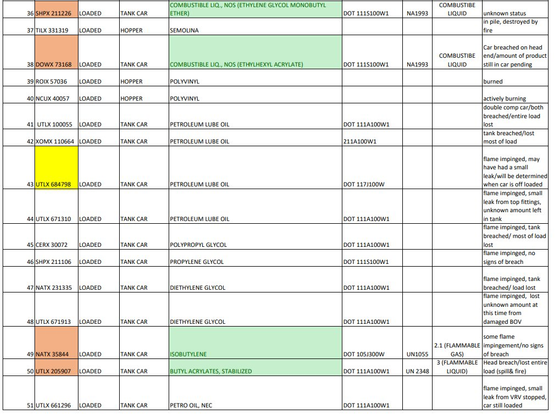
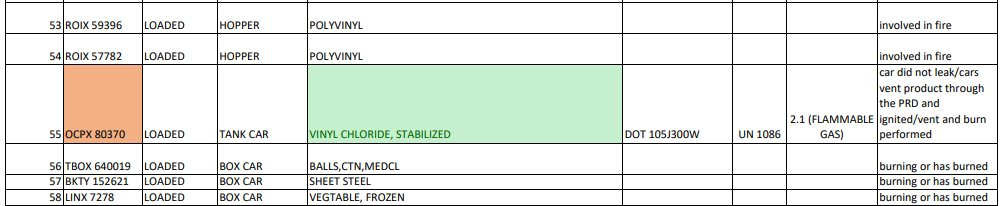
Upon derailment, a bunch of stuff was burning. Some was in the normal range of "stuff on fire," like the semolina and frozen vegetables, and some was nasty but not unusual (polyethylene & polyvinyl), but some of it was uniquely hazardous.
/2

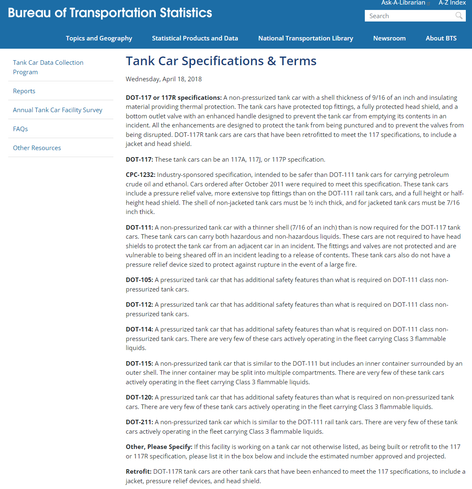
Butyl acrylate, ethylhexyl acrylate, and ethylene glycol monobutyl ether are hazardous cargo. Note the "DOT111" next to them: they're in standard (read: cheap) tanks that don't fare as well in accidents. Big surprise, the cheap tanks were compromised.

/3

https://response.epa.gov/sites/15933/files/TRAIN%2032N%20-%20EAST%20PALESTINE%20-%20derail%20list%20Norfolk%20Southern%20document.pdf

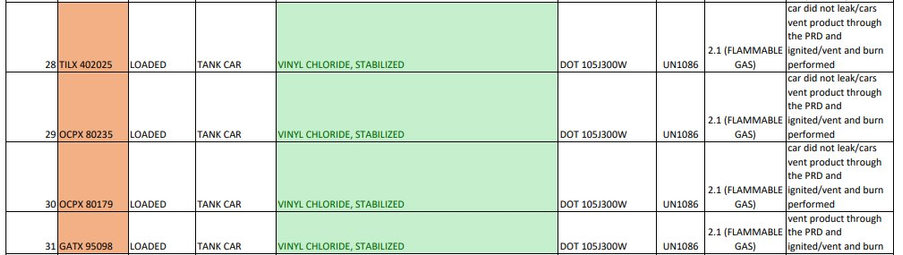
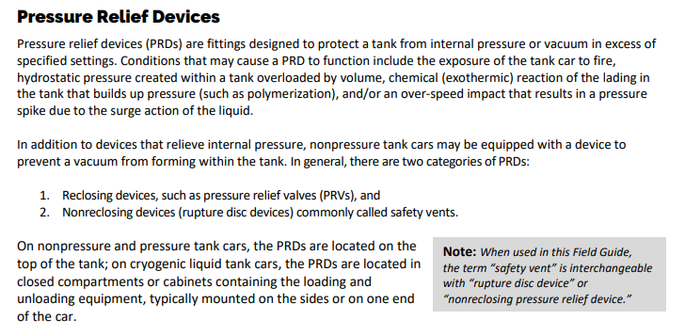
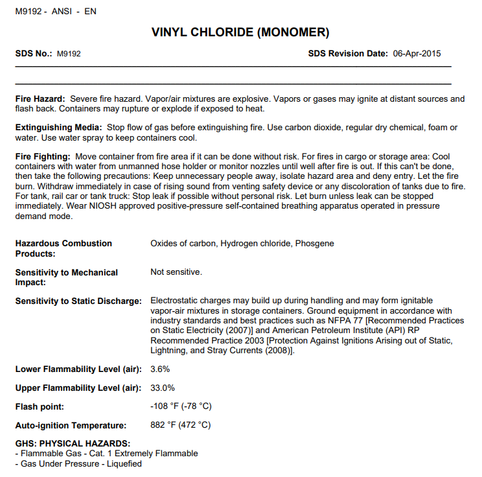
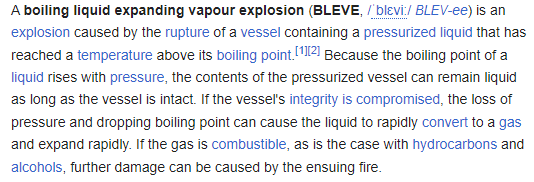
The liquified vinyl chloride was in superior DOT105 tanks. They didn't break open, but their PRD activated and vented some vinyl chloride, a carcinogen. And because they're near a fire, they're also potential giant fuel-air bombs (a/k/a BLEVE). Burning it was the only option.

There is some good news here. Vinyl chloride isn't, say, plutonium. It fares poorly outdoors, as do its byproducts.

/4

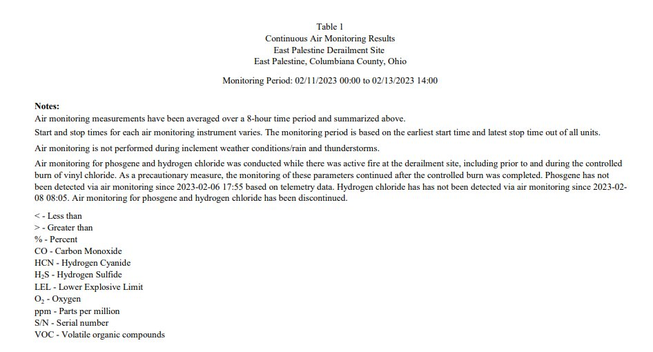
Hydrogen chloride and phosgene are rightly terrifying. EPA has been testing; they're already gone.

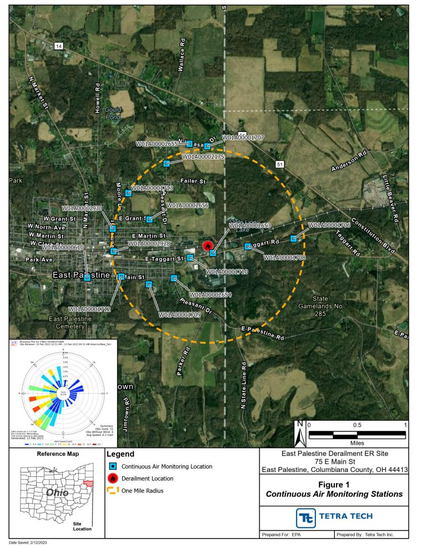
Here's the latest EPA continuous air monitoring results. No hydrogen chloride since Feb 8. No phosgene since Feb 6. No volatile organic chemicals above screening levels. Good news!

Alas, we're not done.

/5

https://response.epa.gov/sites/15933/files/Continuous%20Air%20Monitoring%20Summary%20Table_20230213%201.pdf

It's unknown the extent to which water and soil are contaminated. Three cheap DOT111 cars contained diethylene glycol, famous for being (a) brake fluid and (b) the poison that prompted the Food, Drug, and Cosmetic Act. They broke open.

FWIW, substantial efforts have been made to identify and mitigate water and soil contamination. But we just don't know the extent of it, and likely won't for some time.

/6

https://www.sciencedirect.com/topics/medicine-and-dentistry/diethylene-glycol

https://response.epa.gov/sites/15933/files/East%20Palestine%20RAWP%20Feb%2010%202023.pdf

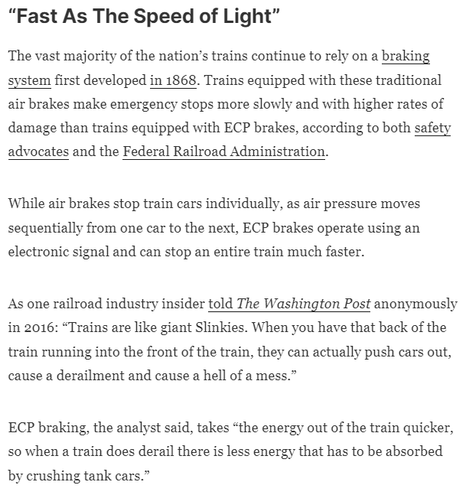
"Electronically Controlled Pneumatic Brake System Requirements for High Hazard Flammable Unit Trains" is a galling example of how captured regulatory agencies are, and how industries won't do the minimum.

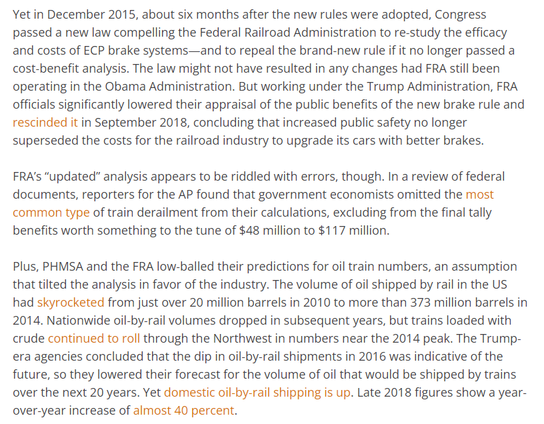
Most trains use the same braking tech used by steam locomotives. The original Obama-era electric brake proposal was already narrow in scope, then hindered more by Congress, then was ruined by the Trump admin outright lying about the numbers.

/7
https://www.levernews.com/rail-companies-blocked-safety-rules-before-ohio-derailment/
https://www.sightline.org/2019/03/28/oil-trains-trump-administration-faulty-logic-ecp-brakes/

Rail Companies Blocked Safety Rules Before Ohio Derailment

The train derailment came after Norfolk Southern helped convince government officials to repeal brake rules and lobbyists watered down safety regulations.

The Lever

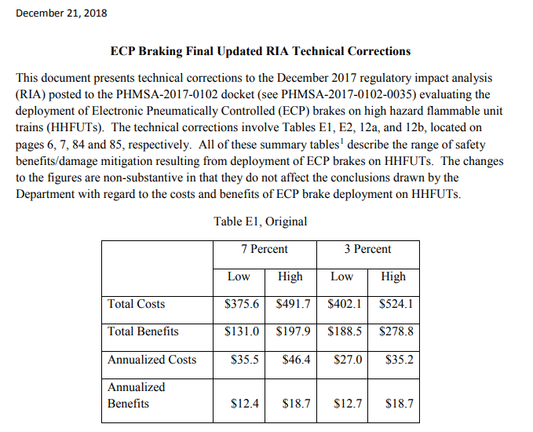
Even after Trump admin number fudging, the annualized cost of electronic brakes on highly hazardous trains was $27.0-$46.4 million.

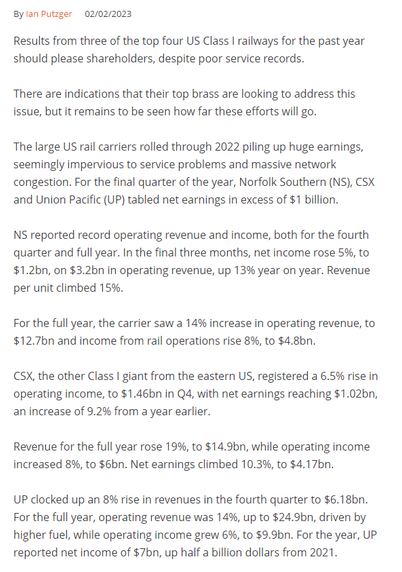
Every day, BNSF, Union Pacific, CSX, and Norfolk Southern make over $50 million in profit.

/8

https://www.regulations.gov/document/PHMSA-2017-0102-0049

https://theloadstar.com/client-anger-as-us-class-i-railways-report-huge-earnings-despite-poor-service/

Regulations.gov

Would the electric braking regulation have stopped/limited this? No—because it wouldn't have even applied to this train, it wasn't carrying enough hazardous cargo. Sure, it had carcinogenic fuel-air bombs and literal poisons, but not enough of them. Need 35 tanks for that.

Which is infuriating. None of this hazardous cargo should ever be transported in cheap DOT111 tanks or on trains with air brakes—much less both, as here. We don't need the old regulation; we need something far more strict.
/9

As for what chemicals might have been produced, the derailment was effectively an open waste burn: plastics, food, and steel all burned together at uncontrolled temperatures. That can produce lots of dioxins, but it's impossible to predict how much. No way to know what catalysts were created or how much material was incompletely burned. Just have to keep testing.

https://link.springer.com/article/10.1007/s10163-022-01430-9

/10

A comprehensive review of domestic-open waste burning: recent trends, methodology comparison, and factors assessment - Journal of Material Cycles and Waste Management

Open burning is a waste management practice performed by many people worldwide, especially in developing countries. Lack of detailed data of open burning practices may lead to a misinterpretation during data analysis, especially when estimating global/local emissions and assessing risks. This study presents a comprehensive review of current research trends, methodological assessments, and factors behind open waste burning practices from published literature. This review used systematic methods such as PRISMA 2020 methodology, a bibliometric approach, and qualitative content analysis to determine and assess 84 articles related to open burning. The results show that environmental risks and emission factors related to open burning incidents at the landfill or residential level are preferable topics that will be rising in the years to come. Coupling methods such as a transect-based approach with a questionnaire survey and mobile-static plume sampling to determine the activities and incidents as baseline data for risk assessment will help researchers gain a robust dataset of open burning emission inventory. In addition, it was found that environmental knowledge and awareness levels influence open burning practices, thereby opening up opportunities for future research.

SpringerLink

As mentioned above, it appears a hot box detector failed to alert the crew of problems 20 miles before the derailment.

Over the past few years, Norfolk Southern increased their profits by simply not having employees to maintain the hot box detectors.

"As recently as three years ago, Norfolk Southern employed five electronic leaders in the area of its rail network that includes East Palestine. Today, it employs zero..."

https://www.freightwaves.com/news/norfolk-southern-eliminated-key-maintenance-role-in-derailment-region-union-says
/11

Norfolk Southern eliminated key maintenance role in derailment region, union says

There are no federal requirements on the usage or maintenance of heat-detecting devices that have helped cut down on derailments.

FreightWaves
@maxkennerly @ggreeneva Here comes the Class Action lawsuit.

@maxkennerly Why does the recent rail strike seem like a warning ignored? Something a little too little a little too late? Is now the time to ask if caring for the employees who support you, and the communities you serve might be more important to increasing margins year-over-year and getting that bonus at the end of the year?

#economics #lobbying #BoostingIsSharing

@sfwrtr @maxkennerly The doctrine of Shareholder Supremacy precludes consideration of the interests of employees or communities, or even national security.

Which, IMO, is a strong argument for ending Shareholder Supremacy and bring back charter reviews.

@opendna @sfwrtr @maxkennerly don't forget insurance. Not sure how railroad insurance works but if it's like any other business, the usual management decision process goes toward not spending money on maintenance to increase profits. When catastrophe happens, let insurance pay for it.
@opendna @maxkennerly I think it is a strong argument for people running for school boards and seeing that their children are taught ethics, civics, how to think for themselves, and skepticism. I think this is a generational thing, sadly. I suspect none of us who cry seeing this over and over, have the power to do anything ourselves, but if we could empower a generation to think... Perhaps they'll make different mistakes.
@maxkennerly Holy cow. In the '80s I was a developer working on the hotbox detectors for N&W railway. N&W is now Norfolk Southern.
@maxkennerly Though I hope for Turing's sake their current units aren't the ones I was working on almost 40 years ago, on a 2 MHz z80.
@resuna I’m surprised N&W was home rolling their own detectors. One would think they would have gotten them from a specialized external vendor. But maybe there were no vendors yet?
@provuejim I was actually working for a company named Ensun, but N&W was our biggest customer.
@maxkennerly This alone should bring a huge criminal lawsuit with not just "fines" but jail time for that entire management chain that signed off on it.
@maxkennerly And, of course, NS is going to appeal to the government to help bail them out when the lawsuits come.

@maxkennerly only five? That’s not a huge salary cost, even for specialists. Guarantee that this one accident eliminated the profits from eliminating those roles a dozen times over.

Penny wise, pound foolish.

@maxkennerly not to worry. I’m sure JD Vance is on top of the situation.
@jag0325 @maxkennerly hahaha thanks for that. I needed a hearty laugh today!
@maxkennerly Forever preaching too much government regulation, but obvi the greedy industries will not do what is right when left to their own devices!!😡

@maxkennerly

One thing to note is that the railroads don't own tank cars.

@Gleng2 But they do set the rates for cars. They could easily demand higher safety standards. They chose not to, and will have to be regulated to compel minimal safety.
@Gleng2 @maxkennerly But they can refuse to carry them, which is something they already do with substandard cars.
@orc @maxkennerly DOT111’s have been the backbone of safe, hazmat rail transportation for decades. They’re currently in short supply. They’re also not cheap. New 111’s were expensive, well over 100k/car with safety features such as advanced high quality steel, insulated jackets, bottom skid protection and pressure relief devices. The newer designs are primarily a response to crude oil cars which run at higher and varied pressures.
@Gleng2 @maxkennerly Which of the tank cars ruptured and which ones didn't? If the DOT11's did and the DOT105s didn't, that would be a case where the regulators should look at them with a gimlet eye (and in the interim the carriers miiight want to reconsider using them in trains that go through (what turned out to be?) hotbox-detector-free territory.)
@orc @maxkennerly It’s all in the hands of the NTSB now. Once they do their investigation, they’ll issue a final report as to cause. Then everyone will discuss what needs to be done. The important thing now is to be patient and let NTSB do their work then let the experts in industry along with the regulators hash it out as they always do, regardless of who’s in charge politically. All aspects will be reviewed but the true cause of the derailment will be the main focus. Right now, nobody knows.
@maxkennerly I would like to see Buttigieg rise to the occasion here and stomp on the regulatory-scoffing industry and put these additional rules in.
@maxkennerly it’s not the money, it’s the time in the shop.
@maxkennerly I have family 50 miles due east as the crow flies/wind blows. Is there a risk to them?

@maxkennerly It is hard to imagine the handling of it to this point will hold up to the scrutiny of history.

Where "history" is like ... later this week.

@maxkennerly I think I read somewhere that railroads have the highest profit margin of all industrial sectors.
@profcarroll Yep. It's been the case for years that the railroads have profit margins far above most industries, and well above much of tech, too. https://fortune.com/2015/06/04/union-pacific-railroad/
The railroad with better profit margins than Google

How old-economy stalwart Union Pacific finds success.

Fortune
@maxkennerly Serious question- if it’s unknown that the hotbox detector picked it up, how do we know it was already sparking/burning 20 miles before? Was there some other witness?
@provuejim Security camera footage from places in Salem, Ohio, Google around and you can find some of it.