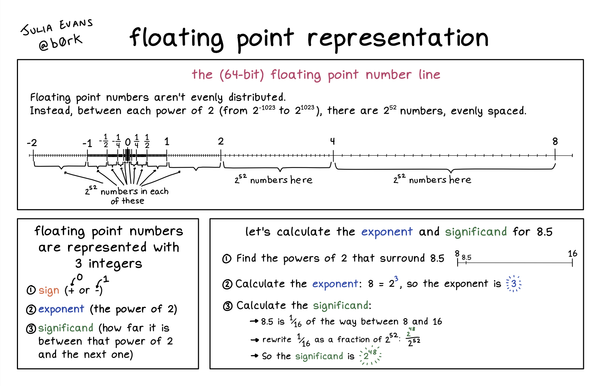
floating point representation
Posit: A Potential Replacement for IEEE 754

Motivation Number systems and computer arithmetics are essential for designing efficient hardware and software architecture. In particular, real-valued computation constitutes a crucial component i…

SIGARCH
@nathanstocks AFAIK nobody (or almost nobody) uses posits, I only write about things that are very commonly used :)
@b0rk Well, dang. Posits are super awesome, and we're only not using them due to inertia. 😢
@nathanstocks that could be true! it's just not what I do here -- I explain how computers work today, not theorize about potential futures :)
@nathanstocks @b0rk that is a pretty strong exaggeration. We don’t use posits partially because of inertia, but also because they aren’t really any better than IEEE floats, and they’re also worse in some important ways.
@steve @b0rk Oh! I didn't know that. I should read up some more, then. All that I've read to date was glowing recommendations for it.
@nathanstocks @steve there's a subthread here talking about some criticisms (if you scroll down) https://social.jvns.ca/@kelpana@mastodon.ie/109835299704305047
Alanna (@[email protected])

@[email protected] The "Posits": https://en.wikipedia.org/wiki/Unum_(number_format)

mastodon.ie
@b0rk @steve Cool, thank you! Such a recent thread, too. I wish I had caught it in the first place. Sorry for the noise!

@nathanstocks @steve @b0rk also worth noting that over the last 8 years there have been 3 different versions:

https://en.wikipedia.org/wiki/Unum_(number_format)

so if you had moved to type II posits (say) you'd have to migrate again. i would stay away unless you're interesting in doing your own evaluation and implementation.

Unum (number format) - Wikipedia

@nathanstocks @b0rk Posits are a scam. I've never read papers more disingenuous in my entire life.
@mbr @b0rk I’ve learned a lot from these sub threads! This paper someone linked to seems to be a pretty thorough look at the pros and cons. Posits are definitely not as advantageous as I was led to believe. Rather there are a bunch of trade offs, like many things in life. https://people.eecs.berkeley.edu/~demmel/ma221_Fall20/Dinechin_etal_2019.pdf
@nathanstocks @b0rk Posits don't live up to the hype, and the posit interval arithmetic proposal was downright broken. The primary thing posits are good at is marketing.
@nathanstocks @b0rk interesting format. I hadn't heard about that before.
How does posit distinguish between positive and negative infinity?
The exponent and fraction do not appear to use the same encoding as the regime number. How does one determine the respective lengths of these fields?
What do you do about computations that result in numbers that posit cannot represent, i.e. NaNs in floating point?
@arildsen I seriously didn't mean to hijack this pretty floating point infographic thread. 🙈 It looks like this wikipedia article is a great jumping off point for learning about posits. https://en.wikipedia.org/wiki/Unum_(number_format)
Unum (number format) - Wikipedia