 mapdirective
 Daniel
The 12-bit rainbox palette is very pleasing to my eyes:
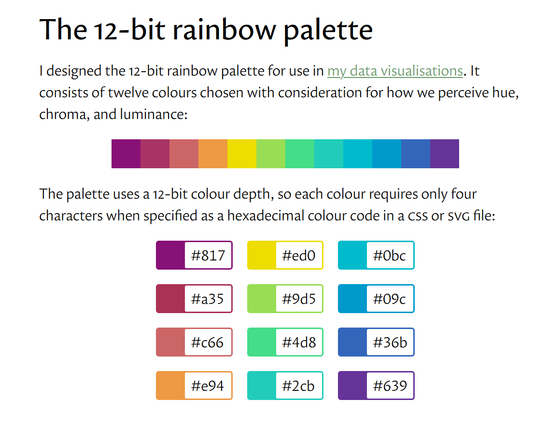
The 12-bit rainbox palette is very pleasing to my eyes:
@dznz this is so good!
I just tried it on this chord project I've got, and it looks pretty nice here too :)
@dznz This feels like a very good idea for scientists to use these colors!
I made this LaTeX code based on these colors, if it can be useful for anyone:
\definecolor{Rainbow1}{rgb}{0.53,0.07,0.47} % Dark red
\definecolor{Rainbow2}{rgb}{0.67,0.20,0.33}
\definecolor{Rainbow3}{rgb}{0.80,0.40,0.40}
\definecolor{Rainbow4}{rgb}{0.93,0.60,0.27}
\definecolor{Rainbow5}{rgb}{0.93,0.87,0} % Yellow
\definecolor{Rainbow6}{rgb}{0.60,0.87,0.33}
\definecolor{Rainbow7}{rgb}{0.27,0.87,0.53}
\definecolor{Rainbow8}{rgb}{0.13,0.80,0.73}
\definecolor{Rainbow9}{rgb}{0,0.73,0.80}
\definecolor{Rainbow10}{rgb}{0,0.60,0.80}
\definecolor{Rainbow11}{rgb}{0.20,0.40,0.73} % Dark blue
\definecolor{Rainbow12}{rgb}{0.40,0.20,0.60}
☺

Attached: 1 image I designed the 12-bit rainbow palette for use on https://grid.iamkate.com. It consists of twelve colours chosen with consideration for how we perceive hue, chroma, and luminance. The palette uses a 12-bit colour depth, so each colour requires only four characters when specified as a hexadecimal colour code in a CSS or SVG file. For more details, see https://iamkate.com/data/12-bit-rainbow/
@dznz I remember when designing a video output system for NTSC Television, 4bits per RGB (12bit pallette) was the ideal trade off between simplicity and color space conversion.
With dithering on old TVs there was no noticeable advantage of additional bits in the output DAC.
@dznz Yeah. : ]
Old TV systems here in the US only had a resolution of 160 individual "pixels" of color per line.
They wheren't pixels because it's analog, but same general idea (discrete points on the phase modulation carrier).
Additional data past 12 bits RGB made no real noticeable difference since everything get blurred and interpolated anyway.
CRT's have soft look to them, which is why the renewed interest in using them with old computers and video games.
 Casey Watts! (he/him) 🌈🫧
 Ariadne
 Officially Tara 🕷️
  🌹
🌹 wakest likes your bugs ⁂
 Dr. T.J. Jankun-Kelly
 Chris Lilley 🏴
 QueenKraken
 eevee 🦊
 King Naga Calyo Lucere-Delphi
 Butter
 Tathar is dragons! (public)
 Martin Constantino-Bodin
 Coyote
 HerrThees
 Troy Harris
 jhhl
jhhl JamesTDG
 mirabilos
 Daniel Darabos
 Thomas Bolon
 Jake Rayson
 canllaith
 Donald Fraser
 Andrew "Ace" Arsenault
 ely
ely dr 🛠️🛰️📡🎧
 BarnCatGardens