
When you automatically cancel all recurring group meetings:

https://news.ycombinator.com/item?id=34230841

I've seen a couple of attempts to cut back on excess meetings in orgs that had way too many useless meetings and they somehow managed to make things even worse.

People who have a high propensity for creating useless meetings kept creating useless meetings and filled up any potentially freed up time within months, but a number of useful meetings that were driving real change were killed and never recovered.
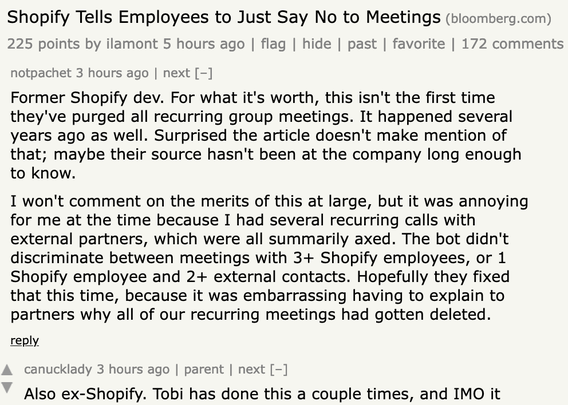

Shopify tells employees to just say no to meetings | Hacker News

I've never personally had a problem with bad meetings filling my schedule since I drop useless meetings but, from looking at calendars of people who don't do that, their calendars became more full of useless meetings after the big push.

In one org, the most effective tool for driving home fixes to cross-team org issues got killed in one of these drives, resulting in permanently reduced effectiveness. Perhaps a meeting isn't the right org-level solution, but no better solution was on the table.

This somehow reminds me of the situation with performance management.

Even in an org that's doing essentially zero performance management, which could clearly benefit from managing some people out, leadership declaring that the org needs more performance management is quite scary because they almost always make things worse, even in cases where anything remotely reasonable would be better than the current situation where there's no performance management.

@danluu Performance management has to be one of the more execrable euphemisms in corporate speak. It has nothing to do with managing high performance.

Telling your staff you're going to start doing performance management brings up several questions. First, weren't you already doing performance management? Your staff were agonizing over it every review period. Second, it sounds like (and often is) a corporate euphemism for cost cutting when it's announced dramatically like that.

@danluu This may be a weird analogy, but it sounds surprisingly similar to what happens in your body after a course of antibiotics. Oftentimes what grows back fastest isn't a symbiotic mix of gut flora but a disruptive monoculture of whatever microbes happened to survive or be reintroduced to a bunch of free space. Current thinking is that maybe a course of probiotics after antibiotics will help get stuff back on track, but as usual in medicine, the clinical evidence is mostly along the lines of, "it's complicated."

I suspect that for meetings, the better solution is not an antibiotics-like "clean wipe" but a more tactical effort to prune bad meetings, and to foster a culture where it's accepted and even encouraged to turn down meetings where your presence is not effective.

@danluu There should be an internal tool (yelp?) that asks meeting attendees "was this meeting a waste of your effing time)

The more time wasting meetings someone creates, the more their meeting creation privileges should be revoked (of course this will only lead to gaming the system and A++++ would gladly go to this meeting again)

@danluu this complaint seems so strange to me because after 5 years in a remote-first environment with a lot of Chaos the one thing as an IC i don't think we suffer from

is useless meetings.

and i wonder if this is some in-person culture hangover.

(it's possible this is a personal idiosyncrasy, since i personally will make every meeting useful somehow, or simply drop it)

@phillmv @danluu There is also the whole thing where in many companies 'normal people' are strongly penalised for dropping useless meetings, along with social pressure to attend every meeting. It took me ~ five years at where I currently work before I was really free to drop useless mass meetings, and I'm still expected to attend useless meetings where I was individually named as invited (which are thankfully rare). I've worked in office and remote at this job, and the expectation was the same.
@phillmv @danluu I even understand what might prompt some of that general norm - I've certainly been part of projects that got held up or died because some crucial stakeholder/credential owner/signoff/tech lead/etc just repeatedly wouldn't show up or even respond to emails about the thing, so we couldn't proceed. But unfortunately that kind of person generally gets away with 'no shows' to critical meetings even in orgs that pressure 'ordinary people' to accept and show up to *all* meetings.
@danluu Stuff like this that I've heard about Tobi is one of the main things holding me back from trying to interview at Shopify again. They're otherwise doing some *very* cool and interesting work on Ruby... but I've learned that whether I basically respect a CEO and his general vibe has a surprisingly big impact on my work happiness.
@danluu Also reminds me of one of the big things @anEXPer has been on about lately (I *think* from "Thinking in Systems") -- that managers are generally pretty good at detecting problems and determining what's causing them, and then have an unfortunate tendency to intervene in *exactly the opposite direction.*
@danluu we tried this exactly once at Dropbox (“Armeetinggeddon”) and every time someone brought up the idea again in the future I just pointed to what a waste of energy that turned out to be. Solves problems at the wrong level and creates make work to fix the new problems introduced. All while looking like you’re doing something. I’m glad we learned that it didn’t work the first time though!
@alexallain heard a rumor it is again being considered...
@kylemisc no longer my problem :p but I guess this is what happens when institutional memory is lost
@kylemisc honestly it’s an effective (“good”?) bad idea in many ways. Highly resistant to being killed off because it is so simple and the reasons it’s bad are subtle
@danluu IME the root problem is the existence of roles in the organization whose only function is to create meetings. Having a meeting reset doesn't really change anything.
@danluu I worked for a company that habitually violated all of the standard "best practices" for effective meetings... and the meetings there were more impactful than anywhere else I've worked. They were created by the stakeholders (groan) for the purpose of actually *doing* something, not by folks whose only role was to "facilitate communications".

@danluu Very agree. I let all recurring meeting end EOY, and it strikes a good balance for me.

I guess it also depends on how much can org collaborate ouside of meetings, and I think engineering org is very highly above average on that, the moment you have to talk cross-functions, I am quite skeptical