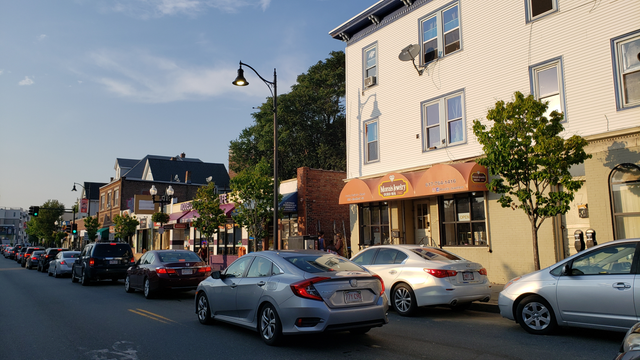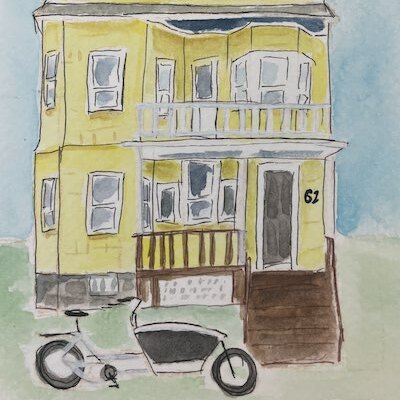
Small landlords, especially owner occupants in older houses, control a large share of the affordable market-rate units we still have in Greater Boston. But many are still struggling due to the effects of the pandemic, and in some areas, like East Boston, they're being targeted heavily by prospective buyers.

In pandemic’s aftermath, small landlords are still feeling the pressure https://www.bostonglobe.com/2022/12/25/business/pandemics-aftermath-small-landlords-are-still-feeling-pressure/

#rentalhousing #affordablehousing #greaterboston @wutrain

In pandemic’s aftermath, small landlords are still feeling the pressure

Struggling tenants and surging inflation are squeezing mom-and-pop landlords in Greater Boston, and there’s growing concern they’ll sell their buildings.

The Boston Globe
@marionsd @wutrain feel like we had this convo many months ago on the old bird site. But do we think this situation—owner occupants of 2 families renting out non-updated units at below market rents—is really a part of the housing picture we should try to preserve long term? I don’t see it. Just think we’re better off building them bigger and preserving affordable unit counts greater than what will be lost as these old buildings get sold.
@klaus As someone who lived in an owner-occupied house for 10+ years, paying well below the rents at Maxwell's Green and other new buildings nearby, my answer is YES, absolutely! Also has long made owning more viable for the non-rich, including many people of color, like the couple featured in the story. Owner-occupied triple-deckers are a very good New England tradition. Nonprofit-owned houses with deed restrictions as @wutrain is helping fund are great too, but we need both, AND new buildings.
@marionsd I love triple deckers. But I think the time has long passed where buying a building in Boston, Cambridge, or here and renting out units is a viable path for the non rich, no matter how much we constrain the size of the buildings. Here it seems we count on long time owners who have paid off their homes to rent non updated units at below market to create “affordable” units. And it’s nice this happens, but they always eventually sell and then it’s a crisis for the tenants.
@klaus So is the best outcome for every triple-decker to ultimately be condofied, bought by a corporation or a nonprofit, or else demolished to be replaced by a commercial apartment building or condos? I don't like that at all. I believe these small landlords are important for affordability, for neighborhood stability and for community. I don't think there's a single solution, but I want policy-makers to try, not accept this as just the way it is.

@marionsd As @klaus says, these small landlords only provide stability for as long as they’re here. Once they sell, it’s a crisis for their tenants b/c the new owners will move to recoup their costs & may need to renovate, which requires empty units.

Agree that there's no single solution.

Let’s remember that 3 deckers are energy inefficient, inaccessible to the disabled, and are all ~100 years old.

At some point, each & every one needs to be replaced, purely b/c nothing lasts forever.

@jeffbyrnes @klaus Why are they energy inefficient? They can be insulated like anything else. I live in one and routinely use less than 200 kWh per month. And you're arguing that because some day, everyone, including presumably my old landlord, @ef4, @StephanieLearns and a large share of current Somerville residents, will fail and be forced to sell to a corporate, we should just give up on them right now? I see a lot of babies going down the drain here.

@marionsd @klaus @ef4 @StephanieLearns most of them are still uninsulated. They can be retrofitted, but let’s remember that’s a form of upcycling (I.e., making those homes more expensive) and thus can encourage displacement b/c those costs need to recouped by the owner.

Keeping the buildings the same, but making them nicer, tends to displace in favor of higher-income households.

@jeffbyrnes @klaus @ef4 @StephanieLearns Isn't that why we have Mass Save, with good deals for property owners at all sizes? https://www.masssave.com/residential/rebates-and-incentives#weatherization

@marionsd @klaus @ef4 @StephanieLearns a new owner may not know about MassSaves (and maybe commercial owners aren’t eligible?)

Even w/ MassSaves though, you’re still talking about having to empty an apartment to do major renovations, which means somebody is gonna lose their home & be displaced to do those upgrades.

We still need more homes to accommodate folks.

Whatever we do, they’re not all going to disappear at once! We’ve many more years of having 3 deckers around.

@jeffbyrnes @klaus @ef4 @StephanieLearns But I never argued against building more housing. I was just saying I think it's important to protect this part of our housing stock, which I consider to be super valuable. Sometimes it makes sense to demolish a bunch of old houses and replace them with new apartment buildings. That doesn't mean triple-deckers aren't a pretty good use of land, and nice to live in. Good housing policies can support a diverse mix.

@marionsd @klaus @ef4 @StephanieLearns to be clear: I’m not saying you did! And definitely, 3 deckers are better than 1 or 2 unit houses in terms of land use.

It starts getting interesting when we think about how Somerville might need to grow to be a home to 2 or 3 times as many people as it is today.

Far future for sure (though maybe not that far!)

@jeffbyrnes @klaus @ef4 @StephanieLearns I'm not sure I'm a fan of a 160,000-240,000-resident future for #SomervilleMA, but replacing triple-deckers on side streets wouldn't be No. 1, 2, or probably even 3 on my list of ways to densify. Sites like Assembly and along 28 are better suited for true high-rises (and we could do more mixed-use and not quite as much lab space!), and main and mid-size streets (e.g. Medford St) could be lined with 3-5 story apartment buildings with ground-floor retail.

@jeffbyrnes @klaus @ef4 @StephanieLearns For perspective, we're at almost 20,000 residents per square mile, among the top 20 most densely populated cities in the U.S. (Boston is ~50th). Doubling our density would put us up with Shanghai, and tripling would make us like Kolkata: https://www.usatoday.com/story/news/world/2019/07/11/the-50-most-densely-populated-cities-in-the-world/39664259/.

I want plentiful affordable housing with efficient use of land so we still have lots of green space and amenities, and room for growth (maybe up to 50%?), but not *quite* 2x or 3x.

75,000 people per square mile? These are the most densely populated cities in the world

American rush hour suddenly doesn't seem so bad.

USA TODAY

@marionsd @klaus @ef4 @StephanieLearns Paris is 55k per sq mi. That tends to be my personal “density done well” guidepost.

Kolkata is 62k / sq mi, interesting it’s similar to Paris!

@jeffbyrnes @klaus @ef4 @StephanieLearns Looking at this again, I think it's doing greater metro areas, because Paris doesn't even make their list. But I also think it's okay for secondary cities like ours to have lower-rise buildings on average. Pack downtown Boston and our post-industrial areas with high-rises (and parks) and let neighborhoods be neighborhoods, densified but not made indistinguishable from major urban cores.
@marionsd @jeffbyrnes @klaus @ef4 @StephanieLearns I mean, people want to live in Somerville (and JP, and Cambridge). We can either build the housing for them or let prices explode while they displace the people already living here.
As for the old triple deckers the issue is that even the ones that are livable today are eventually going to have to be updated and renovated, and no one is going to be able to afford to do that at the current low rents.
@marionsd @jeffbyrnes @klaus @ef4 @StephanieLearns energy efficiency is only one type of obsolescence (and MassSave is okay but it won’t get you anywhere close to the levels of efficiency that you can do with new construction). The other is layout. Household sizes have shrunk considerably since the early 1900s. We have far too many 2-3 bedroom apartments (occupied by non-families) and not nearly enough studios and 1-bedrooms. You can’t really fix that without rebuilding.
@eherot @jeffbyrnes @klaus @ef4 I agree we need more buildings with studios and 1BRs. None of these are absolutes, though. Lots of older houses are smaller than what's built today; my house in Providence, from 1928, was a 3BR with 1200sf of space over 2 floors. My condo now, in a 1915 house, is 2BR, just over 950sf. A lot of new stuff I see has maybe just 1-2BR, but also an office, a den or other spaces. And 99% of new builds are gas-heated.
@eherot @jeffbyrnes @klaus @ef4 I also think we need to be realistic. Most of us aren't Marie Kondo, and if we work from home, even if we have no kids, we want a second room for an office. A nice living room is cool, too. Or should we all move into the absolute smallest unit that we can fit our bed(s), a couch, a small table, a hot plate and a fridge into? I did that at 23, but at this point in my life, I want a little more. I cherish my porch and garden, too. Maybe I'm just not noble enough?
@marionsd @eherot @jeffbyrnes @ef4 no we sure aren’t Marie kondo! My family sure isnt and this is, after all, America. But you already said it, we need small units for the many young people that are going to want to live here so they share large ones. From the reading I’ve done, it wasn’t just a lot of us not wanting to live in small simple spaces but cities deliberately tearing them down and banning them from existence that fueled so much of the homelessness we see.
@klaus @marionsd @jeffbyrnes @ef4 A lot of the new units you see are big because that’s what the zoning calls for. High land prices demand that developers maximize building square footage, but zoning limits the number of units per parcel, so you end up with a small number of big units. It’s hard to know exactly what we would get without these rules but the shortage among studios and 1BRs is among the most acute so we’d probably get a decent number of those.
@marionsd @eherot @jeffbyrnes @ef4 haven’t we banned gas in new buildings yet ?
@klaus @marionsd @eherot @jeffbyrnes @ef4 I heard that Somerville didn't make the cut for the first 10 communities to ban natural gas. So still prohibited by state law
@noisecapella @marionsd @eherot @jeffbyrnes @ef4 we could probably use zoning to accomplish this? More density IF….

@klaus @noisecapella @marionsd @eherot @ef4 zoning is what restricts per-building density, so yep, we can change or get rid of that & see what happens!

Marion, our place is palatial (2500 sq ft) and we really do enjoy it, and there’s nothing wrong with that, so you’re plenty noble 😆 but it’d probably be smaller if >2 homes were allowed on our 7500 sq ft parcel 🤦🏻‍♂️

@jeffbyrnes @klaus @noisecapella @eherot @ef4 All of which brings me back to... don't be so quick to write off old triple-deckers! Unless units-per-parcel-size limits are completely eliminated, and other rules too (like setbacks), and I'm not sure any public officials are willing to go to zero limits, even significant liberalization won't give you the amazing density that older generations produced in much of Somerville.
@marionsd @jeffbyrnes @noisecapella @eherot @ef4 not writing them off nor arguing for zero limits! They should be legal all over Somerville! But as it stands today we mostly get 2 family conversions to 2 large condos, as I’m sure you saw up close during your home buying experience. Hell old triple deckers are often 4 to 6 family buildings (last place we lived was a four family, with first floor divided into two smaller units)…but this is pretty much impossible to build under current zoning.
@klaus @jeffbyrnes @noisecapella @eherot @ef4 I'm pretty sure that's a market choice, not mandated by zoning. It wasn't happening all over the city until a few years ago (I saw the differences between ca. 2010-2018 vs. newer). When so many rich people want to buy in Somerville, you can make more money offering luxury and space than pretty shoeboxes. It *could* be some illegal 3-units aren't legalized, but I don't think it's the majority.
@marionsd @klaus @jeffbyrnes @noisecapella @ef4 rents really started to take off in the last 10-15 years, so we started to see a lot more gut renovations (since prices will support them) but renovating that third unit adds a bunch of expensive new code requirements (e.g. sprinklers) so many find it more profitable to just consolidate. If we relaxed the fire code (sprinklers in small buildings don’t add much safety) or allowed more units by right, you’d almost certainly see less consolidation
@eherot @klaus @jeffbyrnes @noisecapella @ef4 Yeah something is seriously messed up with how Somerville is treating triple-deckers with gut rehabs. We have a gigantic water tank in the basement and a commercial-grade fire suppression system that costs a fortune to maintain.
@marionsd @eherot @klaus @noisecapella @ef4 yeah the building code stuff is a whole other challenge! Outside my knowledge mostly, but the sprinkler stuff is a major stumbling block.
@jeffbyrnes @marionsd @eherot @klaus @noisecapella this is another area where we should look the EU. They have less fire casualties than we do while their fire codes are less onerous.
@marionsd @klaus @jeffbyrnes @noisecapella @ef4 it’s the state’s fault, and I think it has a lot to do with fire officials who live in single family homes in the suburbs having a cultural fear (ahem, racism) of apartment buildings and the people who live in them. I believe the decision to require sprinklers in 3-deckers came after the death of a firefighter in the 2014 townhome fire in Back Bay. There was little discussion of how sprinklers would have helped and zero discussion about cost.
@marionsd @klaus @jeffbyrnes @noisecapella @ef4 in fact the lack of consideration for cost and feasibility is a recurring criticism of the way we do apartment fire codes here in this country. We rarely ask, for example, whether encouraging landlords to put off big repairs (because we have made compliance too costly) ends up hurting more people than it helps.
@jeffbyrnes @klaus @noisecapella @eherot @ef4 We don't need to tear these down for efficiency; let them be, and keep them from being turned into 2-unit luxury condos (a relatively new norm: my renovated 3-unit is now oddly down-market). AND we need to expand and diversify options, using currently underutilized land. Market-but-low-frills 1BRs and studios, and*also* affordable 3BRs. Maybe also some innovative dorm-like but more private housing like they proposed in Davis, and not just for kids.

@marionsd @klaus @noisecapella @eherot @ef4 our new zoning making 3-unit buildings effectively impossible is the biggest driver of this shift. It’s why my building isn’t 3+ units, and the demo & new build on the Community Path is 2 huge semi-detached townhouses.

Fully agree with you on this Marion!

@marionsd @klaus @noisecapella @eherot @ef4 the builder of our home is gonna do a tear down (the existing house needs to go, it’s in bad shape) & new build of two 2-unit houses on our street, again driven by zoning requiring that 3rd unit be subsidized affordable (which doesn’t work finance-wise). Would be nice if he could go a little bigger to actually afford a subsidized unit or two!
@jeffbyrnes @klaus @noisecapella @eherot @ef4 Doesn't work finance-wise or isn't lucrative enough for their taste? Because what you're saying is developers have found an awesome workaround to evade our affordable housing mandates.
@marionsd @klaus @noisecapella @eherot @ef4 this workaround has existed for as long as Inclusionary Zoning has been a thing. The market units would have to be even more wildly expensive to permanently subsidize the 3rd one. In Boston & Cambridge, and for our other zoning districts, IZ starts at 10 units, for example, b/c it actually works at that level.
@jeffbyrnes @klaus @noisecapella @eherot @ef4 I'm pretty sure it's less impossible than developers make it out to be, especially in 3-unit buildings (and I thought Ben Ewen-Campen was here! I'm 99% sure that a third unit doesn't have to be affordable -- our mandate is 20% and for new units, not where existing ones are maintained, isn't it? I've found developers are great at justifying a lot of unsustainable and socially exclusionary choices. Still worth checking for unintended consequences.
@marionsd @klaus @noisecapella @eherot @ef4 for sure the builders do what they know & like (true of most folks, so it’s not really weird just annoying in this case). As long as unit count doesn’t change, IZ isn’t triggered. Interestingly, if you already have 4 units, you could increase up to what zoning allows & go all the way to 9 units w/o triggering the “normal” 20% IZ.
@marionsd @jeffbyrnes @klaus @noisecapella @ef4 Housing development is a business just like growing food or building fire trucks. If we want developers to do certain things, we have to make it profitable for them to do those things. If we make it more profitable to consolidate 3-deckers into duplexes, we shouldn’t be surprised when that happens. We can talk until we’re blue in the face about what they “should” be able to do, but if we want results the incentives need to support them.
@marionsd @jeffbyrnes @klaus @noisecapella @ef4 and to be clear, when I say, “make it profitable” what I mean is that it has to be more profitable than other investments. No one is going to accept a 4% rate of return building a ten unit building with 2 affordable units if they can make an 8% ROR (with much less delay or risk that it will never happen) by buying a 3-decker and converting it into a duplex.
@eherot @jeffbyrnes @klaus @noisecapella @ef4 Making housing affordable will never be the most profitable option. This is where market-driven YIMBY breaks down for me. If you build tons of housing, enough to finally create a glut, that *will* eventually reduce prices, but a) there's so much demand from rich people, it'll take a lot to create a glut, and b) if you're the dummy who builds the building you can't fill at full price, you failed. Without IZ and nonprofits, the market won't deliver.
@marionsd @eherot @jeffbyrnes @noisecapella @ef4 tend to agree w you Marion. But govt policy can and should change the equation. Like 299 Broadway. The best development proposed in Somerville since I’ve paid attention IMO.
@klaus @marionsd @eherot @noisecapella @ef4 I mean, we used to create naturally affordable homes almost entirely via the market. But you’re also right that we’re so far down the hole that “just build” won’t cut it anymore. 50 years of arrested development is a hell of a thing.
@klaus @marionsd @eherot @noisecapella @ef4 Useful bit of data: ~90% of all homes in the US are market-rate homes (i.e., not subsidized to be capital-A Affordable).
@marionsd @jeffbyrnes @klaus @noisecapella @ef4 the thing is that right now we aren’t even letting the market try. If a developer “can’t fill a building at full price” that’s good for the rest of us because it means discounts and free months of rent. Right now we have the exact opposite problem: Developers want to build lots of units and we’re telling them to only build a few.
@marionsd @jeffbyrnes @klaus @noisecapella @ef4 The market will never be able to meet everyone’s needs (some people are just too poor to support the cost of maintaining their own housing) and for those people we need government subsidies, but for most people unsubsidized housing produced by the private market would work if only we would build enough of it. And yeah, we would need a lot, but that’s because we have a lot of jobs, and that’s a good thing!
@marionsd @jeffbyrnes @klaus @noisecapella @ef4 And besides, by not accommodating those rich people, they aren’t going away—They’re just displacing the poorer people who live here today, so really we have no choice but to build that housing (or watch all of our neighbors get forced out).

@eherot @marionsd @klaus @noisecapella @ef4 and to be sure, nobody in this thread thinks the market is perfect or the end-all-be-all. We still need subsidized homes, and tenants’ rights, and lots of other things to try & help folks out & avoid poor outcomes in the micro sense. But at the macro scale, more homes is essential.

A 1–2% vacancy rate for rentals is a terrible place to be, and we’re there 😔 We’ve got folks bidding up rentals & competing with each other! 😭

@eherot @marionsd @klaus @noisecapella @ef4 bit of kismet, I’m reading this article right now talking about unregulated markets & how they tend towards making the rich even richer (which we all know anecdotally happens, but fascinating to read about some of the underpinnings of why that happens): https://pudding.cool/2022/12/yard-sale/
Why the super rich are inevitable

Why some mathematicians argue the economy is designed to create a few super rich people – unless we stop it.

The Pudding
@jeffbyrnes @marionsd @klaus @noisecapella @ef4 To be clear, subsidies and tenant protections are extremely important, but both of these things are far more effective if there is a surplus of houses to begin with. If you’ve got nowhere else to go, you’re probably a lot less likely to report your landlord for breaking the law or providing substandard housing.
@eherot @marionsd @klaus @noisecapella @ef4 Yep! As we know, fixing things needs a “yes, and” set of approaches.
@jeffbyrnes @klaus @noisecapella @eherot @ef4 That's for teardowns, though, Jeff. Or does it apply to gut rehabs? My house was done in 2021 and the interior space was heavily reconfigured, but stayed 3 units. Directly behind us, one triple-decker became 2 luxury units, and its neighbor became a single extra-big unit. They also have a mega-driveway and big garages.
@marionsd @klaus @noisecapella @eherot @ef4 it applies anytime you change the building itself (ours was a 1-to-2 conversion).
@marionsd @klaus @noisecapella @eherot @ef4 it indirectly drives what you just described, since they couldn’t make that 3 decker into 4+ units b/c that triggers zoning review. Fun, ain’t it?