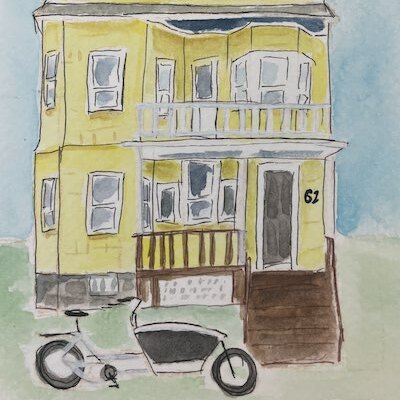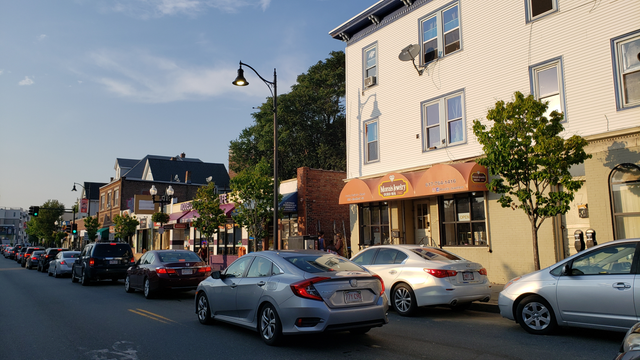
Small landlords, especially owner occupants in older houses, control a large share of the affordable market-rate units we still have in Greater Boston. But many are still struggling due to the effects of the pandemic, and in some areas, like East Boston, they're being targeted heavily by prospective buyers.

In pandemic’s aftermath, small landlords are still feeling the pressure https://www.bostonglobe.com/2022/12/25/business/pandemics-aftermath-small-landlords-are-still-feeling-pressure/

#rentalhousing #affordablehousing #greaterboston @wutrain

In pandemic’s aftermath, small landlords are still feeling the pressure

Struggling tenants and surging inflation are squeezing mom-and-pop landlords in Greater Boston, and there’s growing concern they’ll sell their buildings.

The Boston Globe
@marionsd @wutrain feel like we had this convo many months ago on the old bird site. But do we think this situation—owner occupants of 2 families renting out non-updated units at below market rents—is really a part of the housing picture we should try to preserve long term? I don’t see it. Just think we’re better off building them bigger and preserving affordable unit counts greater than what will be lost as these old buildings get sold.
@klaus As someone who lived in an owner-occupied house for 10+ years, paying well below the rents at Maxwell's Green and other new buildings nearby, my answer is YES, absolutely! Also has long made owning more viable for the non-rich, including many people of color, like the couple featured in the story. Owner-occupied triple-deckers are a very good New England tradition. Nonprofit-owned houses with deed restrictions as @wutrain is helping fund are great too, but we need both, AND new buildings.
@marionsd I love triple deckers. But I think the time has long passed where buying a building in Boston, Cambridge, or here and renting out units is a viable path for the non rich, no matter how much we constrain the size of the buildings. Here it seems we count on long time owners who have paid off their homes to rent non updated units at below market to create “affordable” units. And it’s nice this happens, but they always eventually sell and then it’s a crisis for the tenants.

@marionsd ha was about to say @ef4 is talking about this too but now I see you’re carrying on a couple similar convos at once.

https://better.boston/@ef4/109580700736741365

Edward Faulkner (@[email protected])

This story is off in a way that makes me ask “who’s PR firm pitched this?”. The kind of long-term, stable, mom and pop landlords they’re talking about have necessarily benefitted from huge price appreciation *and* had many recent opportunities to lock in historically low refinancing costs. https://www.bostonglobe.com/2022/12/25/business/pandemics-aftermath-small-landlords-are-still-feeling-pressure/

Better Boston
@klaus So is the best outcome for every triple-decker to ultimately be condofied, bought by a corporation or a nonprofit, or else demolished to be replaced by a commercial apartment building or condos? I don't like that at all. I believe these small landlords are important for affordability, for neighborhood stability and for community. I don't think there's a single solution, but I want policy-makers to try, not accept this as just the way it is.
@klaus Also, I don't believe these are only valuable if they're super cheap. But owner occupants will sacrifice some profits for tenants they like and want to keep long-term. I benefited from that, and I also became part of the community in part because I was in small-scale housing, with neighbors we knew by name.

@marionsd @klaus I don’t that the scale of one’s building dictates whether or not you know your neighbors. I’ve lived in large & small buildings, and I’ve known my neighbors at every address I’ve lived at.

Stability is, ultimately, the arbiter of how plugged in someone can be to their community. If you’re not sure you’ll be here next year (or you’re constantly hustling to make rent) you’re less likely to get involved, y’know?

@jeffbyrnes @klaus There is extensive research about the challenges of social interactions in high-rise buildings. E.g. see https://www.ncbi.nlm.nih.gov/pmc/articles/PMC7369851/

I myself started at 473 Broadway, which isn't high-rise but is much bigger than triple-deckers, and I got to know exactly one neighbor, vs. quite a few while living in a house. It's not impossible to make connections, but it's harder. This is a key reason why public housing was reinvented as mid-rise buildings instead of towers.

Where do People Interact in High-Rise Apartment Buildings? Exploring the Influence of Personal and Neighborhood Characteristics

Early studies conclude that high-rise apartment buildings present challenges for people’s quality of life, resulting in social isolation, social annoyance and anonymity for residents. Nevertheless, empirical research into factors supporting social ...

PubMed Central (PMC)

@marionsd As @klaus says, these small landlords only provide stability for as long as they’re here. Once they sell, it’s a crisis for their tenants b/c the new owners will move to recoup their costs & may need to renovate, which requires empty units.

Agree that there's no single solution.

Let’s remember that 3 deckers are energy inefficient, inaccessible to the disabled, and are all ~100 years old.

At some point, each & every one needs to be replaced, purely b/c nothing lasts forever.

@jeffbyrnes @klaus Why are they energy inefficient? They can be insulated like anything else. I live in one and routinely use less than 200 kWh per month. And you're arguing that because some day, everyone, including presumably my old landlord, @ef4, @StephanieLearns and a large share of current Somerville residents, will fail and be forced to sell to a corporate, we should just give up on them right now? I see a lot of babies going down the drain here.

@marionsd @klaus @ef4 @StephanieLearns most of them are still uninsulated. They can be retrofitted, but let’s remember that’s a form of upcycling (I.e., making those homes more expensive) and thus can encourage displacement b/c those costs need to recouped by the owner.

Keeping the buildings the same, but making them nicer, tends to displace in favor of higher-income households.

@marionsd @klaus @ef4 @StephanieLearns as for selling, that’s not about failing as much as, eventually, everyone’s situation changes & selling their property may be the best move. If tenants are in the picture, that leaves them in a precarious position.
@jeffbyrnes @marionsd @klaus @StephanieLearns yeah and my original point was that no landlords here are actually "failing" regardless. Even the examples in that Globe article almost certainly walked away with more money than the average American family ever sees. That's not failure.
@ef4 @jeffbyrnes @klaus @StephanieLearns But corporate owners sell, too. Renting from the people upstairs or downstairs is not inherently less stable than renting from Real Estate Investments Inc. I would argue that the opposite is more often true, except when a) lightning strikes, as with COVID or a serious recession or a personal tragedy, and/or b) market forces eat you alive, and the public policies and programs in place do nothing to help you. And yes, eventually*everyone* moves or dies.

@marionsd @ef4 @klaus @StephanieLearns generally, mom & pop landlords have far less capacity & capital than corporate ones. So I disagree here: they’re generally less stable, and less able to maintain things, esp. if they’re stingy or strapped. The phrase “house poor” exists for a reason, y’know?

Everyone has a bad landlord story, and they’re just as often corporate as they are mom & pop.

Less about the form, more about if you’re lucky to have a landlord who’s not a jerk.

@jeffbyrnes @klaus @ef4 @StephanieLearns Isn't that why we have Mass Save, with good deals for property owners at all sizes? https://www.masssave.com/residential/rebates-and-incentives#weatherization

@marionsd @klaus @ef4 @StephanieLearns a new owner may not know about MassSaves (and maybe commercial owners aren’t eligible?)

Even w/ MassSaves though, you’re still talking about having to empty an apartment to do major renovations, which means somebody is gonna lose their home & be displaced to do those upgrades.

We still need more homes to accommodate folks.

Whatever we do, they’re not all going to disappear at once! We’ve many more years of having 3 deckers around.

@marionsd @klaus @ef4 @StephanieLearns extra fun for us in our home: almost everything MassSaves offers won’t work b/c our ducting is too small 😭 so we’d need to rip out our entire brand new system to take advantage & go green (new renovation; we didn’t decide on the system).
@jeffbyrnes @klaus @ef4 @StephanieLearns Mass Save has programs even for big apartment buildings. Sorry it didn't work out for your home, but perhaps you're also already pretty efficient? Replacement windows, good door seals and lots of insulation can make a big difference.

@marionsd @klaus @ef4 @StephanieLearns oh for sure our home is otherwise great. The point is that MassSaves isn’t the end all & major renovations are always a challenge.

Some things work out better if we start over & build anew is my larger point, too.

@jeffbyrnes @klaus @ef4 @StephanieLearns But I never argued against building more housing. I was just saying I think it's important to protect this part of our housing stock, which I consider to be super valuable. Sometimes it makes sense to demolish a bunch of old houses and replace them with new apartment buildings. That doesn't mean triple-deckers aren't a pretty good use of land, and nice to live in. Good housing policies can support a diverse mix.

@marionsd @klaus @ef4 @StephanieLearns to be clear: I’m not saying you did! And definitely, 3 deckers are better than 1 or 2 unit houses in terms of land use.

It starts getting interesting when we think about how Somerville might need to grow to be a home to 2 or 3 times as many people as it is today.

Far future for sure (though maybe not that far!)

@jeffbyrnes @klaus @ef4 @StephanieLearns I'm not sure I'm a fan of a 160,000-240,000-resident future for #SomervilleMA, but replacing triple-deckers on side streets wouldn't be No. 1, 2, or probably even 3 on my list of ways to densify. Sites like Assembly and along 28 are better suited for true high-rises (and we could do more mixed-use and not quite as much lab space!), and main and mid-size streets (e.g. Medford St) could be lined with 3-5 story apartment buildings with ground-floor retail.

@jeffbyrnes @klaus @ef4 @StephanieLearns For perspective, we're at almost 20,000 residents per square mile, among the top 20 most densely populated cities in the U.S. (Boston is ~50th). Doubling our density would put us up with Shanghai, and tripling would make us like Kolkata: https://www.usatoday.com/story/news/world/2019/07/11/the-50-most-densely-populated-cities-in-the-world/39664259/.

I want plentiful affordable housing with efficient use of land so we still have lots of green space and amenities, and room for growth (maybe up to 50%?), but not *quite* 2x or 3x.

75,000 people per square mile? These are the most densely populated cities in the world

American rush hour suddenly doesn't seem so bad.

USA TODAY

@marionsd @klaus @ef4 @StephanieLearns Paris is 55k per sq mi. That tends to be my personal “density done well” guidepost.

Kolkata is 62k / sq mi, interesting it’s similar to Paris!

@marionsd @klaus @ef4 @StephanieLearns food for thought: Cambridge’s zoning originally allowed for ~600k people (almost Boston’s current population). Not sure about ours but it was crafted similarly.
@jeffbyrnes In what world does Massachusetts end up with such a huge population anyway? Are we clearing out everything west of Framingham and concentrating everyone here? Or is there mass migration from California or from other countries? Because I assume Boston, Watertown, Everett, Chelsea, Waltham... we'd all densify, and we could easily fit several million additional people here. With climate change, our relative desirability will significantly increase, but still, I'm skeptical.

@marionsd Boston metro already needs ~100k more homes, and we remain an incredibly desirable place to live despite our high housing costs.

You’re right that, really, it’ll be everywhere around here working together, so no one muni bears the weight!

@jeffbyrnes @klaus @ef4 @StephanieLearns Looking at this again, I think it's doing greater metro areas, because Paris doesn't even make their list. But I also think it's okay for secondary cities like ours to have lower-rise buildings on average. Pack downtown Boston and our post-industrial areas with high-rises (and parks) and let neighborhoods be neighborhoods, densified but not made indistinguishable from major urban cores.
@marionsd @jeffbyrnes @ef4 @StephanieLearns damn im missing this whole thing chasing my kids around scienc museum
@klaus @marionsd @ef4 @StephanieLearns 😆 sounds like a great day!
@jeffbyrnes @marionsd @ef4 @StephanieLearns just wait man.
Anyway I love triple deckers and I guess I was once a “mom and pop landlord” when our first home in NC was underwater when we had to move so we rented it out for awhile. My mom is one too, rents out her small condo to live w 96 y/o grandma. They’ll exist…I just don’t see that as an explicit goal we should have, as opposed to providing affordable housing or fighting climate change. And them selling shouldn’t be a crisis.
@marionsd @jeffbyrnes @klaus @ef4 @StephanieLearns I mean, people want to live in Somerville (and JP, and Cambridge). We can either build the housing for them or let prices explode while they displace the people already living here.
As for the old triple deckers the issue is that even the ones that are livable today are eventually going to have to be updated and renovated, and no one is going to be able to afford to do that at the current low rents.
@marionsd @jeffbyrnes @klaus @ef4 @StephanieLearns energy efficiency is only one type of obsolescence (and MassSave is okay but it won’t get you anywhere close to the levels of efficiency that you can do with new construction). The other is layout. Household sizes have shrunk considerably since the early 1900s. We have far too many 2-3 bedroom apartments (occupied by non-families) and not nearly enough studios and 1-bedrooms. You can’t really fix that without rebuilding.
@eherot @marionsd @jeffbyrnes @ef4 @StephanieLearns yea we did mass save on our 1900 home. It helped, but it’s still leaky compared to a modern home. I expect if it’s got “cheap” rent in Somerville, it’s likely not insulated and it’s burning fossil fuels for heat.
@eherot @jeffbyrnes @klaus @ef4 I agree we need more buildings with studios and 1BRs. None of these are absolutes, though. Lots of older houses are smaller than what's built today; my house in Providence, from 1928, was a 3BR with 1200sf of space over 2 floors. My condo now, in a 1915 house, is 2BR, just over 950sf. A lot of new stuff I see has maybe just 1-2BR, but also an office, a den or other spaces. And 99% of new builds are gas-heated.
@eherot @jeffbyrnes @klaus @ef4 I also think we need to be realistic. Most of us aren't Marie Kondo, and if we work from home, even if we have no kids, we want a second room for an office. A nice living room is cool, too. Or should we all move into the absolute smallest unit that we can fit our bed(s), a couch, a small table, a hot plate and a fridge into? I did that at 23, but at this point in my life, I want a little more. I cherish my porch and garden, too. Maybe I'm just not noble enough?
@marionsd @eherot @jeffbyrnes @ef4 no we sure aren’t Marie kondo! My family sure isnt and this is, after all, America. But you already said it, we need small units for the many young people that are going to want to live here so they share large ones. From the reading I’ve done, it wasn’t just a lot of us not wanting to live in small simple spaces but cities deliberately tearing them down and banning them from existence that fueled so much of the homelessness we see.
@klaus @marionsd @jeffbyrnes @ef4 A lot of the new units you see are big because that’s what the zoning calls for. High land prices demand that developers maximize building square footage, but zoning limits the number of units per parcel, so you end up with a small number of big units. It’s hard to know exactly what we would get without these rules but the shortage among studios and 1BRs is among the most acute so we’d probably get a decent number of those.
@marionsd @eherot @jeffbyrnes @ef4 haven’t we banned gas in new buildings yet ?
@klaus @marionsd @eherot @jeffbyrnes @ef4 I heard that Somerville didn't make the cut for the first 10 communities to ban natural gas. So still prohibited by state law
@noisecapella @marionsd @eherot @jeffbyrnes @ef4 we could probably use zoning to accomplish this? More density IF….

@klaus @noisecapella @marionsd @eherot @ef4 zoning is what restricts per-building density, so yep, we can change or get rid of that & see what happens!

Marion, our place is palatial (2500 sq ft) and we really do enjoy it, and there’s nothing wrong with that, so you’re plenty noble 😆 but it’d probably be smaller if >2 homes were allowed on our 7500 sq ft parcel 🤦🏻‍♂️

@jeffbyrnes @klaus @noisecapella @eherot @ef4 All of which brings me back to... don't be so quick to write off old triple-deckers! Unless units-per-parcel-size limits are completely eliminated, and other rules too (like setbacks), and I'm not sure any public officials are willing to go to zero limits, even significant liberalization won't give you the amazing density that older generations produced in much of Somerville.
@marionsd @klaus I think there's an extra assumption baked into this argument that new development can only be done by big corporate landlords. But that is a policy choice we've imposed on ourselves. Historically in American cities, small-scale landlords redeveloped their own properties into midrises as their city grew around them. We've just outlawed that by increasing the red tape until only a big corp can get through it.