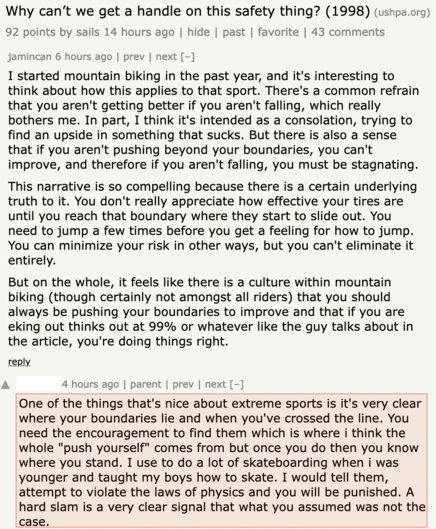
Interesting to see this incorrect line of reasoning about risk laid out so explicitly.

If you're around people who do extreme sports with serous risk, you'll know many people who have this attitude and you'll also know many people who incurred life-altering injuries or died because of this attitude.

A friend of mine who's reasonable and has a higher risk tolerance than me used to paddle with a group of whitewater kayakers who were doing the hardest stuff. 4 out of 7 of them died. She says

the reason she's still alive and so many of her compatriots are not is how she thinks about risk.

People would say things like "there's a 99% chance this will be fine", where "not fine" is fatal and they would then run something that had a 99% chance of working out. She wouldn't do that because, of course, if you regularly take a 1% chance of death, you're going to end up dead unless you're extremely lucky.

Another one is that she would never run something she hadn't observed before, whereas

most people around her would, using the same reasoning as the above. But if you do that often enough, you're not likely to live.

She has a similar attitude when backcountry skiing and would never take a drop of more than a few feet without having inspected it first, which is why she's never been seriously injured in the backcountry, but she's had to carry a partner back who landed on unexpected terrain and broke both legs, a rare occurrence per instance but not unlikely in the long run.

She is also not dead after many years of fairly serious mountaineering where partners would be extremely upset that she wanted to turn back because she thought that were a small chance of weather that would cause an attempt at summitting to be fatal.

If you're around a lot of mountaineers or other people doing high-risk activities, you'll hear about deaths every year because the cumulative impact of summing up small risks is counterintuitive and default human intuition for this is wrong.

@danluu I think people are not so much bad at estimating these things as just talking themselves into doing very risky stuff because otherwise many of the things they want to do are impossible.

@samth If that's the reasoning, that also seems wrong to me because being crippled or dying really puts a damper on both skill development and future chances to accomplish something, e.g., if you look at what people are doing in whitewater today vs. 20 years ago, people are now doing stuff that would've been considered impassable 20 years ago. It would've been more effective to not take fatal risks.

And for things like blind drops / runs, there's no upside in terms of what you can accomplish.

@danluu Sure, but (a) if you're 23 and want to accomplish something big "wait 20 years" doesn't really work. And (b) for some things like base jumping or alpine-style mountaineering on big mountains accceptable levels of risk aren't really possible.
@danluu For example, consider Alex Honnold's free soloing. The way he talks about it is exactly what you criticize. But there's no way to do what he does "safely".

@samth I think that could be true for mountaineering in some cases and some other activities that have a high degree of inherent risk (free soloing is certainly in that category), but I'd still say that, for most extreme sports risk, if you look at where risks are coming from, most of it is on risks with no upside.

It's possible my sample here is highly skewed and and I know people who take more pointless risks than in general, but I would guess that my skew is in the opposite direction.

@samth E.g., with surfskiiing, almost every death could be prevented with mundane standard precautions (have VHF and a beacon, carry a backup paddle, have flares/smoke, etc.), but relatively few people do these things and people die all the time.

Locally, there was a woman who carried all this stuff and was (kindly) made fun of for having her "girly bag" of safety stuff until she had a near death experience that would've been fatal if she wasn't prepared.

@samth Now, locally, guys who are out in big conditions also carry similar equipment, but there was never a reason to not do it in the first place other than people saying "it will probably be fine" in an environment where people have been dying for the same mundane reasons for decades.

At the absolute limit of what a human can do, someone might die because they're doing something that can't be done at low risk, but most deaths were and are preventable in boring ways.

@samth Also, if a significant fraction of risk taken were by people who were doing things with high "inherent' risk, then you'd see that in postmortems, but I've read a ton of postmortems in risky activities that I do and they almost all read like https://mastodon.social/@danluu/109360584113899157.

People generally die due to taking multiple combined risks that have no significant upside. Even if there are a few people who die because they're pushing the limits of what humans can do, that's basically a rounding error.

@danluu @samth What stands out to me about that story is that they had a safety escort but they don't seem to have had a clear plan for what the escort should *do* the event of an emergency.

@nat @samth Yeah, that's sadly common. My guess would be that the (implicit, undiscussed) plan was that the escort could help with an assisted remount if the less experienced paddler had issues, but of course that requires the boat to be seaworthy and attached to the paddler.

Another risk would be that conditions degrade enough that the person can't stay up, so an assisted remount doesn't help because the person immediately gets tossed when they start paddling.

I was reminded of this thread

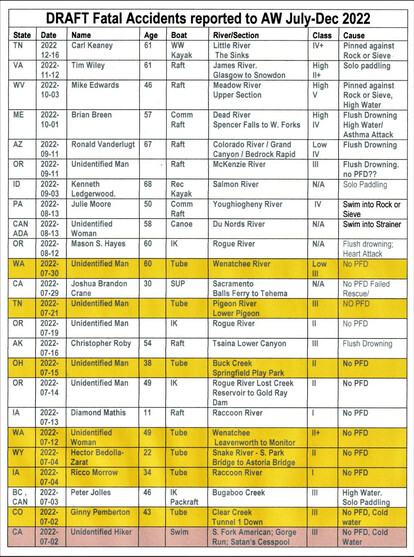
@nat @samth because someone passed me the collection of postmortems reported to AW for H2 2022.

Consistent with the above, zero deaths from people pushing the limits of human capabilities and roughly half from people who didn't take the most basic precautions (no PFD and/or alone in potentially dangerous conditions).

Also notable are the two commercial raft fatalities, where it's sort of out of your control and you're rolling the dice with order 1/100000 chance of death and 1/100 of injury.

@danluu In other words, people should budget their micromorts more carefully.
@danluu that mindset is a thing I like about skydiving. You’re encouraged to try stuff but with strict guidelines (small groups, high breaking altitude, inertia) and the most dangerous stuff (wingsuit, swooping) isn’t even open to you until you have much more experience. Above all, we’re taught to always be on the lookout for warning signs and never to push it. I hurt myself lightly a few time early on before taking too much risks which really made this sink in. Accident # are now super low
@danluu More mountaineers should make it a habit to read Accidents in North American Mountaineering.
@danluu When talking about risk accumulation, it's also interesting to listen to older construction workers.
Almost everyone can tell a few stories about serious injuries.
The reason is simply that they do it every day. Even if the risk of falling, stumbling, breaking something is small, if you repeat the experiment enough times, something will happen.
@danluu There was a fascinating podcast on this very topic - it might have been freakonomics, I forget - where they gave plenty of examples of this. One that stayed with me was a trip in the jungle when the non-native went to rest in the shade under a tree but the locals urged him to move “because the tree might fall”. They understood the unlikely risks still happens eventually.
@danluu people have a tendency to think risk is considerably lower than it is.
Read once about why The Great Blue Hole in Egypt is so dangerous and it resumes mostly to an incorrect calculation of both ability and risk.
I think it is considerably harder than people think to actually know your limits. Hence why people strain themselves even when doing regular exercise. (And I can vouch that myself)

@danluu this seems to track solidly with how alex honnold approaches his free soloing:

there usually is a very lengthy preparation period in which he repeats the route on some form of protection, to know exact solutions to every move that can get dicey. it’s naturally still not a guarantee, but a way to reduce as many controllable factors as possible to lower the risk on an activity with such high consequence.

during a live-tweeting of free solo (the film), he said that after he bailed on his first attempt on the freeblast slab, a climbing pitch where you rely almost entirely on very exact foot placements and if one foot pops, there are no handholds good enough to allow you to hold your bodyweight, he drilled it so hard that he could climb it free-handedly. he said he would’ve loved to see that in the film as an illustration of the amount of obsessive prep that culminates in climbing all of el capitan without ropes.

and even with that entire apparatus around the process, you can still hear him comment other peoples’ free soloing feats with statements like ‘you soloed what, for how many times? that’s completely outrageous.’ – some routes are just too spicy for the consequences, let alone repeating them.

@danluu a different take is some people care more about getting good, or the thrill, and less about their own life or injury. Certainly though a lot of people should take a step back and realize they are not gonna get famous or paid to do this extreme sport. relax. a little patience will keep you very alive and only limits your potential a little bit.
@danluu like my wife is fairly risk averse but she can still win cat 1 mountain bike races. But then she has professional level fitness. If she wanted to take the next step, might need to take the more insane approach. Too old to be patient!

@jackmott Taking the kinds of risks described above is a poor way to get good at something because being crippled or killed really puts a damper on skill development.

The person I'm referring to was a world-class whitewater kayaker and, before that, was a low-level world class athlete in three winter sports (as in, was competitive internationally but was also never in serious contention for a medal) until they quit training seriously to focus on academics.

@jackmott Also, independent of taking on a lot of risk cutting skill development short, taking risks is also not a particularly good way to develop skills in the first place. She didn't become a world class skiier by taking a lot of risks while skiing, she did it by doing the standard stuff people do for skill development, which is very low risk but enables you to do harder stuff if you want to.
@danluu as I remind my kids daily, if you want to practice wheelies fine, but do it on grass, not pavement
@danluu and even just minor injuries can unwind in a few days fitness that took months to build up.
@danluu It was enlightening to see this play out during COVID. Even nowadays, in 2022, I still see people resistant to wearing masks during a new spike because they're uncomfortable (I live in a hot country) and, given the high vaccination rates, you're most likely to be fine.

@danluu

A comparison that shows very conspicuously that repetition count really matters is that a single wingsuit flight has same order of magnitude of risk of death as a single pregnancy.

@danluu

Also, estimating that 99% figure is hard, esp. if you want estimates that take into account various specific things about this particular instance. For many activities, I don't think anyone's trying to do that with any amount of rigor.

I once wanted to compare risks of scuba diving and freediving (for depths up to ~20m) in general. What I gathered from a few afternoons of looking up literature was that risk of dying per day is equal within an order of magnitude (I don't remember the absolute values anymore) and that scuba risk is dominated by accidents preventable by not panicking[1], while freediving risk is dominated by accidents preventable by better planning[2]. If I wanted to learn what are the risks conditioned on e.g. weather (or, more importantly, how weather changes the risks), I would probably be guessing. Similarly, if I wanted to take into account anything about me in those estimates.

In semi-professional situations where one is expected to estimate risk (to determine whether it's acceptable) the accepted ways of doing that are quite far from quantitative, because doing that quantitatively wouldn't work for lack of sources. And not doing it quantitatively makes it harder to notice that the estimates are off, and doesn't make it easier to do it more quantitatively in the future~~~

[1] something like 30~50% of scuba diving fatalities are directly caused by lung barotrauma
[2] some large percentage I can't remember anymore of accidents appeared to be situations where basic buddy observation rules were not followed and contributed to the fatal outcome
@danluu People are really bad at iterative probability. Probably for the same reason they're bad at compound interest, and at exponential growth.

Exponentials are hard.