
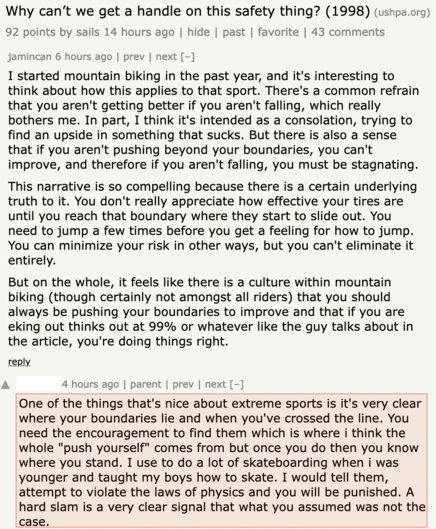
Interesting to see this incorrect line of reasoning about risk laid out so explicitly.

If you're around people who do extreme sports with serous risk, you'll know many people who have this attitude and you'll also know many people who incurred life-altering injuries or died because of this attitude.

A friend of mine who's reasonable and has a higher risk tolerance than me used to paddle with a group of whitewater kayakers who were doing the hardest stuff. 4 out of 7 of them died. She says

the reason she's still alive and so many of her compatriots are not is how she thinks about risk.

People would say things like "there's a 99% chance this will be fine", where "not fine" is fatal and they would then run something that had a 99% chance of working out. She wouldn't do that because, of course, if you regularly take a 1% chance of death, you're going to end up dead unless you're extremely lucky.

Another one is that she would never run something she hadn't observed before, whereas

@danluu a different take is some people care more about getting good, or the thrill, and less about their own life or injury. Certainly though a lot of people should take a step back and realize they are not gonna get famous or paid to do this extreme sport. relax. a little patience will keep you very alive and only limits your potential a little bit.

@jackmott Taking the kinds of risks described above is a poor way to get good at something because being crippled or killed really puts a damper on skill development.

The person I'm referring to was a world-class whitewater kayaker and, before that, was a low-level world class athlete in three winter sports (as in, was competitive internationally but was also never in serious contention for a medal) until they quit training seriously to focus on academics.

@danluu and even just minor injuries can unwind in a few days fitness that took months to build up.