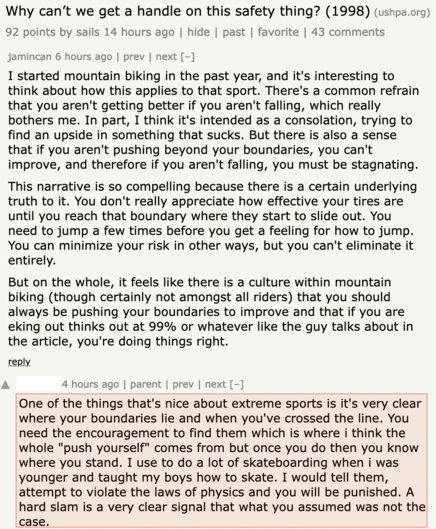
Interesting to see this incorrect line of reasoning about risk laid out so explicitly.

If you're around people who do extreme sports with serous risk, you'll know many people who have this attitude and you'll also know many people who incurred life-altering injuries or died because of this attitude.

A friend of mine who's reasonable and has a higher risk tolerance than me used to paddle with a group of whitewater kayakers who were doing the hardest stuff. 4 out of 7 of them died. She says

the reason she's still alive and so many of her compatriots are not is how she thinks about risk.

People would say things like "there's a 99% chance this will be fine", where "not fine" is fatal and they would then run something that had a 99% chance of working out. She wouldn't do that because, of course, if you regularly take a 1% chance of death, you're going to end up dead unless you're extremely lucky.

Another one is that she would never run something she hadn't observed before, whereas

most people around her would, using the same reasoning as the above. But if you do that often enough, you're not likely to live.

She has a similar attitude when backcountry skiing and would never take a drop of more than a few feet without having inspected it first, which is why she's never been seriously injured in the backcountry, but she's had to carry a partner back who landed on unexpected terrain and broke both legs, a rare occurrence per instance but not unlikely in the long run.

@danluu this seems to track solidly with how alex honnold approaches his free soloing:

there usually is a very lengthy preparation period in which he repeats the route on some form of protection, to know exact solutions to every move that can get dicey. it’s naturally still not a guarantee, but a way to reduce as many controllable factors as possible to lower the risk on an activity with such high consequence.

during a live-tweeting of free solo (the film), he said that after he bailed on his first attempt on the freeblast slab, a climbing pitch where you rely almost entirely on very exact foot placements and if one foot pops, there are no handholds good enough to allow you to hold your bodyweight, he drilled it so hard that he could climb it free-handedly. he said he would’ve loved to see that in the film as an illustration of the amount of obsessive prep that culminates in climbing all of el capitan without ropes.

and even with that entire apparatus around the process, you can still hear him comment other peoples’ free soloing feats with statements like ‘you soloed what, for how many times? that’s completely outrageous.’ – some routes are just too spicy for the consequences, let alone repeating them.