Bit of online history:

Ziff-Davis was a publisher of magazines, mostly about photography, then computers when they came along. They ran some groups on CompuServe and other pre-Internet online services.

Recognizing that online experiences would be the Next Big Thing, and also having learned that the existing options like Prodigy sucked, Z-D embarked on a huge project to invent something new.

It used SGML, which became the parent of HTML.

It used stylesheets.

It used multitasking before Windows really could do it.

It used TCP/IP before Microsoft supported it.

It was not only going to host Z-D magazines, but also the Washington Post, the Star Tribune (Minneapolis), Gartner Group, and I think also some Connecticut newspapers. All paid content.

It was gorgeous, packed full of great ideas and great design work and custom fonts and offline functionality and ....

While Interchange was struggling with bugs and late delivery and servers that weren't up to snuff, the World Wide Web came along.

The Web was pathetic by comparison. Barely supported images and the simplest layout. No fonts. No forums, subscribeable packages, automated downloads, etc.

But the Web was open, free, and it worked. Unlike buggy Interchange.

Boom. In a matter of months it was over.

@online-news

A paper from Ron Perkins, one of the designers of Interchange:

https://dl.acm.org/doi/fullHtml/10.1145/223904.223980

@online-news

The Interchange(tm) Online Network: Simplifying Information Access

@steve @online-news I do like a bit of software/tech history; I still remember GEM before MS Windows came along.
@steve @online-news I somehow had not heard about this and I feel like I had a missing gap just filled in. Amazing.

@ernie @online-news

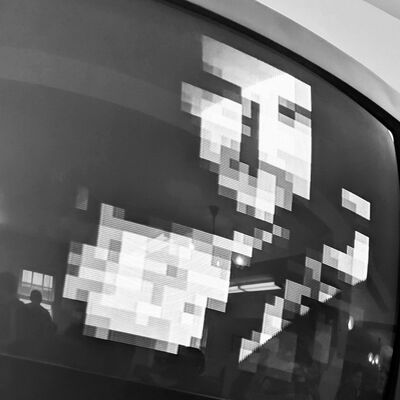
Wait til you learn about NAPLPS .... 😉

@steve @online-news That’s the crazy part! I know about all this stuff—especially NAPLPS! I think I’m just impressed that you pointed out one I wasn’t familiar with.
@steve @ernie @online- [email protected] Even us non-techies at Prodigy knew about NAPLS … and at least some of its limitatations.

@ernie @online-news

I was editor of Star Tribune Online, so I was up to my eyeballs in it. The other online services all had projects to create graphical interfaces but I don't know their specs. @VinCrosbie might know what Delphi had in the works. Prodigy had one on the drawing boards that looked very much like an Interchange clone. The only one that really had legs was AOL.

At a Jupiter conference back then, one of the Prodigy guys said "OK open systems beat great closed systems every time." And he was right.

@steve @ernie @online-news
1/2: Prior to its purchase by Murdoch's News Corp. in Dec. '93, Delphi Internet Services Corp, the world's first ISP, consisted of Gopher, Finger, FTP, Telnet, Usenets,MUDs, and email. FYI, all user-generated content. Murdochites tried to change it all to an online platform for Mass Media (News Corp. newspapers & magazine texts and comments, plus Fox TV & cinema promo forums; plus same from other Mass Media not already on other proprietary online services).
@steve @ernie @online-news
2/2: In other words, Murdochites tried to change an early Info Era many-to-many online service into a late Industrial Era supplemental online platform for one-to-many Mass Media (i.e., 'we pros write it and control all its contents, inclusing screening your comments, you consumers consume it) stuff, the wrong things to do in that formative decade. Murdochites also hated the idea of open Internet access. When all that didn't work, they sold Delphi 3 yrs later.
@VinCrosbie @steve @online-news I’ve not written nearly enough about this era of online access. I would love to do a deep dive into it
@VinCrosbie @steve @online-news My favorite example of the news industry not getting it was in the early ’80s when a bunch of major newspapers essentially gave their content feeds to CompuServe for free, along with millions in free print advertising. CompuServe had originally planned to pay for the feeds but they had a really good pitch, apparently.
@ernie @steve @online-news
People who weren't in the online news industry during the 1980 & '90s don't realize that there many efforts to get consumers to pay extra for major newspapers' contents on proprietary online services and later to pay for access to those newspapers early websites. That the news industry didn't try to charge for online contents back then in is a stupid current myth which those involved back then nowadays roll their eyes about whenever they hear or or read it.

@VinCrosbie @steve @online-news This is a direct paraphrase from Jeff Wilkins, CompuServe’s cofounder. The original plan was to license the wire, but the ask caught the attention of a newspaper publishers’ association and snowballed from there.

He shared it in a 2016 podcast, around the 36 minute mark: http://conqueringcolumbus.com/podcast/episode-8-jeff-wilkins-compuserve-success-living-meaningful-life/

Jeff Wilkins on CompuServe, Success, & Living a Meaningful Life - Conquering Columbus

Summary Jeff Wilkins is an extraordinary business leader, speaker, and all around individual. We talk with him about his journey creating one of the most monumental companies not only in Columbus history, but in the history of the internet. Jeff also shares with us his thoughts on success in life and living a healthy, meaningful …

Conquering Columbus
@VinCrosbie @steve @online-news (That said, the effort landed with a thud; apparently only a tenth of CompuServe subs even used the service. One failed attempt of many, as you note.)
@ernie @steve @online-news
That "a tenth of CompuServe subs even used the [news] service." doesn't surprise me. When news is but one of many threads of contents woven into the fabric of a medium, its usage will be fractional. Surveys during the 20th Cent.'s final decades showed that 25-35% newspaper readers read it for contents other than news. Likewise, more people nowadays are demonstrably willing to pay for access to the NYT's recipes, crosswords, or Wordle, than for its news.
@steve @ernie @online-news
FWIW, my time at Delphi was short: 9 months, mostly during '94. I was last person hired by old Delphi, started work on the day News Corp. took over. Job: enlist non-Murdoch newspapers & magzines to join Delphi. Culture clash Delphites v. Murdochites put me in conflict w/ sr. News Corp exec there: Rupert's bro-in-law Jaan Torv. (Rupert's son, Harvard student James Murdoch, also there as intern). Post Delphi, Rupert wouldn't revisit New Media for 10 yrs.
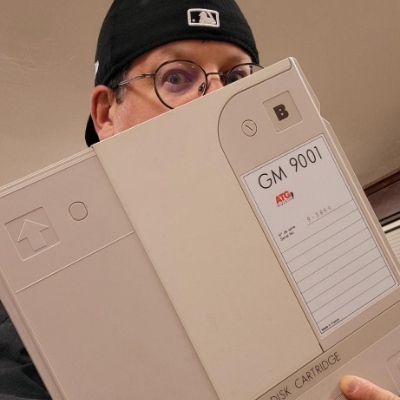
@steve I'm having a hard time finding these disk images over at archive.org. Do you know if these have been imaged elsewhere?
@steve I was an Interchange user and I loved it.
@steve @online-news hadn’t heard of Interchange. I started on CompuServe, which had tons of content. Could be pricey as it wasn’t all you can eat.
I still have my CS userid and password memorized. No idea why.

@steve @online-news Your history here reminded me of Data Courier, the online newspaper database, fate summarized by Neil Budde:

“At the time the [Courier-Journal] newspapers were sold to Gannett, Data Courier was sold to Bell & Howell, which was later sold to University Microfilms, which became UMI, which became ProQuest”

https://www.courier-journal.com/story/opinion/2015/10/02/new-archives-put-history-your-fingertips/73098036/

New archives put history at your fingertips

Subscribers now can search millions of pages of The Courier-Journal going back to 1830.

The Courier-Journal
@steve @online-news Ziff Davis managed to sell the Interchange Network to ATT well before it became apparent that it was doomed.
@steve
Cool! I haven't seen an Interchange disk set since the mid 90s. Are these your disks, and do the files on them exist anywhere other than on these disks?

@spike Those are my disks but I have no idea where they are. I had a complete set of beta disks, too, but none of that will install/run without Windows 3.1 ... and a complete VMS server backend. It barely ran.

We had a fish tank in the online department with two goldfishes. One was named IC1 (same as the Interchange executable). The other was named GPF (General Protection Fault).

They both died.

@steve I volunteer at a lab at CU Boulder called @mediaarchaeologylab and would be really interested to learn more about this platform. If you know anyone who might still have access to any of those materials, I'd be interested to see if we could fire it back up again. (Among other things, I do a lot of work making archaic operating systems available and functional, so it would be an interesting experiment to see if it could be brought out of suspended animation, even for a little while)

Goldfishes die, but media seems to persist much longer than its best-by date.

@steve @online-news I've been working at Ziff Davis for a decade and was never told about any of this. Amazing!
@steve @online-news This is why I believe everyone needs to start developing for the Fediverse now.

@steve @online-news

I am showing my age now, but I think we even had classes at uni on using SGML and also classes about different hypertext models... then within a short time SGML was obsolete... We were also using a version of Java <1.

#hypertext #sgml #html #java

@steve @online-news I love the note asking it to be installed between noon and 5PM :)
@steve @online-news thank you for posting this! This is part of web history I was completely unaware of
@steve @online-news heh, sorry to say I helped Dennis Buster set up the Star Tribune's first Web server back in the day.
Subsequently spent innumerable hours arguing for gay rights against Rip Anderson, sealion and troll extraordinare, on the Strib's early discussion forums.

@Albatross @online-news

I'm not sure we even had a webserver on that first box. It had Gopher!

All the newsroom PCs got Minuet for Telnet, FTP, email and Gopher, and had to reboot to use a different TCP/IP stack to make it work.

But we were on the Internet, buck naked to the world. Firewall? We don't need no steenkin firewall.

I had to go into whois to remember when I got the startribune.com domain registered:
Creation Date: 1994-01-13T05:00:00.00Z

Beat seatimes.com by six days.

And nearly 3 years behind chron.com, which was the first newsroom to plug in.

@steve @online-news Oh yeah! I loved Minuet - I did a lot of work on those programs, including the Gopher client, the POPmail program, and the underlying TCP/IP stack. Even coded in assembly for that one!

I was helping Buster when my birthmother phoned me for the very first time, almost exactly thirty years ago today. Because of her call I missed a meeting with him, and when I told him why I ended up on the cover of the Strib Variety section with a birthmother reunion story.

@steve @online-news
I took an course on Intranets through ZD Net back in the day. It helped me get my first job building a knowledge management system for Stephen Covey's organization.

@steve @online-news

Oh - I assumed that since Berners-Lee invented the web, he invented HTML.

@strangetruther @online-news Every inventor stands on the shoulders of giants.

@steve @online-news

Right! Now I just have to work out if T B-L was a giant, or standing on one!😆

@steve Thanks so much for this blast from my past! I tripped across it while I was writing a memoir of my journey in digital media.

It was, indeed, a remarkable team that we assembled at 25 First Street in Cambridge (which later became HubSpot's headquarters), and the team, led by Ed Belove, Mike Kraley, Dave Rollert, and others broke a lot of new ground before we got overrun by the Mosaic/WWW tsunami. Still, the effort led to ZDNet.

Here, to complete a bit more of the picture, is a piece I penned 12 years ago for the 20th anniversary of ZDNet: https://www.zdnet.com/article/ziffnet-project-athena-and-the-moment-of-conception/.

ZiffNet: 'Project Athena' and the moment of conception

ZDNet's 20th anniversary: former Ziff-Davis Interactive Michael Kolowich takes us back to experience the birth pangs of ZiffNet, ZDNet's predecessor.

ZDNET