
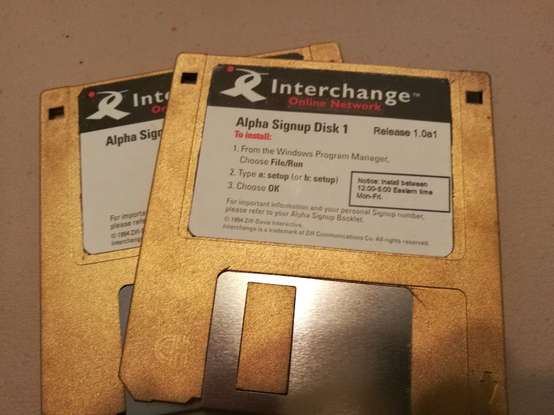
Bit of online history:

Ziff-Davis was a publisher of magazines, mostly about photography, then computers when they came along. They ran some groups on CompuServe and other pre-Internet online services.

Recognizing that online experiences would be the Next Big Thing, and also having learned that the existing options like Prodigy sucked, Z-D embarked on a huge project to invent something new.

It used SGML, which became the parent of HTML.

It used stylesheets.

It used multitasking before Windows really could do it.

It used TCP/IP before Microsoft supported it.

It was not only going to host Z-D magazines, but also the Washington Post, the Star Tribune (Minneapolis), Gartner Group, and I think also some Connecticut newspapers. All paid content.

It was gorgeous, packed full of great ideas and great design work and custom fonts and offline functionality and ....

While Interchange was struggling with bugs and late delivery and servers that weren't up to snuff, the World Wide Web came along.

The Web was pathetic by comparison. Barely supported images and the simplest layout. No fonts. No forums, subscribeable packages, automated downloads, etc.

But the Web was open, free, and it worked. Unlike buggy Interchange.

Boom. In a matter of months it was over.
@online-news

@steve @online-news I somehow had not heard about this and I feel like I had a missing gap just filled in. Amazing.

@ernie @online-news

I was editor of Star Tribune Online, so I was up to my eyeballs in it. The other online services all had projects to create graphical interfaces but I don't know their specs. @VinCrosbie might know what Delphi had in the works. Prodigy had one on the drawing boards that looked very much like an Interchange clone. The only one that really had legs was AOL.

At a Jupiter conference back then, one of the Prodigy guys said "OK open systems beat great closed systems every time." And he was right.

@steve @ernie @online-news
2/2: In other words, Murdochites tried to change an early Info Era many-to-many online service into a late Industrial Era supplemental online platform for one-to-many Mass Media (i.e., 'we pros write it and control all its contents, inclusing screening your comments, you consumers consume it) stuff, the wrong things to do in that formative decade. Murdochites also hated the idea of open Internet access. When all that didn't work, they sold Delphi 3 yrs later.
@VinCrosbie @steve @online-news I’ve not written nearly enough about this era of online access. I would love to do a deep dive into it
@VinCrosbie @steve @online-news My favorite example of the news industry not getting it was in the early ’80s when a bunch of major newspapers essentially gave their content feeds to CompuServe for free, along with millions in free print advertising. CompuServe had originally planned to pay for the feeds but they had a really good pitch, apparently.
@ernie @steve @online-news
People who weren't in the online news industry during the 1980 & '90s don't realize that there many efforts to get consumers to pay extra for major newspapers' contents on proprietary online services and later to pay for access to those newspapers early websites. That the news industry didn't try to charge for online contents back then in is a stupid current myth which those involved back then nowadays roll their eyes about whenever they hear or or read it.

@VinCrosbie @steve @online-news This is a direct paraphrase from Jeff Wilkins, CompuServe’s cofounder. The original plan was to license the wire, but the ask caught the attention of a newspaper publishers’ association and snowballed from there.

He shared it in a 2016 podcast, around the 36 minute mark: http://conqueringcolumbus.com/podcast/episode-8-jeff-wilkins-compuserve-success-living-meaningful-life/

Jeff Wilkins on CompuServe, Success, & Living a Meaningful Life - Conquering Columbus

Summary Jeff Wilkins is an extraordinary business leader, speaker, and all around individual. We talk with him about his journey creating one of the most monumental companies not only in Columbus history, but in the history of the internet. Jeff also shares with us his thoughts on success in life and living a healthy, meaningful …

Conquering Columbus
@VinCrosbie @steve @online-news (That said, the effort landed with a thud; apparently only a tenth of CompuServe subs even used the service. One failed attempt of many, as you note.)
@ernie @steve @online-news
That "a tenth of CompuServe subs even used the [news] service." doesn't surprise me. When news is but one of many threads of contents woven into the fabric of a medium, its usage will be fractional. Surveys during the 20th Cent.'s final decades showed that 25-35% newspaper readers read it for contents other than news. Likewise, more people nowadays are demonstrably willing to pay for access to the NYT's recipes, crosswords, or Wordle, than for its news.