AI's aren't sentient. They can't "steal."

Programmers and institutions select the data with which to train the model. They take art and writing from artists and authors without credit or payment. The software then remixes and mimics what it is given.

Displacing agency by attributing intent to the AI is exactly how people and institutions erase human action in the creation of technology. It also leads to further perceptions of technology as acultural, unbiased, and, in essence, magical.

@Manigarm This is an interesting point, and certainly correct.

It's also exactly how humans learn to become artists and writers - by studying, mimicking, and eventually adding to the existing body of work. We don't generally consider that theft, unless the copying is exact or deceptive.

Yet AI feels somehow different, much more like plagiarism. Perhaps it's that the ONLY input an ML system has is others' art, with no real-world human experience of its own to contribute.

@mattblaze

In my high school arts classes, when we did reproductions of renowned art, it was known as a "Master's study" to attempt to learn, first hand, how the original creator may have gotten to an end product by attempting to mimic their output as precisely as possible.

I do not know if that nomenclature is widespread?

Steve Jobs uttering "good artist copy, great artists steal" can be attributed at least as far back as Picasso. Others cite T.S. Eliot: https://quoteinvestigator.com/2013/03/06/artists-steal/

@Manigarm

Quote Origin: Good Artists Copy; Great Artists Steal – Quote Investigator®

@Manigarm I think part of it is that we expect art and literature to have a creator, an actual person whose work expresses a human point of view, one that encompasses something beyond the literal work itself. By lacking an author who stands behind it, is AI-generated art somehow inherently fraudulent? Maybe.
@Manigarm Is the person who runs an AI-based art generator and selects which ones are "good" any less an artist than Duchamp with his readymades?

@Manigarm It seems relevant that similar discussions seem to have occurred throughout history every time a new artistic medium is introduced, especially those involving some kind of automation.

Is photography art? What about music played on synthesizers? Acrylic paints? And so on. Much impassioned hand-wringing about the "end of art" with all of these, all of it seeming very silly in retrospect.

@Manigarm Anyway, my apologies for responding with a long thread of thoughts. I didn't want to hijack your interesting and important point.
@mattblaze @Manigarm And photography was once (and sometimes still) thought of as not art, since the camera did all the work.
AI is a medium, just like oil paint, bronze sculpture, photography, and many, many more.

@mattblaze @Manigarm

I'm only mostly comfortable saying that someone who writes his name on a urinal is not thereby making art.

I'm ENTIRELY comfortable saying that someone who commissions an artist to make a bunch of pictures is not the one making art, and that this doesn't change if you replace the (actual) artist with a machine.

@byterhymer Didn't the Steve Jobs version of that aphorism famously end, at least by implication, with "but not from me"?

I also think the comparison to training an AI and human learning, while somewhat clever, ultimately misses the mark. A human studying the old masters (or any other source of inspiration) is making conscious decisions about what to emulate.

They're not making a spreadsheet of every element of every artwork they've ever seen and picking out the elements with the strongest statistical correlation with keywords they were given.

@linebyline @Manigarm @byterhymer A film director doesn't generally directly do any of the things involved in making a movie. They just tell others what to do. Yet we generally consider the director to be the principal artist of a film.
@mattblaze Of course, the extent to which that is actually true varies wildly. In cases where it's warranted, the director is actually providing creative direction (hence the name) beyond just punching in a list of keywords and picking which completed movie they like best.
@mattblaze @linebyline @Manigarm @byterhymer That might be because with film, like with symphonies, the impact of the whole stands or falls with unity, direction, overall arc, rhythm and tensions. So much is not just in the action, but also in combining it on the cutting table and with soundtracks. The orchestra conductor combines it with that extra pause, the invitation to share a deeper well. They're teams with relationships. They're co-creating.

@mattblaze @Manigarm I think photography is another useful reference--the photographer doesn't create the imagery they capture from nothing, but they choose what to photograph, tuning parameters of the camera (which they probably didn't build either), making tweaks to an image after the fact, etc.

We don't have as much trouble assigning a creator in those instances--are the AI designers like the camera makers? are the images input into the model like the made objects that appear in a photo?

@zalcarik @Manigarm Yes, I think photography is a good example. When I make a photograph (and I use the word "make" quite deliberately instead of "take"), I'm trying to produce art. We can argue about whether it's good art or bad, but there's no longer any serious question, here in the 21st century, done with intention, that photographs can be art.

Why is selecting the input and curating the output of an AI system any different?

@zalcarik @Manigarm @mattblaze because the input sources are different - with a camera, you have to find or make something to aim the camera at; with AI generation, you’re amalgamating the set of training images (which were already found and/or made by other people). If you want to treat them similarly, AI generation should follow the same rules about including others’ work in the training set, and at best we don’t have documentation of that being the case
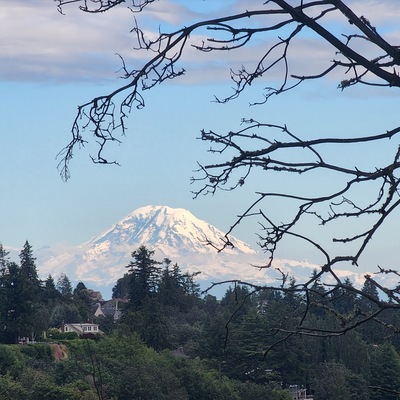
@ShadSterling @mattblaze Suppose I want a photograph of, say, a mountain framed by tree branches. I could look at parks on google, see other people have taken such photographs at a specific place, go to the park, and take my own photograph. I had to find something, sure, but I used other people to do that--nothing I found hadn't, in it's general nature, not been found before. My photograph will still be different, influenced by my own actions but also the random vagaries of nature.
@ShadSterling That strikes me as fairly analogous to asking the AI for a "picture of a mountain framed by tree branches"--what it produces will be influenced by what came before, but the random nature of what it shows to me will be unique, and I retain an ability to curate and fiddle with the results it presents to me. (Certainly as it pertains to my own participation and authorship in the process)
@zalcarik but the AI can’t take a picture of the real world, all it can do is create derivative works based on the pictures in its dataset. It’s more analogous to you overlaying existing images and adjusting the result by tuning how strongly each appears in the result - and claiming that image is originally yours without crediting the creators of the existing images. And it wouldn’t include any actual change in the view from the park, as a new picture on site would

@ShadSterling I think that's a common misconception, these AI models almost never work in a way analogous to that. To carry on the analogy about finding a photo spot (where "I" am acting like the AI now), it would be if I looked at the google image results to learn what the place looked like, then stepped over to a canvas and painted a picture of what I remembered.

A novel work is being created, but yes also one that is intrinsically derivative of the work of others.

@ShadSterling But that's pretty on par with what human artists need to do. Consider not the scenic photo spot, but instead something like a dragon--there's no real-world example an AI or human could draw from, they need to make reference to existing art.

I think that's all still mostly tangential to the issue of authorship and creative/artistic input. The AI/camera are backboxes, that take inputs and allow for creative input in turning those inputs to outputs.

@zalcarik it’s more elaborate than my analogy, but that doesn’t make it not analogous; the best introview I’ve seen is https://youtu.be/1CIpzeNxIhU . There’s no experience, no context, no story, no mental model of growth or movement or weather, just numerical calculation with a large number of tuning parameters set by the prompt.
How AI Image Generators Work (Stable Diffusion / Dall-E) - Computerphile

YouTube
@zalcarik If you were to paint a branch, you would draw on a lifetime of seeing them in trees and on the ground, picking them up, maybe building things with them, maybe whittling them and so on. You have mental models of how they grow, how they bend, the different between wet and dry, maybe differences between different plants, and so on. Far more than could be encoded in images alone, or be included in this kind of AI
@zalcarik if you were to paint a dragon, you might not have the same experience, but you could have in mind a mental model of how a dragon physically moves, of its skeleton and muscles and mind, of the physics of flight, and beyond that of the context of the picture, the story in which the dragon lives, and who else lives there. I’ve never heard of any AI coming anywhere near that kind of creative process
@zalcarik All these AIs can work with is the training data. Anything recognizable in their output is a result of deriving it from the training data and nothing else. And you can see that in the parts of the images that don’t make sense. We could be creating these as tools for artists, to expand art, figuring out how to share credit (and payments) between the creators of the training images and the prompt writers, treating them like the collaborations they are, but that’s not what we’re doing
@zalcarik (“introview” came from indecision between “introduction” and “overview”, but I kindof like it)

@ShadSterling That video elides much of what's being considered here though, namely the actual representational/encoding part of the network. The part you're looking at is the part of the model that turns the abstract representation into an image.

It's not analogous to the creative neural activity performed by a human artist, but rather the series of motor functions needed to move a hand across a page to draw a line.

@ShadSterling Perhaps the most significant departure from your analogy is that the images are not in the model. It doesn't combine different amounts of images it's seen before, it combines different amounts of abstract concepts that it learned from images it's seen before.

When it creates a landscape it doesn't find 100 landscapes in its training set and weight them accordingly, it proceeds from landscape to some combination of mountain-ness, hill-ness, and tree-ness, and so on.

@ShadSterling Consider it as if it had watched a lot of Bob Ross tutorials, and then sat down in front of a blank canvas. It would follow the ideas from the tutorials, putting together mountains, hills, happy little trees, etc. If a human did that, there'd be little question that they had created art. Derivative art. Maybe not good art. But art. (And most people wouldn't be asking for the human to pay Bob Ross either.)
@ShadSterling And to return to the photography comparison, the camera has no knowledge of story, context, growth, movement, or weather. The photographer doesn't need those things either (and the natural scene doesn't have like half of them, certainly no story or context). They might help the human make a better photograph, but they're not needed for us to recognize the artistic nature of the work or the human's creative involvement in its production.

@zalcarik I would have preferred that the video include more about the intermediate data; if you know of one that covers that similarly succinctly I'd like to see it

The AI has nothing like motor functions or abstract concepts like "hill-ness" (or even lines); AIUI it has something like probabilities of pixel value relationships associated with words or phrases, and it's generating an estimate of the most likely image similar to how language models generate an estimate of the most likely text.

@zalcarik The analogy is not of a process that combines images without any intermediate data, but of one that combines images through a tunable mathematical relationship, regardless of how many steps are involved. (You could think of the model as a derived work, and the images it generates as derived again; either way, it's output is derived from the training images.) There may be artistry in the tuning, but anything recognizable in the output is there because of what was in the training set.
@zalcarik If a person gained access to a library of Bob Ross tutorials to train themselves, they should have also gained a license to do so, which would amount to having bought (copies of) each tutorial. Bob Ross will have been paid. The way these models are generated does not include paying the artists, getting permission from the artists, or even informing the artists that their work has been used, even for models that were created for the purpose of selling image generation services
@zalcarik And professional artists are losing clients to AI services which use their art without permission. The AI can generate new images based on the artists' work much faster than another human artist, so a single AI can dramatically expand the supply (of some subset) of pictures made to a client's "prompt", and dramatically reduce the cost per picture, which could easily put the artists whose work the AI depends on out of business. The least we can do is pay the artists a fair cut.
@zalcarik @mattblaze @Manigarm The difference is the photographer has the "eye" to discover/uncover beauty in their surroundings. They cannot photograph what isn't there (although they can manipulate a fair deal). With AI generated art, the discovery part is crucially less valuable. You can basically say "give me a beautiful composition" and you'll have one, often more intriguing than every day art works, because they don't have the same limitations as traditional artists.

@sehe I can see an argument for "less valuable", but aren't there still analogues with photography? cliché photo spots, etc. "If you want a nice picture of the skyline, you go to this overlook at sunset" sort of thing.

I think that's still in the realm of good/bad or impressive/lazy, it's on a continuum that's still within the art-space. Even if the act of discovery is constrained in different ways, can't we still identify a sense of human authorship?

@sehe I think a lot of this is confounded by the fact that the technology is so new that we're being inundated with a lot of, essentially, amateur art. So much of what I see from AI art feels like what I produced when I first discovered all the stuff I could do manipulating random noise textures on a computer.

We're still figuring out how to be expressive with this new suite of tools. But I do think the ability to be expressive is there, even if the tendency is towards banal expression for now

@zalcarik Oh yes. The problem is more short-term. In the short term people will mistake the AI for the original artistry that was used as prompt and training.

It becomes malicious when copy-cats are using established artist's names to *sell* AI-generated works - basically swindling artists and buyers alike.

The problem isn't that AI cannot be used constructively. Nor that humans would be redundant. The challenge is, how do artists survive in the presence of predatory competition. #ethics

@zalcarik Another comparison would be: nobody would mind that mediocre painters would have employed the camera obscura to get the scene right.

However, it would be a problem if they then passed it off as the work of a renowned painter. It's a brand protection problem, where previously required skills were a natural barrier to infringement.

Nothing new, just new in these particular areas and extents.

@mattblaze @Manigarm Hmm. Duchamps cannot summon ready-mades that are certain to appeal to an audience and competes commercially with other creators that it takes inspiration from. Nor would he, probably
@mattblaze
I think the labor and value-accrual/ownership analysises end up being much more useful than debating whether or not the outputs are art.
@Manigarm @mattblaze
@dymaxion @Manigarm They're related. Consider the two main ways (visual) artists are employed: as illustrators-for-hire (e.g., by publications) and as fine artists collected by rich investors. For the former, AI systems (currently) produce nice looking illustrations, but they require extensive selection before getting one that's an exact fit; it's probably cheaper & faster to just hire an artist. But for the latter, "Is it art" is a central issue for collector value.
@dymaxion @Manigarm If the AI-based systems are able to follow instructions and interact with an art director as efficiently as a human artist, it could significantly displace human artists. But we seem to be a long way from that with the current state of the art. The fact that these kinds of artists already work fairly cheaply is a factor here, too.

@mattblaze
Honestly, a lot more artists do small scale sales in middle-class contexts than do sales to the rich, and in that context, their work is bought for a more utilitarian understanding of decorativeness+meaning, much closer to the illustration case. But what I mean around labor and value-accrual is on the other end. None of these systems work without the training data, and there derivative works that conversation compressed versions of that training data, and yet the value accrues entirely to an intermediary. Artists have the right to set their own rates for derivative works licensing. I'm not usually an IP maximalist, but there's a meaningful distinction between access to culture on an individual basis and the creation of a system intended to evolve to a point where the work of the people from which its creators are stealing is entirely replaced.

Something entirely based on theft from other people cannot be art. An original tuned prompt absolutely can have artistic merit, but the artistic merit and "artness" of the result rests almost entirely on a) the work of the ML engineering team, and b), much more heavily, on the source material. Now, there's of course a long tradition of artists working with general purpose software and having that software considered a tool or at most (e.g. with reactive projection mapping installations and touchdesigner or max) a medium, so we can ignore the first. However the last is and always will be an intrinsic component, massively more important than anything involved in prompt engineering. The prompt engineering has contributed almost none of the art and should receive almost none of the value.

It would be perfectly possible, if any of these companies cared, to create a fair licensing structure and modeling systems that could provide a proportional attribution distribution across the source material derived from each prompt, paid out in accordance with derivative work prices determined by the rights holders. Until they do this, it's nothing but theft.

@mattblaze
And yes, it's unclear if IP law, created and maintained as a tool to make money flow towards capital and as often as not weaponized against individual artists these days, will support this understanding. Certainly, the ML image generators are operating in the fine Valley tradition of "ignore the law until we're big enough to buy the laws we need". Pretending that this is reasonable conduct and something that can be overlooked to consider the product as though it did not occur in a context of theft by the ML data collection teams is unreasonable.
@dymaxion I agree that The Valley’s long history of rights-trampling bad behavior should absolutely make us especially skeptical here, and I think that was part of the original poster’s (quite valid) point. But even putting the equity issues aside, that still leaves fundamental questions of how we should approach machine-generated art. Assume for a moment all the input is public domain. Can the output be considered original? How can artists use this? Etc.
@dymaxion I’m not saying the equity questions aren’t important or worth exploring. Only that these systems also expose and amplify other vital, and fundamentally deep, questions of how we analyze (and what we value about) human creativity.
@dymaxion @mattblaze the law is certainly not set up for this, but it’s doubtful that it’s infringement in the US, but might run into moral rights elsewhere. I don’t think theft is the right framework to think about AI datasets at all. The question is of either displacement (artists losing employment) or of French style moral rights, which isn’t a great place to be. Displacement is the obvious first case, though what is being displaced? Is there material harm?
@dymaxion @mattblaze does that displacement harm the creative world, or does the creative work react and adapt? Is there lose or gain order money, prestige, etc.?
@dymaxion @mattblaze Then there’s moral rights, but if we say an artist should be able to control how a machine looks at and learns from art, how to we distinguish that from a human? And in what setting? With what tools? How many digital artifacts between a human and a piece do art are ok? How do we define that socially, much less legally?

@dymaxion @mattblaze If we said somehow that we didn't want to let any copyrighted art be consumed by AI, and it was a successful influence on culture, are we not just washing out all innovation from the last 90s years? Will artists have to chase that fashion to stay relevant? If AI replaces artists, does that just push them more into the fine art world of catering to the rich?

Can they be pushed more that way? They're already just about entirely there.

@dymaxion @mattblaze IP law doesn't stop being utterly problematic in the cases where you like it, nor does the neoliberal logic about art markets suddenly become desirable when a machine and made pictures. The art market and IP are hopelessly corrupt, in a very master's tools way.
@dymaxion @mattblaze The political/economic system we live in makes your friends poor, (Jaron) not filesharing, or now, AI.
@mattblaze @Manigarm Exactly - we are cheated by that expectation. When we read AI-generated art generously, as if it had a creator, as if we are seeking the aim of that creator, we are giving it a weight it does not deserve.

@mattblaze @Manigarm I think a substantial part of the reason also comes down to market effects.

What makes plagiarism grate for creators (artists, writers etc) is that their work is high-intensity, and they object to plagiarists in part because those plagiarists avoid the costs of developing the creative talent/expertise to produce cheaper alternatives and that impacts the creator's ability to get ROI on their work. AI does that to an *insane* scale, essentially annihilating the whole market.

@Pwnallthethings @mattblaze @Manigarm We teach students that copying text or code and applying synonym substitution is plagiarism. They're expected to develop and abstract understanding and then write their own sentences. Software branded as AI does only the mashup-obfuscation bit because it doesn't have anything like abstract understanding. It can be tuned to copy near-verbatim (CoPilot) or to babble confident nonsense (Galactica), but the mechanisms would all be plagiarism if a human did it.
@mattblaze @Pwnallthethings @Manigarm Playing devil’s advocate here: isn’t the whole point of technology to take things that are hard for humans to do, and build machines that make that work effortless?

@Manigarm @Pwnallthethings @mattblaze I guess what I’m trying to say is that “it’s harder for humans to do this than machines” isn’t enough of an argument.

But trying to define what the missing “this” is, that question’s going to take you straight into the hardest problems of consciousness and computer science. I don’t envy the person trying to win that fight, long term.

@matthew_d_green @Manigarm @mattblaze ah, ok. I see where you're coming from. I'm not saying artists are *right* (that's a subjective argument), but that part of why they are so angry about it that probably not just that it's taking credit for their work, but that its monetizing it in a way that means that the bread-and-butter creative work that used to pay the bills for $100 here, or $1000 there will now go to an AI that can do it for $0.03 each.