AI's aren't sentient. They can't "steal."

Programmers and institutions select the data with which to train the model. They take art and writing from artists and authors without credit or payment. The software then remixes and mimics what it is given.

Displacing agency by attributing intent to the AI is exactly how people and institutions erase human action in the creation of technology. It also leads to further perceptions of technology as acultural, unbiased, and, in essence, magical.
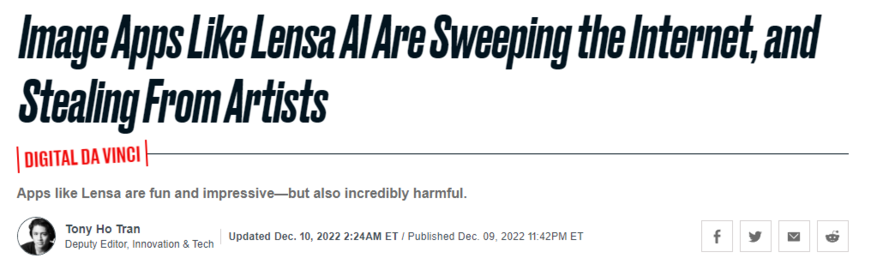

@Manigarm This is an interesting point, and certainly correct.

It's also exactly how humans learn to become artists and writers - by studying, mimicking, and eventually adding to the existing body of work. We don't generally consider that theft, unless the copying is exact or deceptive.

Yet AI feels somehow different, much more like plagiarism. Perhaps it's that the ONLY input an ML system has is others' art, with no real-world human experience of its own to contribute.

@mattblaze

In my high school arts classes, when we did reproductions of renowned art, it was known as a "Master's study" to attempt to learn, first hand, how the original creator may have gotten to an end product by attempting to mimic their output as precisely as possible.

I do not know if that nomenclature is widespread?

Steve Jobs uttering "good artist copy, great artists steal" can be attributed at least as far back as Picasso. Others cite T.S. Eliot: https://quoteinvestigator.com/2013/03/06/artists-steal/

@Manigarm

Quote Origin: Good Artists Copy; Great Artists Steal – Quote Investigator®