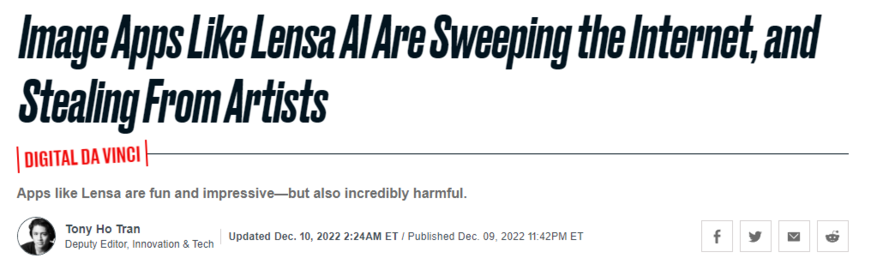
AI's aren't sentient. They can't "steal."

Programmers and institutions select the data with which to train the model. They take art and writing from artists and authors without credit or payment. The software then remixes and mimics what it is given.

Displacing agency by attributing intent to the AI is exactly how people and institutions erase human action in the creation of technology. It also leads to further perceptions of technology as acultural, unbiased, and, in essence, magical.

@Manigarm This is an interesting point, and certainly correct.

It's also exactly how humans learn to become artists and writers - by studying, mimicking, and eventually adding to the existing body of work. We don't generally consider that theft, unless the copying is exact or deceptive.

Yet AI feels somehow different, much more like plagiarism. Perhaps it's that the ONLY input an ML system has is others' art, with no real-world human experience of its own to contribute.

@Manigarm I think part of it is that we expect art and literature to have a creator, an actual person whose work expresses a human point of view, one that encompasses something beyond the literal work itself. By lacking an author who stands behind it, is AI-generated art somehow inherently fraudulent? Maybe.
@Manigarm Is the person who runs an AI-based art generator and selects which ones are "good" any less an artist than Duchamp with his readymades?

@mattblaze @Manigarm I think photography is another useful reference--the photographer doesn't create the imagery they capture from nothing, but they choose what to photograph, tuning parameters of the camera (which they probably didn't build either), making tweaks to an image after the fact, etc.

We don't have as much trouble assigning a creator in those instances--are the AI designers like the camera makers? are the images input into the model like the made objects that appear in a photo?

@zalcarik @mattblaze @Manigarm The difference is the photographer has the "eye" to discover/uncover beauty in their surroundings. They cannot photograph what isn't there (although they can manipulate a fair deal). With AI generated art, the discovery part is crucially less valuable. You can basically say "give me a beautiful composition" and you'll have one, often more intriguing than every day art works, because they don't have the same limitations as traditional artists.

@sehe I can see an argument for "less valuable", but aren't there still analogues with photography? cliché photo spots, etc. "If you want a nice picture of the skyline, you go to this overlook at sunset" sort of thing.

I think that's still in the realm of good/bad or impressive/lazy, it's on a continuum that's still within the art-space. Even if the act of discovery is constrained in different ways, can't we still identify a sense of human authorship?

@sehe I think a lot of this is confounded by the fact that the technology is so new that we're being inundated with a lot of, essentially, amateur art. So much of what I see from AI art feels like what I produced when I first discovered all the stuff I could do manipulating random noise textures on a computer.

We're still figuring out how to be expressive with this new suite of tools. But I do think the ability to be expressive is there, even if the tendency is towards banal expression for now

@zalcarik Oh yes. The problem is more short-term. In the short term people will mistake the AI for the original artistry that was used as prompt and training.

It becomes malicious when copy-cats are using established artist's names to *sell* AI-generated works - basically swindling artists and buyers alike.

The problem isn't that AI cannot be used constructively. Nor that humans would be redundant. The challenge is, how do artists survive in the presence of predatory competition. #ethics

@zalcarik Another comparison would be: nobody would mind that mediocre painters would have employed the camera obscura to get the scene right.

However, it would be a problem if they then passed it off as the work of a renowned painter. It's a brand protection problem, where previously required skills were a natural barrier to infringement.

Nothing new, just new in these particular areas and extents.