What drove the internet in the 90s and 00s was that it was so cool to be doing good shit with it. Social media was like a giant manure dump all over that culture. We've never recovered.

The Fediverse and the death of Twitter promise a rebirth of that culture, if we don't let the cool kids and a lazy press bury the public in vapid bullshit again.

We wasted 16 goddamn years enduring Facebook and Twitter. In the end, they were both toxic and regressive. Can we please not go back there? Please?

@shoq please let’s not go back there. I miss Web 1.0. Web 3.0 can go ahead and fû€k off.
@shoq In the 70s, you needed a license to operate a CB radio and your license culled be revoked for abusing the privilege. The Internet arrives and anyone with access to a “device” can spew whatever they want with zero accountability.
@shoq I miss GeoCities. ⌨️📱
@shoq Can we please also not idealize a mythical past? This is a fundamentally conservative worldview and there was no time in history when anyone but the privileged enjoyed a mythical golden age. Yes Twitter was wielded to do a lot of bad things but it was also instrumental in speaking truth to power and making it so the privileged couldn't ignore injustices they otherwise would have.
@shoq We should be learning from the good and the bad to create systems that will push us into a better world not trying to go back to an imagined better time.
@dalias I'm not big on nostalgia, but objectively, it was a better time. Software was erupting everywhere, and big commerce hadn't gobbled everything in sight yet.
@shoq @dalias
If you want to truly look at this era objectively, you should look at how many people worldwide had access to computers and the internet. The 90's was only a golden era of computing to those few who could afford to be there.

@ProjectFearlessness @dalias

Yes, but that's true of anything new. You can't fault early adopters for being early adopters.
There are millions who still can't afford internet access NOW. But back then, the adopters at least cared about that. Now, very few do. I resent that inherent selfishness.

@shoq @ProjectFearlessness LMAO no. The gamers mocked HPBs. The IRC channels banned and servers klined residential ISP IP blocks available to ordinary ppl. Etc. etc.

Even before you get to things like race and gender, 90s internet was not at all inclusive or welcoming.

@shoq @ProjectFearlessness The early internet was not much better than the shallow tech libertarianism of today. Folks with privilege demanding the right to do anything they want, but no care for making a better world for everyone, and screw anyone who didn't have the same needs and interests as themselves.
@dalias @ProjectFearlessness I think we had different experiences. Sure, there were libertarians, or characters like RMS insisting on free everything (and who seem more prescient now than he did then), but the 00s also saw people like @davew giving away great software and ideas just because he wanted to. His RSS, OPML (and Podcasting) didn't come from corporations milking culture. It came from humans putting out for their culture. Because they could.

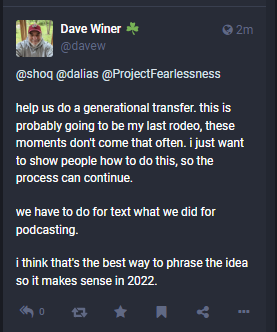
@shoq @dalias @ProjectFearlessness

help us do a generational transfer. this is probably going to be my last rodeo, these moments don't come that often. i just want to show people how to do this, so the process can continue.

we have to do for text what we did for podcasting.

i think that's the best way to phrase the idea so it makes sense in 2022.

@davew @dalias @ProjectFearlessness

Dave, this may be one of the most important (and nicest) posts I ever seen on social media. And I agree 1000%.

If we all practiced what you're preaching here, the world would look very different (and much more hopeful) than it does to so many now.

@dalias @ProjectFearlessness

So what? It was primordial. I find nothing useful in the observative. People and societies evolve. I am not saying life was great in the 90s. I am saying the attitudes about software, innovation, and collective actualization were all more prevalent then than they seem to be today. We have lots of diversity today, on some levels, yet crushingly dull and toxic conformity on others. The Fediverse "feels" like a second chance to me. For all of humanity.

@shoq @ProjectFearlessness I think we're in a much better position today because (1) we have lots of people who've learned from the past and strongly intend to make it different, and (2) we have representation of a much more diverse space of personal backgrounds, needs, etc. that design needs to be inclusive of.

The early internet was just *bad*. And I say that as a product of it.

@shoq @dalias
I'm not sure early adopters is a good choice of words. Early adopters use new things available to everybody before anyone else realises their use. The same can't be said of the internet. Access wasn't equal.
It's cool. Nobody can help their privilege. It would just be nice to hear more acknowledgement that the first 20 years of the internet was really just a handful of privileged elites talking amongst themselves.

@ProjectFearlessness @dalias

You've just described the evolution of nearly everything important since the industrial revolution began. The poor didn't get to light their homes with gas or electricity, or sail on steamships, or use telephones and TVS, for quite a while after the privileged elites did. Radio was (at least partially) one of the few exceptions because it coincided with a burgeoning industrial base looking for thing to market.

@shoq @dalias
No, I just made one observation. Instead of just acknowledging it you seem to be going the really long way round it. If you don't mind, I won't join you.
@ProjectFearlessness @dalias
You made a statement that was false. Internet technology was available to everyone who chose to avail themselves of it equally. Whether they knew that or not, or whether they could afford it or not, was and is immaterial. It was no different than where we are now. The Fediverse is here. Most people can avail themselves of it. They just have to know about it and care. Most don't. The same was true for Compuserve in 1984 and AOL in 1994.
@shoq @ProjectFearlessness I thought you had something interesting to say at one point but asserting that whether someone can afford something (ntm whether they have any way of knowing it might be useful to them, or whether parents or partners might block their access to it, etc.) is irrelevant to whether it's "available" to them is such a laughably bad take I'm not sure you're even trying to be taken seriously...
@dalias @shoq
Agreed. I'm done here. The internet has opened up so many different viewpoints from all around the world that I don't have the time to listen to this one. It's depressingly familiar.
@shoq @dalias
Oh, you've got to be kidding. If you couldn't afford the technology, you had no access to the internet. Worldwide, billions didn't have access. That's not immaterial. It's super material.
All I will say is I'm really glad that now about 70% of people worldwide have Internet access we get to hear from different viewpoints than yours.
@shoq Wow. Some figures on just how white this attitude is: https://tldr.nettime.org/@festal/109490467887417091
felix stalder (@[email protected])

"80% of Black Americans said social media help shed light on rarely discussed issues; the same share of White Americans said these sites distract from more important issues." This probably reflects the degree to which the traditional media have historically addressed their issues. Remember that when you do you're next social media critique (which remain necessary, of course). https://www.pewresearch.org/internet/2018/07/11/public-attitudes-toward-political-engagement-on-social-media/

tldr.nettime
@dalias Nothing in statement said there were no positive impacts of social media. There were. And most them created their own dynamics, and we haven't come to grips with most of those changes yet. What society does with technology as a whole is of much greater interest to me that the impact it has on each of our many parts. Fortunately, many others are focused on those parts. I'm interested in tools that serve the parts collectively—and equally.
@dalias @shoq Yes! There has never been better access to information and this in itself is an absolute good, however messy that gets in practice. It would be tidier if only the powerful or accredited could listen or speak, of course The powers that be would love it.
@dalias Yuo sound like someone telling me Godwin's law in the time of Trump. Just because conservatives hagiographically recast the past, doesn't mean reflecting back to a time before complete corporate dominance of almost all commerce and technology was not objectively, a better time—in that one respect. We simply didn't know it then,. We do now. I don't want to roll back time. Only really bad policies and norms. I want innovation back.
@shoq @dalias I remember when The Fairness Doctrine was repealed. Also, I remember when Clear Channel bought my favorite alternative rock station in 1997 and destroyed it.
@ChloePolitiCat @shoq @dalias clear channel truly ruined radio

@dalias @shoq

Well said, Rich. I loved Twitter and learned a ton from it, especially as a white person increasing my racial consciousness, and during the T****p years as a pro-Democracy American in need of trustworthy perspectives on current events that I didn't find in media coverage. #BlackLivesMatter #antifascism

@shoq I got on for my business. First limo and then later when I was a hotel Director of Sales. Mostly biz and some snark, yes.
I am trying to get back a bit and push some writing. But I cannot keep quiet on all the BS trying to derail us.

🙂 Welcome thoughts.

I wish people in mainstream media were as sensible. If twitter dies today, compulsive lifeloggers, online harrasers and braggadocios, and their ilk will not have an easy outlet, but the rest of us wouldn’t mind I believe.

@shoq @jeffjarvis
A garden can grow from a pile of manure, if you can keep the weeds out.
@shoq in addition to mastodon I've found myself reading pieces found via Feedly much more often and am really enjoying it compared to my former endless doom scrolling on Twitter.
@shoq I seem to remember Fidonet getting pretty nasty back in the day. It had the nickname “fight o’net.” Humans will be humans irrespective of mediums or platforms.
@lonseidman Oh, I'm in no way nostalgic for most of the period. But I was in DC Metro VA during those years, and there were more software and networking startups per city block than automobiles. Everyone was going to be the next PSInet or AOL sensation. The gobbling by Softbank and others was just getting started.
@shoq Never going back. ❤️
@shoq What is interesting about one aspect of what you are pointing to is what I've said about our social economic non democratic, capitalistic culture. It often cultivates the worst of our human qualities. So yeah, can a culture be formed, which provides a space that elevates our higher and better nature! Then, we could really tip the status quo!
@shoq Is Mastodon the Methadone for Twitter addiction?
@shoq let’s consider how social media got that way: ad-funded business model. Rather than paying for a service that takes billions (or whatever) to run with a monthly subscription, we let the ads pay for it….then bitched about it. With the ads came the data and then the AI that effed the world. The only way this works is our financial support. It’s crowdfunded, and we’re the crowd. It will be worth a donation once in awhile…like for public radio, pbs, or Wikipedia.
@davidwburns @shoq The thing is - most people don’t care all that much about the ads, which is why Facebook, Twitter, and for that matter broadcast TV/radio and newspapers have always functioned the way they have. IMHO, there’s absolutely no reason why the Fediverse couldn’t have ad-supported instances alongside crowdsourced ones - if I want to use a site that is highly reliable and has fantastic moderation that occasionally shows me an ad, that’s my choice.
@davidwburns @shoq The knee-jerk anti-capitalism I often see from old-school Fediverse folks reminds me a lot of the knee-jerk anti-capitalism I saw on USENET and elsewhere on the early Internet in the early 90’s, which didn’t stop anything. I think it’s counter-productive to what we really need to focus on, which is having a “public square” that can’t come under the control of a crazy/evil (take your pick, or take both) billionaire.
@aelman @shoq choice being the key. People act like they didn’t have a choice but to dump their whole lives into an ad machine. Given the choice of a monthly fee for ad free Facebook I would take, not because ads are annoying but because I don’t want to give FB the need to collect my data and use it to manipulate my experience.
@davidwburns @shoq I think we all have a choice, and for millions and millions of us, the down side of the ads has been *well* worth the benefit we get from engaging on FB/Twitter without having to spend any money at all. You can certainly argue that much of that is based on a lack of awareness of the true down sides both on a personal and societal level - which is why we need regulation. But even fully informed people may make a rational choice that ads are ok.
@davidwburns @shoq My point is that the fundamental architecture of the Fediverse makes it a lot easier to make a rational choice, because the choice isn’t between “give up my data” and “completely lose access to my community”.
@davidwburns @shoq as another example - I use Gmail for my personal mail, despite the fact that I know Google is using data in my email to target me with ads, because a) I trust that they’re not maliciously manipulating me, and b) it works well and fast and doesn’t cost me money. You, on the other hand, can choose to get an account on a private, non-ad-supported mail server, or even set up your own, and we can still mail each other.

@aelman @davidwburns

So long as ads are supporting some other value, I have never objected to them. Ads or subscriptions should not be the determinant. Only value. If someone wants to use a commercial instance because they get better performance, or different tools, great. Just don't impede the free service everyone else uses for free and everyone wins.

@shoq @aelman the harm is that FB , for example, gives you want it thinks you need to keep the app in front of you. If you click on a Big Foot link, FB might say hmmmm, let’s give him another far out post…maybe a conspiracy theory. click on that, next thing you know the world through FB looks a lot different. You still thinking reality is diverging. It doesn’t sync up with the news….so THAT must be a conspiracy too!

@davidwburns @shoq yeah, no disagreement from me on that. FB has been irresponsible in addressing the impact of their design decisions on society. I honestly believe they’re trying to do better (as was pre-Elon Twitter) but it takes time and they’ve already done massive damage.

I think there are ways to do a responsible ad-based social media business, but the existing ones are hardly examples.

@shoq I never imagined the freedom of social media and the Fediverse until I actually showed up here.

I believe it will endure, but I also think that all sources of freeform information and community will come under attack.

We're definitely at the beginnings of an information war. I have to admit I'm worried.

@shoq The other loss came with the introduction of LMS in tertiary institutions. Overnight educator multimedia and web creativity was decapitated for the sake of institutional corporate branding and standardisation. Had that not taken place to the degree that it has, institutions would have been in a much better place to handle the fallout from the past, present and ongoing pandemic.
@shoq Still praying we all go back to Usenet and gizzie from alt.tv.x-files returns.
@shoq well said! Agree with all of that, 💯