*A Thread on Activism in Academia* 🧵

Yesterday I gave a talk about climate activism in academia, first to a group of students at Sciences Po, and later to faculty members at McGill University and University of Vermont.

The core question of the talk was: What is the role of researchers in a time of ecological emergency — should we all become activists?

Here are some key takeaways.

#climate #activism #dkgreen #ClimateCrisis #climatejustice @academicchatter @politicalscience @sociology

1/11

*Scientists are rebelling*

For the past two years, I have been involved in the international movement @ScientistRebellion. SR brings together researchers from different scientific backgrounds, who all believe that the ecological emergency poses an existential threat to our ongoing survival on this planet, and that we have an obligation to do something about it.

“If we scientists don’t act like we’re in an emergency, how can we expect the public to do so?"

https://scientistrebellion.com/about-us/

2/11

About Us – scientist rebellion_

*Examples from Denmark*

In the Danish group of Scientist Rebellion, we have organised various kinds of non-violent direct actions — such as teach-ins and road blockades — that involve different levels of civil disobedience.

Here is a picture from one of our actions in the spring, where we blocked all the roads to the Danish parliament together with XR, Greenpeace, and other green organisation in Denmark.

3/11

*A growing movement of researchers*

And we are far from alone. More and more people within academia are calling for their colleagues to take action and engage in new forms of activism. Here is an example from Nature earlier this year: https://www.nature.com/articles/s41558-022-01461-y

4/11

Civil disobedience by scientists helps press for urgent climate action - Nature Climate Change

Time is short to secure a liveable and sustainable future; yet, inaction from governments, industry and civil society is setting the course for 3.2 °C of warming, with all the cascading and catastrophic consequences that this implies. In this context, when does civil disobedience by scientists become justified?

Nature

*Time to change tactics*

The main point is this: If we, as researchers, really believe that the house is on fire — that the ecological crises pose an existential threat — how can we keep on doing all the same things as before?

Is it enough to observe and describe, and to publish our findings in prestigious journals? Is it not time to shift our tactics?

See for example this recent article written by my colleague and co-activist @FerRacimo among others: https://elifesciences.org/articles/83292.

5/11

Point of View: The biospheric emergency calls for scientists to change tactics

The ever-worsening climate and ecological crises calls for life scientists to engage in advocacy and activism to galvanise governments and the public into action.

eLife

*Many researchers are hesitant to act politically*

One of the barriers preventing scholars from engaging in political activism is the fear that they might be perceived as less trustworthy by doing so. But if we look at the research that fear might very well be overstated.

6/11

*Advocacy does not necessarily make researchers less credible*

Recent empirical studies suggest not only that scientists who advocate politically are perceived as equally trustworthy as their non-advocate counterparts: https://www.tandfonline.com/doi/full/10.1080/17524032.2016.1275736

But also that citizens are more likely to support researchers whose actions are in alignment with their political beliefs: https://link.springer.com/article/10.1007/s10584-019-02463-0

7/11

Does Engagement in Advocacy Hurt the Credibility of Scientists? Results from a Randomized National Survey Experiment

It is often assumed that issue advocacy will compromise the credibility of scientists. We conducted a randomized controlled experiment to test public reactions to six different advocacy statements ...

Taylor & Francis

*Citizens expect researchers to act politically*

In fact, a recent study found that citizens in Germany and the US expect and support political advocacy from climate researchers — with the caveat that they remained divided on the question of outright protest: https://iopscience.iop.org/article/10.1088/1748-9326/abd4ac

Interestingly, researchers who advocated politically, while considered less objective, were perceived to be acting more "in the interest of society" than their non-advocate counterparts.

8/11

*Must we all become activists then?*

In sum, there are good reasons why some researchers might want to engage in climate activism.

That does not mean, however, that everyone must hit the streets or engage in civil disobedience — especially when considering the different levels of risk that exist in different contexts and across gendered and racialized lines.

But it does encourage all of us to rethink how, and to what extent, we might act and push for change in our role as researchers.

9/11

@madsejsing I am reminded of this 2010 AGU Schneider lecture by Michael Oppenheimer: https://agupubs.onlinelibrary.wiley.com/doi/epdf/10.1029/2011EO160001
@bobkopp I didn't know that one. Thanks for sharing!

*We might not save the world*

To end on a slightly more personal note, I am not naive about the effects of these small instances of civil disobedience. For me, they are part of a much larger palette of actions that are needed to initiate the deep structural transformations of our societies that are required.

Whether these changes will happen “in time” (whatever that means) seems more and more unlikely. It remains what a colleague of mine likes to call "an improbably necessity."

10/11

*But we can at least try together!*

Taking part in activism is one of the few places where, for once, I get to act in concert with others, who care as deeply about these issues, as I do.

And although the context is gloomy, and although it can be scary to put one’s career and reputation on the line, the act of collective resistance is, for the most part, full of of joy, community, and a sense of togetherness. 🔥

11/11

@madsejsing Thx. Thoughtful thread.
@sorenhave Thanks, Søren. Glad you think so! 😊
@madsejsing This sounds fine, as long as scientists do not become peace police for those who want to protest differently
@madsejsing Thanks for this thread. Very thoughtful and thought-provoking #ClImateAction #AcademicMastodon

@madsejsing Thank you! This really resonates with me. Might also be interesting to @SGruninger

Do you know whether the findings on trustworthiness also apply to other scientactivists (thinking of feminists, anti-racists etc.) ?

@OpenlyBiased @SGruninger Hi Leandra (and Servan). I am glad it resonates! I am afraid I don't know the answer to that question. My intuition (and anecdotal experience) is that it's more complicated when advocating for other causes like gender and racial equality...
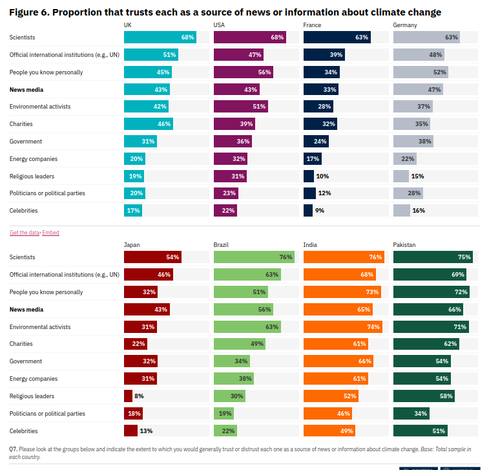
@madsejsing @OpenlyBiased Thanks for the thread and the tag. An addition regarding trustworthiness: Depending on the country, there seems to be a considerable drop in trustworthiness from scientists to activists (how this translates to scientists who are also activists is of course another question). See e.g. this article that came out today https://reutersinstitute.politics.ox.ac.uk/how-we-follow-climate-change-climate-news-use-and-attitudes-eight-countries
How we follow climate change: climate news use and attitudes in eight countries

Reuters Institute for the Study of Journalism

@SGruninger @OpenlyBiased Thanks for sharing! It's a really good point. That was part of the reason why I noted in the original thread that the conditions of doing science activism are going to look very different depending on the context. And probably across policy topic as well, as Leandra suggested.

On a side note: Interesting how trustworthy environmental activists are perceived in India and Pakistan. Do they address it in the article? Looking forward to reading it!

@madsejsing @OpenlyBiased No, it's mainly a description of the survey results, not the causes behind it. But I'd also be quite interested in finding out why such differences arise...

@madsejsing thanks for following and for your interesting intro about you and research in this area.

I can add this one, too, on institutional responsibilities for structurally making activism possible and likely, reducing frictions such as time, career anxieties, etc.

https://www.frontiersin.org/articles/10.3389/frsus.2021.679019/full

#activism #ScientistRebellion #XR #CSR #AcademicFreedom #BiodiversityCrisis #ClimateCrisis

From Publications to Public Actions: The Role of Universities in Facilitating Academic Advocacy and Activism in the Climate and Ecological Emergency

Thousands of universities have made climate emergency declarations; however the higher education sector is not rising to the collective challenge with the urgency commensurate with scientific warnings. Universities are promoting an increased focus on sustainability through their research, teaching and their own institutional footprints. However, we suggest that such initiatives will be insufficient to catalyse the required transformations in our societies and economies because of (i) the time lags inherent in education and research pathways to impact, and (ii) their failure to address either real-world political processes or the forces invested in maintaining the status quo. We therefore suggest that academics should move from publications to public actions and engage in advocacy and activism to affect urgent and transformational change. We discuss the barriers to engagement in advocacy that academics face, and propose a number of actions that universities should adopt to help overcome them. These include explicitly recognising advocacy as part of the work mandate of academic staff by altering work allocation models, facilitating engaged research sabbaticals, altering hiring and promotion policies, and providing training to enhance the effectiveness of engagement. In addition, universities must defend the right of academics to engage in protest and push back against emerging threats to academic freedom. Such actions would strengthen a rich tradition of academic protest and...

Frontiers
@paulpeace Thanks for sharing. I actually talked about that piece in the talk I did. Charlie Gardner is great! 😊
@madsejsing yes, I follow him on Twitter. Is he on here?

@madsejsing @academicchatter @politicalscience @sociology

thank you for sharing and all your work. look forward to reading thread and learning more.

i'm not in academia but wanted to see what/how to bring this into my #PublicHealt work.

@BeTongLen You're very welcome. I'd be curious how this translates to other arenas for sure! 😊
I see the "change tactics" as the most important and first thing to do for every researcher. #OpenScience
Also see:
https://mastodon.social/@LudwigHuelk/109364434894685408

@madsejsing @academicchatter @politicalscience @sociology

I have a session every year in my 4th year energy policy and governance course on the role of the scientist in society, including the role of activism. It's always an interesting discussion as the course is mainly students getting science (natural resource conservation or forestry) or engineering degrees.